
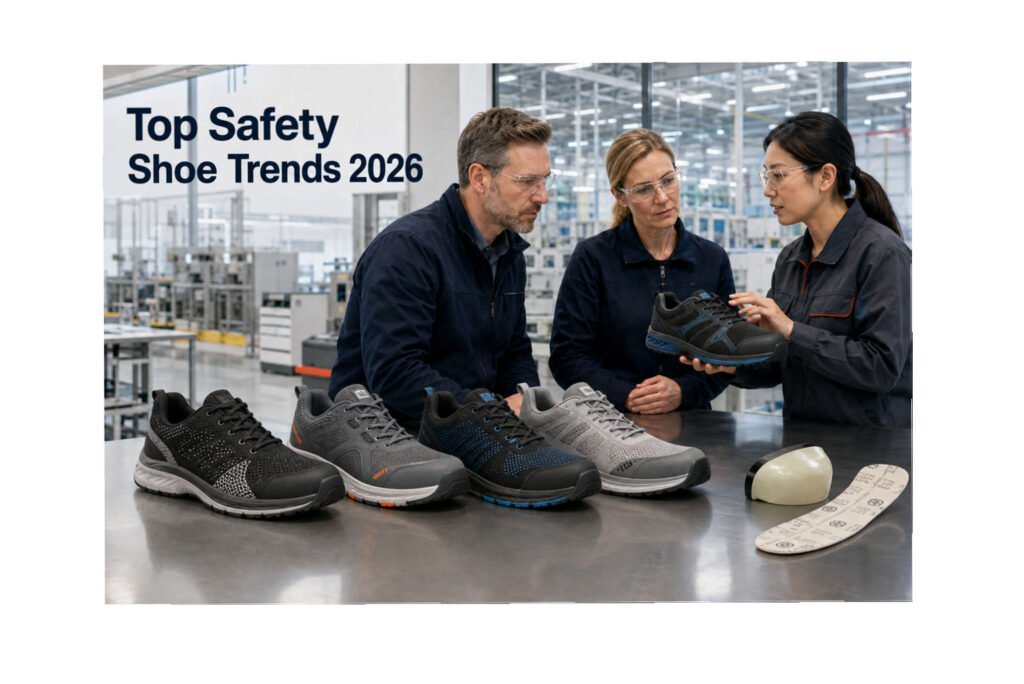
Top Safety Shoe Trends 2026: What Workers, PPE Buyers and Safety Managers Need to Know
Safety footwear in 2026 is moving beyond the traditional formula of a heavy leather upper, steel toe cap and thick industrial outsole.
Protection is still the foundation. Workers continue to face hazards from falling objects, sharp materials, slippery floors, electrical risks, heat and demanding outdoor conditions. OSHA, for example, requires protective footwear where workers face dangers from falling or rolling objects, objects piercing the sole, or certain electrical hazards.¹
What is changing is how that protection is delivered.
Workers increasingly expect lighter weight, better cushioning and more comfortable fitting. PPE buyers are paying greater attention to certification, traceability and product specialization. At the same time, regulatory developments in Europe are increasing interest in sustainability information and digital product data.
For safety footwear brands and manufacturers, these developments are influencing materials, lasts, outsole construction, closure systems and even how new products are tested and documented.
Here are 12 important safety shoe trends for 2026 and what they mean for workers, PPE buyers and safety managers.
1. Sport-Inspired Safety Shoes Continue to Grow
One of the clearest safety shoe trends in 2026 is the continued movement toward footwear that looks and feels more like an athletic shoe.
Traditional leather safety boots remain important in construction, mining and heavy industry. But workers in warehousing, logistics, light manufacturing and automotive environments often spend thousands of steps per shift on relatively predictable surfaces.
For these applications, lighter constructions are becoming increasingly attractive.
Modern sport-inspired safety footwear may combine:
- engineered mesh or knitted textile uppers
- TPU reinforcement around high-wear areas
- fiberglass or other composite toe caps
- non-metallic penetration-resistant inserts
- cushioned EVA midsoles
- slip-resistant rubber outsoles
- breathable mesh linings
The important point is that athletic styling should not replace hazard protection.
ISO describes ISO 20345:2021 as covering basic and additional requirements for general-purpose safety footwear, including mechanical risks, slip resistance, thermal risks and ergonomic behaviour.²
That last point is particularly relevant to the development of modern safety sneakers: protection and wearability need to be considered together.
2. Composite Protection Supports Lighter Footwear
Steel toe caps remain widely used because they offer established performance and are well suited to many heavy-duty applications.
But lightweight footwear is increasing demand for non-metallic protection.
Fiberglass and other composite toe caps can help reduce weight and support metal-free designs. Textile penetration-resistant components can also be incorporated into lighter and more flexible footwear constructions when appropriate to the required certification.
These technologies are especially relevant for:
- warehouse workers
- logistics employees
- light manufacturing
- airport-related environments
- workers walking long distances
- sporty safety footwear
This does not mean composite toe caps are replacing steel everywhere.
A better 2026 product-development approach is to ask:
Which protection system is best suited to the worker, workplace and required standard?
A heavy-duty leather construction boot and a lightweight warehouse safety sneaker do not necessarily need the same solution.
3. All-Day Comfort Becomes Part of PPE Procurement
Comfort is moving from a marketing benefit toward a genuine product-development requirement.
Workers may wear safety footwear for eight, ten or twelve hours. During that time, footwear weight, fit, cushioning, flexibility and internal construction can all influence the wearing experience.
This means buyers are paying greater attention to:
Footbeds
PU and other cushioned footbeds can provide additional underfoot comfort.
Midsoles
EVA and PU cushioning systems can help create a softer walking platform than highly rigid constructions.
Padded Areas
Appropriate collar and tongue padding can improve comfort around the ankle and instep.
Weight
Removing unnecessary weight becomes especially noticeable for workers who walk throughout the day.
Last Design
The last determines much more than the size number. Toe space, heel fit, forefoot width and instep volume all influence how the footwear fits.
The trend is straightforward:
A technically protective shoe also needs to be wearable for the job it was designed to perform.
4. Slip Resistance Becomes More Application-Specific
The words “non-slip” or “anti-slip” are no longer detailed enough for a professional safety footwear specification.
Workplace surfaces vary considerably.
A warehouse employee may work primarily on smooth industrial flooring. A mechanic may encounter oil contamination. Food-processing workers can face wet surfaces, while construction workers regularly move between concrete, soil and uneven outdoor ground.
As a result, outsole development increasingly needs to consider:
- tread geometry
- contact area
- flex channels
- liquid drainage
- heel geometry
- outsole compound
- abrasion resistance
- actual workplace surface
ISO 20345:2021 specifically includes slip resistance among the areas covered by the standard.²
But passing a standardized test should not be interpreted as meaning one outsole is ideal for every real-world environment. Laboratory performance and workplace suitability need to be considered together.
For OEM buyers, a better development brief is therefore:
“We need footwear for warehouse workers using smooth floors where occasional water and oil contamination can occur.”
rather than simply:
“We need a non-slip outsole.”
That gives the footwear developer useful information about the real application.
5. Waterproof Claims Become More Precise
Another trend is more careful use of the words water-resistant and waterproof.
A water-resistant leather upper may perform well against limited moisture exposure, but that does not automatically make the complete boot waterproof.
A more comprehensive waterproof construction can involve:
- water-resistant upper materials
- waterproof membrane or bootie construction
- controlled seams
- appropriate lining construction
- correct lasting and assembly
- production inspection
This distinction matters for construction, utilities, landscaping, agriculture and outdoor work.
It also matters for B2B product descriptions.
Professional buyers increasingly need to understand how the footwear achieves the claimed performance, rather than relying on a single marketing term.
For manufacturers, waterproof performance therefore begins with product engineering, not the final product-page description.
6. Dial, Zip and Quick-Fastening Systems Expand
Traditional laces remain practical, inexpensive and widely accepted.
But faster closure systems continue to gain attention.
Rotary Dial Systems
Dial-based systems allow workers to tighten and release footwear quickly. They are particularly well suited to modern sport-inspired safety shoes.
Side-Zip Work Boots
Side zippers remain important in ankle and mid-cut work boots, particularly in markets such as Australia.
They allow the wearer to retain the adjustable fit and appearance of laces while making daily entry and removal faster.
Hybrid Systems
Laces, zippers, hook-and-loop components and other systems can also be combined depending on the intended user.
The important consideration is durability.
A closure that is operated repeatedly throughout a working week must be evaluated as a functional component—not simply a visual design feature.
7. Safety Footwear Becomes More Job-Specific
The market is gradually moving away from the idea that one generic steel-toe boot is suitable for every worker.
Different workplaces create different priorities.
Warehousing and Logistics
Light weight, flexibility, cushioning and slip resistance may be particularly important.
Construction
Durable leather, toe protection, penetration resistance and abrasion protection can take priority.
Outdoor Work
Water protection, outsole grip and upper durability become more important.
Hot Environments
Heat-resistant outsole performance may become a key specification.
This application-based approach is supported by workplace safety regulation.
OSHA’s U.S. foot-protection rule, for example, ties protective footwear to actual hazards such as falling or rolling objects, sole penetration and electrical hazards.¹
That provides a useful product-development principle:
Start with the hazard and the worker—not with a generic shoe catalogue.
8. Updated Standards Influence Product Development Earlier
Certification is increasingly becoming an early product-development decision rather than something discussed after the shoe has been designed.
ISO currently lists ISO 20345:2021 as the published international standard for general-purpose safety footwear. It covers basic and additional requirements including mechanical risks, slip resistance, thermal risks and ergonomic behaviour.²
Importantly for a 2026 article, ISO also published ISO 20345:2021/Amd 1:2024 in January 2024.³
The U.S. system is different. ASTM currently lists ASTM F2413-24, which establishes minimum performance requirements for protective safety-toe footwear across several workplace hazards. ASTM also notes that changes to original safety-footwear components, such as certain replacement inserts or resoling, could result in footwear no longer meeting the standard.⁴
This highlights something particularly important for OEM projects:
Tested construction and production construction need to remain aligned.
Before selecting a toe cap, penetration-resistant component, outsole or complete construction, buyers should therefore define:
- target country
- applicable standard
- required protection
- workplace hazards
- certification strategy
- documentation requirements
This is especially important when one footwear platform is intended for several markets.
For detailed explanations of ASTM, EN ISO 20345 and Australian requirements, buyers should use a dedicated safety footwear standards guide rather than treating a trends article as a complete certification manual.
9. Sustainability Claims Need Better Evidence
“Sustainable safety shoes” sounds attractive.
But in 2026, broad environmental language without supporting information is becoming less useful to professional buyers.
Instead, brands increasingly need to ask what actually changed.
Possible areas include:
- more efficient material cutting
- reduced production waste
- improved chemical management
- water-based or lower-impact adhesive systems where technically suitable
- reduced packaging
- improved material documentation
- longer-lasting construction
- better supply-chain information
European regulation provides an important reason to watch this area.
The EU’s Ecodesign for Sustainable Products Regulation (EU) 2024/1781, or ESPR, establishes a framework under which product requirements can address areas such as durability, environmental impacts, substances of concern and product information.⁵
This does not mean that every safety shoe suddenly has identical new sustainability requirements.
It does mean that the direction of travel is toward better-supported product and environmental information.
For PPE brands, claims such as “eco-friendly” will increasingly be less useful than specific statements that can be documented.
10. Traceability and Digital Product Data Become More Important
Traceability may become one of the most significant long-term changes affecting footwear sourcing.
The EU’s ESPR establishes the framework for a Digital Product Passport (DPP). The regulation defines a DPP as product-specific data accessible electronically through a data carrier and establishes requirements concerning how such information can be structured and accessed under applicable delegated acts.⁵
For safety footwear buyers, the wider direction is important even before every product-specific requirement is finalized.
Manufacturers may increasingly need better control of information such as:
- product identity
- material specifications
- critical component suppliers
- batch information
- test reports
- certification documents
- production records
- quality-control results
- sustainability information
This also connects directly to safety footwear quality control.
Imagine that a certified shoe was tested using a particular toe cap, penetration-resistant insert and outsole construction.
If critical components are changed during mass production without proper control, the production footwear may no longer correspond to the tested specification.
ASTM F2413-24 itself warns that changes to original components can affect conformity with its requirements.⁴
For PPE buyers, traceability therefore is not just a future digital trend.
It answers a very practical question:
Can the manufacturer demonstrate that the product being produced matches the specification that was approved?
A Note About Digital Product Passports
It would be inaccurate to claim that every safety shoe sold in Europe already requires a Digital Product Passport in 2026.
The ESPR creates the framework, while detailed obligations depend on applicable product-specific measures.⁵
For a professional B2B article, that distinction is important.
11. Better Fit Options Become More Important
Safety footwear ranges are also becoming more diverse in fit.
Historically, many industrial footwear collections were built mainly around men’s lasts and then extended into smaller sizes.
That approach does not necessarily create the best fit for every worker.
Buyers are increasingly interested in:
- wider fitting options
- women’s-specific lasts
- smaller sizes
- improved heel fit
- more appropriate toe-box volume
- market-specific last development
This is particularly relevant in Australia, where many work-boot buyers expect generous fitting suitable for long working shifts.
Other markets and footwear categories may require different shapes.
For OEM development, the lesson is simple:
The last is a functional part of the safety shoe—not just a tool used to determine shoe size.
12. Smaller MOQ and Faster Development Support Private-Label Brands
A final trend is occurring behind the product itself.
Private-label safety footwear development is becoming more flexible.
Traditionally, new shoe development could require relatively large initial quantities, particularly where new cutting dies, outsole tooling or specialized materials were involved.
Modern production technology can reduce some of these barriers.
At Ocean Safety Shoes, for example, automated cutting allows upper components to be produced without relying exclusively on traditional cutting dies. For suitable OEM/ODM projects, we can support flexible trial quantities starting from approximately 300 pairs, depending on materials, outsole construction, certification and customization requirements.
This allows buyers to:
- test a new safety shoe concept
- introduce a new color
- evaluate a new market
- build a smaller private-label range
- collect customer feedback before scaling
Smaller MOQ does not mean every customized safety shoe can economically be produced in tiny quantities. Tooling, certified components, leather, packaging and special materials still influence practical production minimums.
But flexible manufacturing is making product testing easier for some importers and emerging PPE brands.
What These 2026 Safety Shoe Trends Mean for PPE Buyers
Not every trend belongs in every safety shoe.
A construction footwear brand does not need to replace every leather boot with a knitted safety sneaker. A warehouse range does not need the construction of a heavy mining boot.
Instead, trends should help buyers identify where genuine improvements are possible.
Ask five questions:
- Who will wear the shoe?
- What hazards exist in that workplace?
- Which safety standard applies?
- Which new features solve an actual worker problem?
- Can the manufacturer document and consistently produce the approved specification?
This approach separates useful innovation from unnecessary product features.
A lightweight composite construction is valuable when weight matters.
A side zipper is useful when workers frequently remove their boots.
A waterproof membrane matters when the workplace is genuinely wet.
And better traceability matters when product compliance depends on maintaining consistent components.
2026 Safety Footwear Development Checklist
Before developing a new collection, PPE brands and importers should consider:
Worker and Application
- What industry is the footwear designed for?
- How many hours will workers typically wear it?
- What surfaces and environmental conditions will they encounter?
Protection and Compliance
- What workplace hazards exist?
- Which standard and classification apply?
- Are the proposed protective components appropriate for the target certification?
Comfort and Fit
- Does the last suit the target market?
- Is a wide-fit or women’s-specific option required?
- Can unnecessary weight be reduced?
Product Usability
- Would a dial or side zipper improve daily use?
- Is genuine waterproof construction required?
- Is the outsole designed around the intended workplace?
Supply Chain
- Can critical components be traced?
- Are production specifications controlled?
- Can certification-related documents be linked to the correct model?
Commercial Development
- Is a smaller trial order appropriate?
- Can the design scale into a larger product family?
- Are sustainability claims specific and supportable?
Ocean Safety Shoes: Turning Safety Footwear Trends into Practical Products
At Ocean Safety Shoes, we combine product development with approximately 15 years of experience manufacturing safety footwear for the Australian market.
That experience has given our team practical knowledge of Australian-style work boots, including wide-fit lasts, leather uppers, side-zip constructions, TPU scuff protection and durable industrial outsole systems.
At the same time, our newer development work increasingly includes sport-inspired safety footwear using mesh or knitted uppers, fiberglass toe caps, non-metallic penetration-resistant components, EVA cushioning, rubber outsoles and quick-fastening systems.
Our manufacturing capability includes four injection lines and two cold-cement lines, with total daily production capacity of approximately 5,000 pairs.
For OEM and ODM projects, however, manufacturing capacity is only one part of the process.
The target market, safety standard, worker profile, product construction and certification strategy should ideally be discussed before samples are finalized. This helps ensure that new design trends are introduced for a practical reason rather than simply added as marketing features.
Frequently Asked Questions About Safety Shoe Trends 2026
What is one of the biggest safety shoe trends in 2026?
The shift toward lighter, more comfortable and more job-specific footwear continues to be important. Sport-inspired designs, composite protection and improved cushioning are particularly relevant in logistics, warehousing and light industrial applications.
Are lightweight safety shoes replacing traditional work boots?
No. Leather safety boots remain important for construction and other demanding environments. Lightweight footwear is expanding mainly in applications where mobility, flexibility and reduced weight provide practical advantages.
Why is traceability becoming more important in safety footwear?
Certification and quality control depend on consistency between the tested product and mass production. Better component and production records can help buyers verify that critical materials remain consistent.
Does every safety shoe in Europe need a Digital Product Passport in 2026?
No. The EU ESPR establishes the Digital Product Passport framework, but detailed requirements depend on applicable product-specific measures.⁵
Are safety footwear standards still changing?
Yes. ISO 20345:2021 remains published and ISO issued Amendment 1 in 2024.² ³ Buyers should therefore check the applicable standard and certification requirements rather than relying on specifications copied from old catalogues.
What should PPE buyers focus on when developing a 2026 collection?
Start with the worker, workplace hazards and target market. Then evaluate protection, certification, comfort, fit, outsole performance, traceability and whether new technologies solve a genuine problem.
Conclusion: Safety Footwear in 2026 Is Becoming More Specialized
The most important development in safety shoe trends for 2026 is not one particular material.
It is the movement toward more specialized safety footwear.
Workers want lighter and more comfortable products. PPE buyers want footwear designed around specific workplaces. Composite technologies are supporting lighter constructions. Quick-fastening systems are improving convenience. Standards continue to influence product development, while sustainability claims and supply-chain information are receiving greater scrutiny.
At the same time, traceability is becoming more important as buyers seek stronger connections between product specifications, certification documents and mass production.
The best response is not to put every new feature into one safety shoe.
It is to select the right innovation for the right worker.
Planning a new safety footwear collection for 2026? Contact Ocean Safety Shoes to discuss OEM/ODM development, Australian-style work boots, lightweight safety shoes, private-label production, samples and flexible order quantities.
Authoritative References
1. OSHA — 29 CFR 1910.136, Foot Protection
U.S. Occupational Safety and Health Administration.
2. ISO — ISO 20345:2021, Personal Protective Equipment — Safety Footwear
International Organization for Standardization.
3. ISO — ISO 20345:2021/Amd 1:2024
International Organization for Standardization, published January 2024.
4. ASTM International — ASTM F2413-24, Standard Specification for Performance Requirements for Protective (Safety) Toe Cap Footwear
5. European Union — Regulation (EU) 2024/1781, Ecodesign for Sustainable Products Regulation (ESPR)