
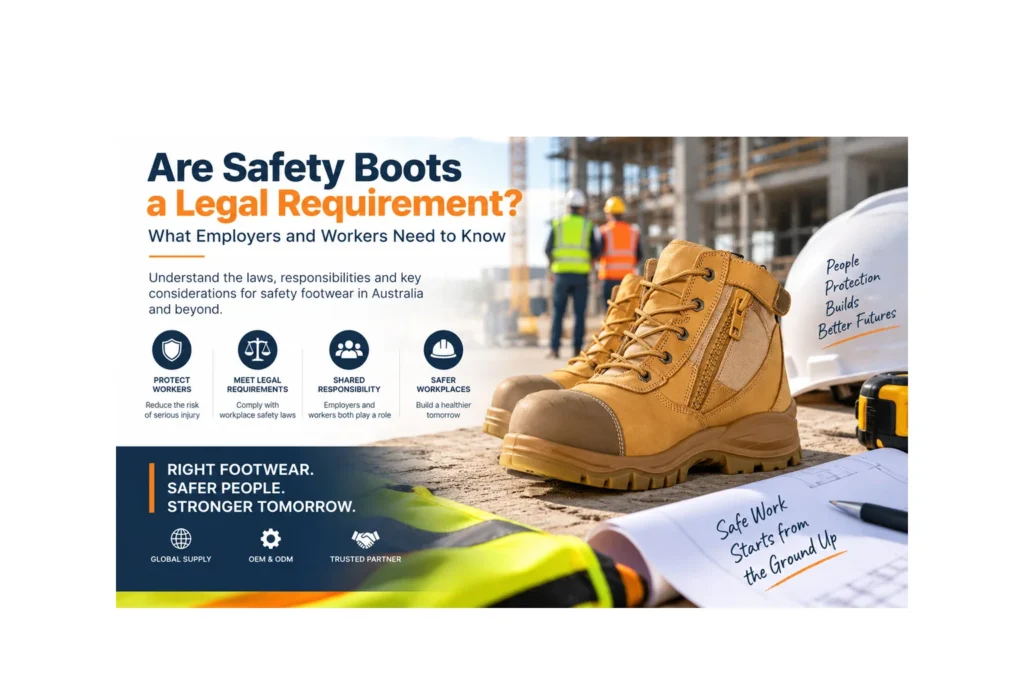
Imagine a worker arriving at a construction site wearing ordinary trainers.
The site manager takes one look at the footwear and says:
“You can’t work here without safety boots.”
That situation raises a common question among workers, employers and PPE buyers:
Are safety boots actually a legal requirement, or are they simply a company rule?
The answer is more nuanced than a simple yes or no.
In many countries, there is no universal law saying that every worker in every workplace must wear safety boots. Instead, workplace safety laws generally require employers to identify hazards, control risks and provide appropriate personal protective equipment when those risks cannot be adequately controlled by other means.
If a workplace risk assessment identifies hazards that could injure a worker’s feet, suitable safety footwear may become a legal requirement for that job or workplace.
In Australia, for example, Safe Work Australia identifies safety boots as a form of personal protective equipment (PPE). Under the model Work Health and Safety Regulations, a person conducting a business or undertaking must provide workers with appropriate PPE when it is required, unless another PCBU has already provided it.
The same general principle can be seen internationally. In the United States, OSHA requires protective footwear where workers face specified hazards such as falling or rolling objects, penetration through the sole or certain electrical hazards.
So the better question is not simply:
“Does the law require safety boots?”
It is:
“Does the work expose employees to foot hazards that require protective footwear as part of the workplace risk controls?”
For many construction, manufacturing, warehousing, engineering, mining and industrial jobs, the answer will be yes.
Are Safety Boots a Legal Requirement in Australia?
Safety boots can be legally required in Australian workplaces when they are necessary to manage identified health and safety risks.
However, Australian workplace safety legislation does not simply state that every employee must wear steel toe boots.
The requirement depends on the risks associated with the work.
Safe Work Australia explains that PPE includes items such as hard hats, gloves, respirators, high-visibility clothing and safety boots. Under the model WHS framework, the PCBU must provide PPE if workers need it and must ensure that the PPE is appropriate for the worker and the task.
This means that if a risk assessment identifies a significant possibility of foot injury and protective footwear is required as part of the risk-control strategy, the employer cannot simply ignore that risk.
The footwear needs to be suitable for the hazards involved.
That could mean different things in different workplaces.
A warehouse employee may need impact-resistant and slip-resistant footwear.
A construction worker may require toe protection and penetration resistance.
A worker exposed to wet outdoor conditions may need waterproof safety boots.
Someone working around electrical hazards may require footwear with appropriate electrical properties as part of a broader electrical safety system.
The law focuses on controlling risk—not simply on requiring a particular style of boot.
Australia Does Not Have One Single Workplace Safety Law
Another important point for Australian employers is that Safe Work Australia is not itself the workplace safety regulator.
Safe Work Australia develops national WHS policy and model laws, but Commonwealth, state and territory authorities regulate and enforce workplace health and safety laws.
Most Australian jurisdictions have implemented laws based on the model WHS framework, although local legislation can differ.
Victoria operates under its own Occupational Health and Safety framework rather than the model WHS laws.
WorkSafe Victoria states that employers must provide and maintain a working environment that is safe and without risks to health so far as reasonably practicable. It also notes that employees must cooperate with employer safety measures, including using PPE such as safety boots when instructed.
Therefore, businesses should always verify the specific requirements applying in the state or territory where the work is being performed.
Does Every Worker Need Safety Boots?
No.
Safety footwear should be selected according to workplace hazards rather than simply according to job titles.
Consider two employees working for the same manufacturing company.
The first works in an administrative office.
The second works on the production floor around forklifts, pallets, machinery and heavy materials.
Although both employees work for the same company, their foot-protection requirements may be completely different.
The office employee may have no significant occupational foot hazards.
The production employee may face:
- Falling materials
- Rolling equipment
- Sharp objects
- Slippery floors
- Oils
- Machinery
- Heavy components
Safety boots may therefore be necessary for the production worker even though they are unnecessary for the office employee.
This risk-based approach is one of the most important concepts for employers and PPE buyers to understand.
When Do Safety Boots Become Necessary?
Protective footwear should be considered when workers are exposed to hazards capable of causing foot injuries.
Common situations include the following.
Falling Objects
Construction materials, tools, boxes, steel components and machine parts can all cause serious injuries if dropped onto a worker’s foot.
Protective toe caps can help reduce the risk of crushing or impact injuries.
Rolling Objects
Warehouses, workshops and industrial facilities frequently contain:
- Trolleys
- Carts
- Drums
- Pallets
- Equipment
- Heavy components
A worker’s feet may be exposed when objects roll or move unexpectedly.
Sharp Objects
Construction and demolition sites may contain nails, screws, metal fragments and other sharp debris.
In such environments, a protective toe cap alone may not be enough.
Footwear may also require a penetration-resistant midsole.
Slippery Surfaces
Workers may encounter:
- Water
- Oil
- Grease
- Chemicals
- Dust
- Food products
- Smooth industrial floors
Slip-resistant safety footwear can form part of a broader strategy for controlling slip risks.
It should not, however, replace basic controls such as cleaning spills, maintaining floors and removing hazards.
Safe Work Australia emphasises that PPE is one of the lower-level controls in the hierarchy of controls and should not be relied upon as the only way of managing workplace risks.
Electrical Hazards
Certain workplaces may require footwear designed for specific electrical conditions.
However, employers should be careful with terms such as:
- Electrical hazard
- Electrically insulating
- Conductive
- Antistatic
- ESD
These terms do not necessarily mean the same thing.
Selecting the wrong electrical property can be inappropriate for the workplace.
Safety footwear should therefore be chosen according to the actual electrical risk assessment and applicable regulations.
Heat and Hot Surfaces
Workers in foundries, welding environments, roadwork and other high-temperature industries may require footwear designed for heat exposure.
Ordinary safety sneakers may not provide adequate protection in these environments.
Chemicals
Some jobs involve acids, oils, fuels or other chemicals.
Safety boots should be selected according to the specific substances involved.
A boot described as “chemical resistant” should not automatically be assumed to resist every industrial chemical.
Manufacturers’ technical data should be checked carefully.
Are Steel Toe Boots Legally Required?
Not necessarily.
This is another common misunderstanding.
The legal requirement is typically for suitable protective footwear, not specifically for steel toe caps.
Depending on the relevant safety standard and product design, toe protection may be provided using different materials.
Common options include:
- Steel toe caps
- Composite toe caps
- Fibreglass toe caps
- Other tested non-metallic protective toe systems
What matters is whether the complete footwear provides the required level of protection.
For example, a properly certified composite toe safety shoe may be perfectly suitable in a workplace where impact-resistant footwear is required.
This is particularly useful in industries where workers prefer:
- Lightweight footwear
- Metal-free designs
- Athletic-style safety shoes
Employers should therefore avoid writing policies that unnecessarily specify “steel toe boots” when the actual requirement is compliant protective footwear—unless steel toe construction is specifically necessary for the application.
Are Safety Shoes and Safety Boots the Same Legally?
The distinction between a shoe and a boot is often less important than the protection provided.
Safety footwear may include:
- Low-cut safety shoes
- Safety sneakers
- Ankle safety boots
- Lace-up work boots
- Chelsea safety boots
- Side-zip safety boots
- Waterproof industrial boots
- Gumboots
A low-cut safety shoe can potentially provide suitable toe and sole protection in some workplaces.
In other environments, a higher boot may be preferable because workers also need:
- Ankle coverage
- Water resistance
- Additional stability
- Debris protection
- More durable uppers
The workplace risk assessment should determine what is appropriate.
A warehouse worker does not automatically need the same footwear as a mining worker simply because both require PPE footwear.
What Does Australian WHS Law Say About Providing PPE?
Under the model WHS framework, when PPE is required, the employer or other responsible PCBU has several important responsibilities.
Safe Work Australia states that the PCBU must provide PPE where it is needed unless it has been provided by another PCBU. The PPE should be suitable for the nature of the work and associated hazards and should be reasonably comfortable and properly fitted for the worker.
The responsibility does not end when a box of safety boots is handed to an employee.
PPE also needs to be appropriately maintained and replaced so that it continues to minimise risk. Workers must receive information, training and instruction about how to use, wear, store and maintain PPE correctly.
This has important implications for businesses purchasing safety footwear.
Buying the cheapest available safety boots may not satisfy the underlying safety objective if the boots:
- Do not match the workplace hazard
- Fit poorly
- Are uncomfortable
- Deter workers from wearing them correctly
- Deteriorate quickly
- Lack appropriate protection
Fit and usability are part of effective PPE selection.
Does the Employer Have to Pay for Safety Boots in Australia?
Under the model WHS approach, workers should not have to personally bear the cost of PPE required for their work.
Safe Work Australia explains that the PCBU can purchase and provide the PPE directly or provide a PPE allowance. Even where an allowance is used, the PCBU remains responsible for ensuring that the PPE fits correctly, is reasonably comfortable and provides appropriate protection.
This is important.
An employer cannot necessarily avoid its PPE responsibilities simply by giving workers money and telling them to buy whatever boots they prefer.
The footwear still needs to satisfy the workplace safety requirements.
Businesses operating in Australia should check their local jurisdiction, industrial arrangements and employment conditions for specific obligations.
Can an Employer Make Safety Boots Mandatory?
Yes.
If an employer has determined through its risk-management process that safety boots are required, workers can generally be instructed to wear the appropriate footwear while carrying out relevant work.
This often appears in:
- Site safety rules
- PPE policies
- Induction requirements
- Safe work procedures
- Contractor requirements
For example, a construction site may require anyone entering the active work area to wear compliant safety footwear.
That rule may apply even to someone who only expects to remain on site briefly.
Why?
Because the hazard exists regardless of how long the person intends to stay.
In Victoria, WorkSafe specifically notes that employees are expected to cooperate with workplace safety measures and use PPE such as safety boots when instructed.
Can a Worker Refuse to Wear Safety Boots?
Workers may have genuine concerns about PPE, particularly where footwear causes pain, does not fit correctly or is unsuitable for a medical or physical reason.
These concerns should be addressed rather than ignored.
However, where suitable protective footwear is legitimately required for workplace safety, simply refusing to wear it can create serious safety and employment issues.
Workers also have responsibilities to follow reasonable workplace safety procedures and use supplied PPE correctly.
Employers should consult workers during PPE selection wherever possible.
This can improve:
- Fit
- Comfort
- Worker acceptance
- Compliance
- Identification of practical problems
Providing workers with a choice between several approved footwear styles can sometimes achieve better results than imposing one model on everybody.
What Happens If Safety Boots Are Uncomfortable?
Uncomfortable footwear should not simply be accepted as inevitable.
Poorly fitted safety boots can create problems such as:
- Blisters
- Heel rubbing
- Toe pressure
- Foot fatigue
- Hot spots
- Difficulty walking
- Worker resistance to PPE
Safe Work Australia specifically states that PPE should be reasonably comfortable and suitable for the worker and the task.
For large organisations, footwear selection should therefore consider different:
- Foot widths
- Foot shapes
- Sizes
- Job roles
- Working environments
Safety managers and procurement departments should look beyond certification alone.
A compliant boot that workers hate wearing can create its own practical problems.
Which Australian Standard Applies to Safety Footwear?
Australian buyers commonly encounter the AS 2210 / AS/NZS 2210 family of standards relating to occupational protective footwear.
Product standards help define performance requirements and testing for characteristics such as protective toe performance and other safety properties.
However, an important legal distinction should be understood.
An Australian Standard is not automatically a legal requirement simply because the standard exists. Standards may become particularly important when legislation, regulations, codes, contractual requirements or workplace specifications refer to them.
For this reason, employers should identify both:
- The legal duties that apply to their workplace.
- The appropriate footwear standard and performance classification for the identified hazards.
The correct question is not simply:
“Does this shoe say safety on the box?”
It should be:
“Does this particular footwear provide the tested protection required for this job and market?”
Industries Where Safety Boots Are Commonly Required
Whether safety footwear is mandatory depends on the specific hazards, but several industries commonly require it.
Construction
Potential risks include:
- Falling tools
- Heavy building materials
- Nails and sharp debris
- Uneven ground
- Wet surfaces
- Machinery
Safety footwear specifications may include toe protection, penetration resistance and slip resistance.
Manufacturing
Workers may face heavy machinery, moving components, forklifts, oil and industrial floors.
Different departments within the same factory may require different safety footwear.
Warehousing and Logistics
Typical hazards include:
- Pallets
- Forklifts
- Trolleys
- Falling packages
- Long periods of walking
- Smooth floors
Lightweight safety shoes and athletic-style protective footwear are increasingly common in these environments.
Mining
Mining can demand significantly more robust footwear because of:
- Rough terrain
- Heavy equipment
- Water
- Mud
- Abrasion
- Extreme working conditions
Heavy-duty safety boots are often more appropriate than low-cut safety sneakers.
Engineering and Maintenance
Technicians may encounter machinery, sharp objects, electrical equipment and industrial surfaces.
The correct footwear depends heavily on the exact role.
Oil and Gas
Workers may require combinations of:
- Impact protection
- Slip resistance
- Oil resistance
- Antistatic properties
- Heat resistance
- Chemical resistance
The footwear specification should be defined carefully because different hazards may require different performance properties.
Are Safety Boots Mandatory on Every Construction Site?
They are extremely common, but the exact requirement should come from the applicable safety rules and risk assessment.
Many construction companies treat safety boots as standard site-entry PPE because active construction environments routinely contain hazards capable of injuring feet.
A typical site PPE rule may require:
- Hard hat
- High-visibility clothing
- Protective footwear
- Eye protection where appropriate
But a company should still understand why the footwear is required.
Good safety management is based on hazard control—not simply repeating a generic PPE checklist.
Are Safety Boots Required for Warehouse Workers?
Not automatically in every warehouse.
The decision depends on the hazards.
A small warehouse handling lightweight cartons may present a different risk profile from a distribution centre operating forklifts, pallet trucks and heavy industrial goods.
Potential hazards to consider include:
- Falling goods
- Rolling pallets
- Forklifts
- Sharp materials
- Slippery floors
- Long walking distances
If protective footwear is necessary, employers should then determine which features are appropriate.
For example, workers who walk all day may benefit from lightweight safety sneakers with protective toe caps rather than unnecessarily heavy work boots.
Protection and comfort should be considered together.
Are Safety Boots Required for Visitors and Contractors?
Potentially, yes.
If a visitor enters an area where protective footwear is required because of workplace hazards, the person may need appropriate PPE regardless of whether they are a permanent employee.
This is why many factories and construction sites maintain:
- Visitor safety boots
- Protective overshoes
- Restricted visitor routes
Contractors should also be included in workplace PPE planning.
Responsibility may depend on workplace arrangements and the relevant WHS duties, so businesses should establish clearly who provides and verifies required PPE before work begins.
What About Safety Boots in the United States?
In the United States, OSHA’s requirements are more explicit regarding foot protection.
Under 29 CFR 1910.136, employers must ensure employees use protective footwear when working in areas where there is danger from falling or rolling objects, objects that may pierce the sole, or certain electrical hazards remaining after other protective measures have been taken.
OSHA’s interpretation also emphasises that the requirement is based on hazard exposure rather than job title.
That principle closely matches good safety-management practice elsewhere.
A job title alone does not determine whether safety footwear is needed.
The hazards do.
Are Safety Boots a Substitute for Other Safety Controls?
No.
This is extremely important.
Safety boots are PPE, and PPE is generally one of the lower levels in the hierarchy of controls.
If a workplace has sharp debris covering the floor, the correct response is not simply:
“Everyone has puncture-resistant boots, so leave it there.”
The debris should be removed where reasonably practicable.
Similarly, if oil is regularly leaking onto a walkway, issuing slip-resistant shoes is not an adequate substitute for fixing the leak and managing the contaminated floor.
Safe Work Australia explicitly describes PPE as one of the least effective risk controls and states that higher-level controls should be considered first.
Safety footwear should therefore support a complete risk-control strategy.
It should not become an excuse for leaving avoidable hazards in place.
Common Mistakes Employers Make With Safety Footwear
One common mistake is assuming that every “safety boot” provides the same protection.
It does not.
A steel toe boot may protect against impact but provide no suitable penetration resistance.
A lightweight warehouse shoe may be comfortable but unsuitable for hot metal environments.
A waterproof boot may protect against rain but not aggressive chemicals.
An antistatic shoe may have very different electrical characteristics from footwear intended for electrical insulation.
Another mistake is buying footwear based only on price.
For B2B procurement teams, the true cost of safety footwear also includes:
- Replacement frequency
- Worker comfort
- Absenteeism associated with foot discomfort
- Product consistency
- Fit problems
- Returns
- Compliance
- Supply reliability
Buying a slightly cheaper boot that needs frequent replacement may not actually reduce total procurement costs.
How Should Businesses Choose Legally Appropriate Safety Footwear?
A practical purchasing process starts with workplace hazards rather than a footwear catalogue.
The process should look something like this:
Hazard assessment → Required protection → Applicable regulations → Safety standard → Footwear style → Fit and comfort → Wearer trial → Supplier evaluation → Ongoing inspection
This sequence helps prevent a common sourcing mistake:
Choosing a product first and trying to justify it afterward.
For large orders, PPE buyers should request product documentation for the exact footwear model being supplied.
Important information can include:
- Test reports
- Certification
- Product markings
- Toe-cap specification
- Penetration resistance
- Outsole performance
- Electrical properties where relevant
- Material details
- Sizing information
Do not assume that every product made by a certified factory automatically has the same certification.
Certification should be checked at product level.
How Often Should Safety Boots Be Replaced?
There is no universal replacement period suitable for every job.
A warehouse employee and a mining worker can wear out footwear at very different rates.
Safety boots should be inspected regularly for signs such as:
- Worn tread
- Sole separation
- Damaged uppers
- Exposed protective components
- Cracked soles
- Damaged toe areas
- Broken closures
- Loss of waterproof performance
- Internal damage
- Excessive deformation
If a shoe has experienced significant impact or damage that may have compromised its protective components, it should be assessed and replaced when necessary.
The fact that the boot still “looks wearable” does not automatically mean it continues to provide the intended protection.
Frequently Asked Questions About Safety Boot Legal Requirements
Are safety boots legally required at work?
They may be. If workplace hazards require protective footwear as part of the risk-control measures, employers can have a legal obligation to provide and require appropriate safety footwear.
Are steel toe boots required by law?
Not universally. The requirement is usually for suitable protective footwear rather than specifically steel toe caps. Composite or other compliant protective toe systems may also be acceptable depending on the workplace and applicable standard.
Does my employer have to provide safety boots?
Under Australia’s model WHS framework, when PPE is required, the PCBU must generally provide it unless another PCBU has done so. An allowance may also be provided, but the employer remains responsible for ensuring the PPE is suitable, fits properly and provides appropriate protection.
Can my employer tell me which safety boots to wear?
Yes. Employers may specify footwear requirements based on workplace hazards, applicable standards and company safety procedures. Workers should use required PPE correctly.
Can I wear my own safety boots?
Potentially, but the footwear should satisfy the employer’s safety specification and applicable workplace requirements. A personal preference for a particular boot does not override hazard-control requirements.
Do office workers need safety boots?
Usually not if they are not exposed to occupational foot hazards. However, an office worker entering an active warehouse, factory floor or construction site may need protective footwear while inside that area.
Do warehouse workers have to wear safety shoes?
It depends on the hazards. Where there is risk from falling goods, rolling objects, penetration or other foot hazards, protective footwear may be necessary.
Are composite toe shoes legally acceptable?
They can be, provided the footwear meets the required performance and certification criteria for the workplace. The protective material itself is less important than the verified performance of the complete footwear.
Can I be sent home for not wearing safety boots?
Where protective footwear is a legitimate site or workplace safety requirement, employers may restrict access to workers who do not have the required PPE. The specific employment consequences depend on workplace policies and applicable laws.
Are safety boots required for visitors?
Visitors entering areas with foot hazards may also need appropriate protective footwear. Many workplaces manage this through visitor PPE or restricted access routes.
Conclusion: Are Safety Boots a Legal Requirement?
Safety boots are not automatically required for every worker, but they can become a legal requirement when workplace hazards make protective footwear necessary.
That distinction is important.
In Australia, workplace health and safety obligations are based on identifying hazards and controlling risks. Safety boots are recognised as PPE, and where PPE is required, businesses have responsibilities regarding provision, suitability, fit, maintenance and worker instruction.
Employers should therefore avoid treating safety footwear as either:
“mandatory everywhere”
or
“just a company preference.”
Neither statement is accurate.
The correct approach is:
Assess the hazard. Determine the required protection. Select appropriate footwear. Verify the relevant standard. Make sure the footwear fits the worker and the job.
For workers, wearing the correct safety footwear can help reduce exposure to crushing, impact, penetration, slip and other occupational foot hazards.
For employers, choosing appropriate footwear is part of a broader workplace safety system—not a replacement for eliminating or controlling hazards at their source.
Sourcing Safety Footwear for Your Workforce or PPE Business
For PPE distributors, importers, wholesalers and businesses sourcing workplace footwear, Ocean Safety Shoes manufactures industrial safety footwear for a wide range of occupational applications.
Our product range includes:
- Steel toe safety shoes
- Composite toe safety shoes
- Lightweight safety sneakers
- Slip-resistant safety footwear
- Penetration-resistant work shoes
- Waterproof safety boots
- Side-zip work boots
- Industrial leather boots
- Sport-style safety footwear
For B2B buyers, the most important starting point is not simply deciding whether workers need “safety boots.”
It is defining the hazards, target market, required protection and expected working environment first.
Ocean Safety Shoes supports OEM and ODM development for PPE distributors and private-label brands, including product specification, materials, colours, branding and packaging.
The objective is straightforward:
Choose footwear because it provides the right protection for the job—not simply because the label says “safety shoe.”