
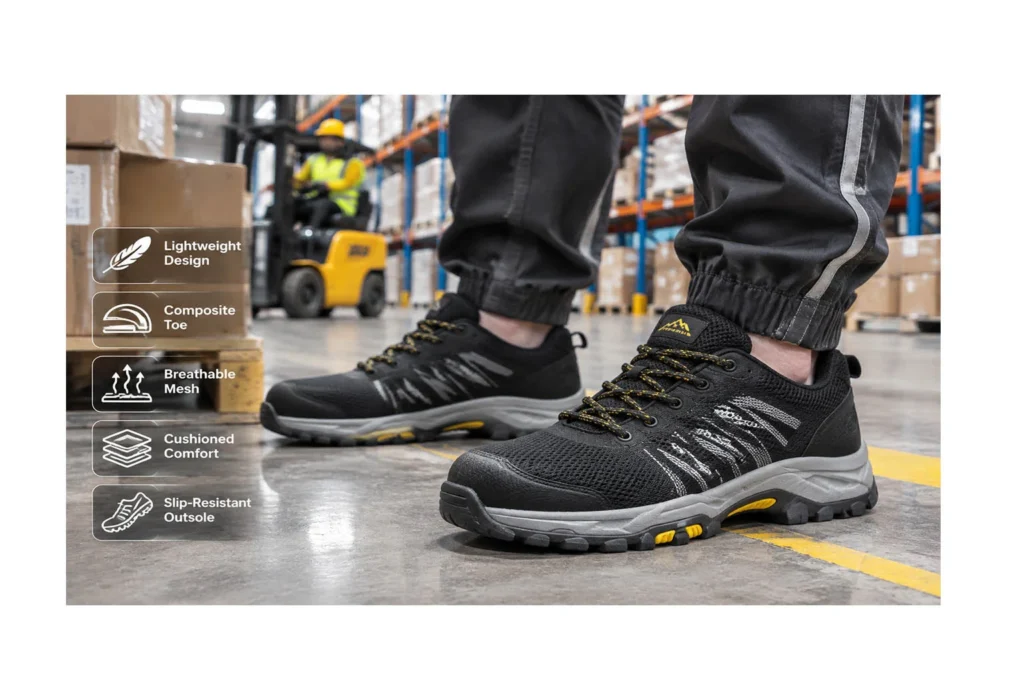
Choosing the right lightweight composite toe safety trainers is becoming an important consideration for warehouse operators, logistics companies, PPE distributors, and workwear retailers in Ireland.
Warehouse employees often spend eight or more hours walking, standing, picking orders, moving goods, and operating around material-handling equipment. Traditional heavy safety boots may not always be the most comfortable option for these working conditions.
Lightweight safety trainers offer an alternative by combining protective toe caps with athletic-inspired designs, breathable uppers, cushioned footbeds, and flexible outsole constructions.
For Irish businesses purchasing safety footwear in bulk, the challenge is finding products that balance protection, comfort, durability, and competitive wholesale pricing.
This guide explores how to evaluate composite toe safety trainers for Irish warehouse environments, what product specifications to consider, how to verify EU compliance, and how to select a reliable manufacturing partner.
It is particularly relevant to:
- Irish warehouse and logistics companies
- PPE distributors and wholesalers
- Workwear retailers
- Safety footwear importers
- Industrial procurement managers
- Private-label footwear brands
- Businesses sourcing lightweight safety footwear in bulk
Table of Contents
- Why Irish Warehouses Need Lightweight Safety Trainers
- What Are Composite Toe Safety Trainers?
- Key Features to Look for in Lightweight Safety Trainers
- Composite Toe vs Steel Toe Safety Trainers
- How to Choose Safety Trainers for Different Warehouse Applications
- EU Safety Standards and Compliance Requirements
- How PPE Distributors Can Source Safety Trainers
- Wholesale Pricing and MOQ Considerations
- Common Buying Mistakes to Avoid
- Frequently Asked Questions
1. Why Irish Warehouses Need Lightweight Safety Trainers
Ireland has a diverse warehousing and logistics sector, including e-commerce fulfilment centres, distribution facilities, food warehouses, manufacturing plants, and transport operations.
Employees in these environments frequently walk on concrete floors, handle cartons, move pallets, and work around forklifts and other industrial equipment.
These activities create several footwear requirements.
Long Working Hours and Continuous Movement
Warehouse employees may spend most of their shifts standing or walking.
Heavy footwear can become uncomfortable during extended periods of use, particularly when the design does not provide appropriate cushioning and support.
Lightweight safety trainers can offer several practical advantages:
- Reduced footwear weight
- Flexible construction
- Athletic-inspired styling
- Breathable upper materials
- Cushioned footbeds
- Comfortable walking performance
However, overall shoe weight and fit depend on the complete construction, not just the toe cap material.
Indoor Working Environments
Many Irish warehouses operate primarily indoors, where employees encounter relatively dry concrete floors, packaging materials, and occasional liquid contamination.
For these environments, buyers may prioritise:
- Suitable slip resistance
- Breathable uppers
- Protective toe caps
- Flexible outsoles
- Lightweight construction
The exact specifications should be determined through the employer’s workplace risk assessment.
Employee Comfort and Footwear Acceptance
Comfort is also an important consideration for warehouse employers.
Footwear that fits properly and feels comfortable throughout a shift can improve employee acceptance and support consistent use.
For distributors, this creates an opportunity to offer modern safety footwear that combines industrial protection with a more familiar sports-shoe appearance.
2. What Are Composite Toe Safety Trainers?
Composite toe safety trainers are protective shoes featuring a non-metallic protective toe cap.
Instead of traditional steel, the toe cap is manufactured using engineered non-metallic materials designed to meet applicable impact and compression protection requirements.
Common composite materials include reinforced polymers and other engineered protective materials.
Main Characteristics of Composite Toe Trainers
Non-metallic toe protection
Composite toe caps provide protective performance without using a traditional steel toe cap.
Potentially lightweight construction
Some composite toe designs can help reduce overall footwear weight, depending on the materials and shoe construction.
Thermal insulation characteristics
Non-metallic materials generally conduct heat and cold less readily than steel. This may be useful in certain working environments.
Modern footwear designs
Composite toe caps can be incorporated into athletic-inspired safety trainers, lightweight work shoes, and industrial footwear.
Typical Product Construction
A lightweight composite toe safety trainer may include the following components:
| Component | Common materials | Main function |
|---|---|---|
| Upper | Mesh, microfiber, textile or synthetic leather | Breathability and structural support |
| Toe cap | Composite material | Impact and compression protection |
| Lining | Breathable mesh | Internal comfort |
| Footbed | EVA, PU foam or other cushioning materials | Cushioning and support |
| Midsole | EVA, PU or other materials | Cushioning and structural support |
| Penetration-resistant insert | Textile or metal | Underfoot penetration protection, where required |
| Outsole | Rubber, PU or combined materials | Traction and durability |
The exact construction varies according to the required safety classification.
Buyers should distinguish between the composite toe cap and the penetration-resistant midsole. They are separate components serving different protective purposes.
3. Key Features to Look for in Lightweight Safety Trainers
When evaluating lightweight safety trainers Ireland businesses may purchase for warehouse employees, several product characteristics deserve particular attention.
Breathable Mesh Uppers
Breathable mesh is a popular material for lightweight safety trainers.
Its open structure can support airflow and help manage heat during extended indoor use.
Potential advantages include:
- Reduced upper weight
- Flexible construction
- Modern sports-inspired appearance
- Breathability
- Comfortable internal environment
However, mesh is not automatically waterproof or suitable for every industrial application.
For workplaces with frequent liquid exposure, buyers should consider more protective upper constructions.
Cushioned Footbeds
A cushioned footbed can improve the wearing experience for employees who spend long periods standing and walking.
Common materials include:
- EVA foam
- PU foam
- High-polyurethane foam
- Removable cushioned insoles
When evaluating samples, consider heel cushioning, arch support, footbed thickness, and overall fit.
Slip-Resistant Rubber Outsoles
Warehouse floors can become slippery because of dust, water, oil, and packaging materials.
A suitable outsole should be selected according to the actual floor conditions.
Important considerations include:
- Rubber compound
- Tread pattern
- Contact area
- Abrasion resistance
- Tested slip performance
- Ease of cleaning
Do not assume that every rubber outsole provides the same slip resistance.
Flexible Construction
A flexible forefoot can improve walking comfort for warehouse employees.
However, flexibility must be balanced with structural stability and the protective requirements of the footwear.
Durable Upper and Toe Protection
Warehouse footwear can experience repeated contact with pallets, cartons, equipment, and other materials.
Look for:
- Reinforced toe areas
- Abrasion-resistant materials
- Strong stitching
- Secure upper-to-sole construction
- Durable heel support
A lightweight design should not sacrifice the durability required by the intended application.
4. Composite Toe vs Steel Toe Safety Trainers
Both composite toe and steel toe footwear can provide certified toe protection when designed and assessed according to the applicable requirements.
The best option depends on the workplace environment, product design, and employee preferences.
| Comparison | Composite toe | Steel toe |
|---|---|---|
| Toe cap material | Non-metallic | Steel |
| Weight | Can be lighter | Often heavier |
| Thermal conductivity | Generally lower | Generally higher |
| Metal content | Non-metallic toe cap | Metallic toe cap |
| Design options | Suitable for modern trainer designs | Available in traditional and modern designs |
| Protection | Depends on certified product performance | Depends on certified product performance |
| Cost | Depends on materials and construction | Depends on materials and construction |
When Should Buyers Choose Composite Toe Trainers?
Composite toe models may be attractive for:
- Indoor warehouse employees
- Order-picking personnel
- Distribution centre workers
- Logistics employees
- Businesses seeking metal-free toe protection
- Employees who prefer lightweight footwear
Are Composite Toe Safety Trainers Completely Metal-Free?
Not necessarily.
Although the toe cap is non-metallic, other components may contain metal.
For example, some footwear models use metallic penetration-resistant midsoles, eyelets, or other components.
If a warehouse requires completely metal-free footwear, request confirmation of the entire product construction.
5. How to Choose Safety Trainers for Different Warehouse Applications
Different warehouse operations require different footwear specifications.
Irish buyers should avoid selecting products based only on appearance or price.
E-Commerce Fulfilment Centres
Employees in e-commerce warehouses may spend long periods walking between storage locations and picking orders.
Potentially suitable features include:
- Lightweight construction
- Composite toe protection
- Breathable mesh
- Cushioned footbeds
- Flexible outsoles
Distribution Centres
Distribution centres often involve pallet movement, loading operations, and interaction with material-handling equipment.
Buyers may need to consider:
- Protective toe caps
- Appropriate outsole grip
- Durable uppers
- Penetration resistance where required
- Secure footwear fit
Food and Beverage Warehouses
Food distribution environments may involve moisture, cleaning procedures, and occasional exposure to liquids.
Consider:
- Suitable slip-resistant outsoles
- Easy-clean upper materials
- Appropriate water-related protection
- Resistance to relevant cleaning conditions
Cold Storage Warehouses
Ordinary lightweight mesh trainers may not provide sufficient thermal protection in cold storage environments.
Businesses should evaluate footwear specifically designed for lower-temperature conditions.
Warehouse Footwear Selection Table
| Warehouse application | Recommended features |
|---|---|
| E-commerce fulfilment | Lightweight construction, breathable mesh, cushioning |
| General distribution | Composite toe, suitable slip resistance, durable upper |
| Pallet handling | Toe protection and penetration resistance where required |
| Food distribution | Easy-clean materials and suitable outsole performance |
| Cold storage | Thermal protection and appropriate traction |
| Outdoor loading areas | More protective upper construction and suitable water-related performance |
Always match the final product specification to the workplace risk assessment.
6. EU Safety Standards and Compliance Requirements
Irish importers and distributors must pay particular attention to EU safety footwear compliance.
Safety trainers placed on the Irish market must meet the applicable requirements of European PPE legislation.
Regulation (EU) 2016/425
Regulation (EU) 2016/425 establishes the requirements for personal protective equipment placed on the EU market.
Safety footwear covered by the regulation must undergo the appropriate conformity assessment before being placed on the market.
The relevant requirements include:
- Product design and protective performance
- Conformity assessment
- Technical documentation
- EU Declaration of Conformity
- CE marking
- Required product identification and instructions
Official guidance:
European Commission – Personal Protective Equipment
EN ISO 20345
EN ISO 20345 is the principal European standard for general-purpose safety footwear.
When purchasing composite toe safety trainers, verify the applicable standard edition and product classification.
The EN ISO 20345:2022 edition introduced updated classifications and requirements.
Depending on the product design, classifications may include:
- S1
- S1P
- S1PL
- S1PS
- S2
- S3
- S3L
- S3S
These classifications represent different combinations of protective features.
For example, S1PS and S1PL distinguish between different types of penetration-resistant inserts.
Do not select a classification simply because it sounds more protective. The correct specification should reflect the workplace hazards.
Documents to Request From Manufacturers
| Document | Purpose |
|---|---|
| EU Declaration of Conformity | Manufacturer’s declaration of compliance |
| EU type-examination certificate | Evidence of the applicable conformity assessment |
| Product test reports | Supports product performance claims |
| Technical documentation | Provides supporting technical information |
| User instructions | Explains intended use and limitations |
| Product identification | Identifies the manufacturer and model |
Check that all documentation relates to the exact model being purchased.
A certificate for another model or product construction should not be assumed to cover your selected trainers.
Important Consideration for Irish Importers
Businesses importing footwear from outside the EU should understand their responsibilities under the PPE Regulation.
Importers must verify the relevant conformity requirements before placing products on the market.
Businesses selling products under their own name or trademark may assume manufacturer responsibilities.
7. How PPE Distributors Can Source Safety Trainers
For Irish PPE distributors and workwear retailers, sourcing the right composite toe safety trainers requires evaluating both the product and the manufacturing partner.
Compare Local Suppliers and Direct Manufacturers
| Purchasing factor | Irish distributor | Direct manufacturer |
|---|---|---|
| Delivery | Often faster for stocked products | Requires international shipping |
| MOQ | May offer smaller quantities | Depends on factory requirements |
| Customisation | Often limited | OEM and ODM options may be available |
| Product selection | Depends on available brands | May offer broader manufacturing options |
| Unit price | Includes distribution costs | Factory-direct pricing may be available |
| Private label | Depends on supplier | Often available through OEM services |
Local distributors may be suitable for immediate replenishment.
Direct manufacturers may be worth considering for larger orders, repeat purchasing, and private-label development.
Evaluate the Manufacturer’s Capabilities
Before choosing a composite toe safety trainers manufacturer, request information about:
- Safety footwear manufacturing experience
- Composite toe product range
- Upper and outsole materials
- Production equipment
- Quality inspection procedures
- OEM and ODM capabilities
- Export experience
- Production capacity
If possible, arrange a factory visit or independent factory audit.
Request Samples Before Bulk Purchasing
Product samples allow buyers to evaluate actual performance and construction.
Check:
- Overall shoe weight
- Toe box space
- Heel fit
- Upper breathability
- Outsole flexibility
- Tread design
- Stitching quality
- Product finishing
- Size consistency
For distributors, testing samples with potential customers can also provide valuable feedback before committing to a large order.
8. Wholesale Pricing and MOQ Considerations
The cost of lightweight composite toe safety trainers depends on several factors.
There is no single wholesale price that applies to every product.
Factors That Affect Manufacturing Costs
| Cost factor | Potential impact |
|---|---|
| Composite toe cap | Material and component costs |
| Upper material | Mesh, microfiber and leather have different costs |
| Outsole construction | Rubber, EVA and PU combinations affect pricing |
| Penetration-resistant insert | Additional protective components increase complexity |
| Product design | Customised construction may require development |
| Logo customisation | Adds branding costs |
| Packaging | Custom boxes and labels affect unit cost |
| Order quantity | Larger production runs may improve unit economics |
Understand MOQ Requirements
Manufacturers may have different MOQ requirements for:
- Existing models
- Custom colours
- Custom logos
- Special materials
- Custom packaging
- Newly developed footwear
Ask for separate MOQ quotations for standard and customised products.
Start With a Focused Product Range
For businesses entering the Irish market, it may be more practical to begin with a small selection of composite toe trainer designs.
For example:
| Product model | Target customer |
|---|---|
| Breathable mesh composite toe trainers | Indoor warehouse employees |
| Lightweight safety sneakers | Logistics and distribution workers |
| Composite toe trainers with penetration-resistant midsoles | Warehouses with underfoot hazards |
This approach can reduce inventory complexity and help identify which models generate the strongest demand.
9. Common Buying Mistakes to Avoid
Choosing Based Only on Weight
A very lightweight shoe is not automatically the best warehouse safety trainer.
Evaluate protection, durability, fit, and outsole performance alongside weight.
Assuming Composite Toe Means Better Protection
Composite toe caps and steel toe caps can both meet applicable protective requirements.
The material alone does not determine the complete safety performance of the shoe.
Ignoring Outsole Performance
Warehouse floors can have different surface conditions and contaminants.
Check the product’s tested slip performance and suitability for the intended workplace.
Overlooking Size and Fit
Different manufacturers may use different lasts and sizing specifications.
Request samples and size charts before confirming a bulk order.
Purchasing Without Checking Compliance Documents
Do not rely on a CE logo or a general factory certificate.
Verify product-specific documentation and applicable conformity assessment requirements.
Ignoring Repeat Supply Capability
For distributors, consistent product specifications and reliable repeat orders are important.
Confirm production capacity, lead times, and material availability before establishing a long-term supply arrangement.
10. Frequently Asked Questions
Are Composite Toe Safety Trainers Suitable for Warehouse Work?
Yes. Composite toe safety trainers can be suitable for many warehouse environments when they meet the applicable safety requirements and provide the protection identified by the workplace risk assessment.
Are Lightweight Composite Toe Safety Trainers Better Than Steel Toe Trainers?
Not necessarily. Composite toe trainers may offer lower weight and reduced thermal conductivity, while steel toe footwear remains a widely used protective option. The best choice depends on product construction, working conditions, and employee preferences.
What Is the EN ISO 20345 Standard?
EN ISO 20345 is the European standard for general-purpose safety footwear. It specifies protective requirements, including toe protection and other relevant performance characteristics.
What Is the Difference Between S1PS and S1PL Safety Trainers?
Both classifications include penetration-resistant protection, but they distinguish between different test methods and insert constructions. Buyers should check the current standard and the manufacturer’s product documentation when comparing models.
Are Composite Toe Safety Trainers Metal-Free?
The composite toe cap itself is non-metallic, but other components may contain metal. If completely metal-free footwear is required, confirm the specifications of every component.
What Materials Are Commonly Used in Lightweight Safety Trainers?
Common materials include engineered mesh, microfiber, textile uppers, EVA cushioning, PU footbeds, composite toe caps, and rubber outsoles. The final construction depends on the required protective classification.
Can Irish Distributors Buy Composite Toe Safety Trainers Directly From China?
Yes. Irish distributors can source products directly from Chinese manufacturers. However, the products must comply with applicable EU PPE requirements, and importers must fulfil their customs and regulatory obligations.
What Should I Check Before Ordering Wholesale Composite Toe Trainers?
Check the protective classification, product-specific documentation, sample quality, materials, shoe weight, size range, MOQ, production lead time, wholesale price, and repeat-order capability.
Can Composite Toe Safety Trainers Be Customised With My Own Brand?
Yes. Manufacturers offering OEM and ODM services may support custom logos, colours, packaging, and product development. The final product must remain compliant with the applicable EU PPE requirements.
Conclusion
Lightweight composite toe safety trainers offer an attractive footwear option for many Irish warehouse and logistics operations.
For PPE distributors, wholesalers, and industrial buyers, the right product should combine suitable protection, comfortable construction, durable materials, and reliable manufacturing quality.
Before placing a bulk order, focus on:
- Selecting footwear for the actual warehouse environment
- Evaluating composite toe protection
- Checking upper breathability and outsole performance
- Prioritising fit and cushioning
- Verifying EN ISO 20345 compliance
- Comparing manufacturers and wholesale quotations
- Testing samples before mass production
- Planning size distribution and repeat orders
A well-selected product range can help Irish distributors serve warehouse customers more effectively while building a competitive safety footwear business.
Source Lightweight Composite Toe Safety Trainers From Ocean Safety Shoes
Ocean Safety Shoes is a professional safety footwear manufacturer serving international B2B customers, including PPE distributors, importers, wholesalers, workwear retailers, and private-label brands.
We provide manufacturing and product development solutions covering:
- Lightweight composite toe safety trainers
- Sport-inspired safety sneakers
- Breathable mesh safety shoes
- Industrial safety footwear
- OEM and ODM manufacturing
- Custom logos and packaging
- Private-label footwear development
Our manufacturing solutions support businesses looking for different footwear designs, materials, protective components, and product specifications.
Explore the Ocean Safety Shoes product range to review available safety footwear styles.
For Irish distributors and importers interested in sourcing composite toe safety trainers, provide the following information when requesting a quotation:
- Required footwear styles
- Preferred upper materials
- Composite toe requirements
- Required safety classification
- Estimated order quantity
- Size assortment
- Logo and packaging requirements
- Target delivery schedule
This information helps us understand your purchasing requirements and recommend suitable manufacturing options.
Looking for a composite toe safety trainers manufacturer for your Irish wholesale business?
Contact Ocean Safety Shoes to discuss product samples, bulk orders, and OEM or private-label manufacturing opportunities.