
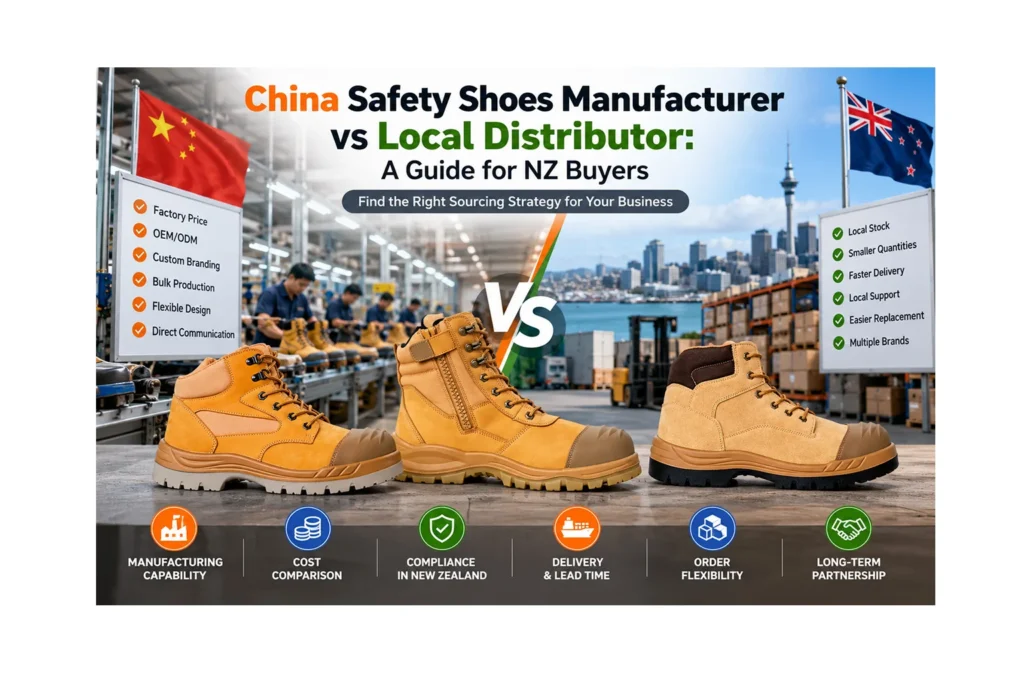
For New Zealand PPE importers, safety footwear retailers, construction suppliers, and industrial procurement teams, sourcing protective footwear involves an important commercial decision: should you purchase directly from a Safety Shoes Manufacturer China or work with a local New Zealand distributor?
Both approaches can support a successful safety footwear business, but they solve different purchasing problems.
A Chinese manufacturer may offer factory-direct production, private-label development, and greater control over product specifications. A local distributor may provide immediate access to stock, smaller purchasing quantities, domestic delivery, and easier replacement arrangements.
For a Wellington-based PPE retailer expanding its product range or an Auckland construction company purchasing safety boots for employees, the right sourcing strategy depends on more than the quoted price per pair.
Buyers need to consider landed costs, inventory commitments, product compliance, delivery schedules, after-sales support, and the ability to respond when demand changes.
This guide examines these considerations specifically for the New Zealand market, helping businesses compare overseas manufacturing with domestic distribution and develop a practical sourcing strategy.
Understanding New Zealand’s Safety Footwear Supply Chain
New Zealand businesses purchase protective footwear through several supply channels. These commonly include overseas manufacturers, local importers, national PPE distributors, specialist footwear wholesalers, and industrial supply retailers.
Although these businesses may sell similar products, their roles within the supply chain differ.
Buying Directly From a Chinese Manufacturer
A Chinese safety footwear manufacturer produces shoes or boots for international customers, either using established product designs or developing customised models.
For New Zealand importers, direct manufacturing relationships can provide access to:
- Factory-direct quotations.
- OEM and private-label footwear.
- Custom branding and packaging.
- Product specifications for different workplace applications.
- Bulk production and repeat-order planning.
- Direct communication about materials and construction.
However, buyers must also manage international purchasing, production schedules, freight arrangements, import clearance, and local inventory.
Buying From a Local New Zealand Distributor
A local distributor imports or purchases footwear and supplies it to businesses within New Zealand.
The distributor typically manages overseas procurement, stockholding, local sales, and domestic fulfilment.
For businesses searching for a safety footwear supplier NZ, this model can offer convenient access to established product ranges without requiring direct international sourcing.
Local distributors may provide smaller orders, faster replenishment of stocked products, local customer service, and simplified purchasing administration.
The trade-off is that buyers may have less influence over product development, manufacturing specifications, and branding.
China Safety Shoes Manufacturer vs Local Distributor: Key Differences
The distinction becomes clearer when comparing the two purchasing models across the factors that matter most to New Zealand businesses.
| Purchasing Factor | Chinese Manufacturer | NZ Local Distributor |
|---|---|---|
| Supply model | Direct factory production | Local stock and distribution |
| Order quantity | Usually production-based MOQ | Often smaller quantities |
| Product customisation | OEM/ODM options may be available | Usually limited to existing ranges |
| Initial lead time | Includes manufacturing and international freight | Shorter for stocked products |
| Pricing | Factory-direct quotation | Includes local distribution costs |
| Inventory responsibility | Usually managed by NZ importer | Distributor may hold inventory |
| Product development | Direct technical communication | Depends on manufacturer relationship |
| Returns and replacements | International arrangements | Local arrangements may be available |
| Brand development | Suitable for private-label projects | Usually focused on existing brands |
Neither model automatically guarantees better quality or lower total cost. The outcome depends on the individual supplier, product specifications, purchasing volume, and commercial agreement.
The Real Cost of Importing Safety Shoes From China to New Zealand
One of the main reasons New Zealand buyers explore direct manufacturing is the potential to improve purchasing costs.
However, comparing a Chinese factory quotation with a local wholesale price can be misleading.
A factory price is only one component of the final cost.
Understanding Total Landed Cost
Before comparing suppliers, calculate the total expense required to make the footwear available for sale or workplace use in New Zealand.
The following table provides a practical cost framework.
| Cost Component | Direct Import From China | Local NZ Purchase |
|---|---|---|
| Product cost | Factory quotation | Distributor price |
| International freight | Usually buyer responsibility, depending on Incoterms | Usually included upstream |
| Customs clearance | Importer responsibility | Generally managed by distributor |
| Import duty | Depends on classification and origin | Generally reflected in supply pricing |
| Import GST | Accounted for during importation | Domestic GST treatment applies |
| Warehousing | Buyer may need storage | Smaller stock commitments possible |
| Inspection | Buyer may arrange pre-shipment inspection | Distributor may manage upstream checks |
| Local delivery | Additional cost | Depends on supplier terms |
New Zealand Customs explains that import duties depend on tariff classification and origin. GST is generally calculated at 15% on the relevant import value, including applicable duty, freight, and insurance.
Importers should also account for applicable border-management levies and confirm current charges with their customs broker.
A Practical Purchasing Scenario
Consider a hypothetical New Zealand PPE business evaluating two purchasing arrangements.
Option A: Direct manufacturing
The company orders a production batch from China, arranges shipping, completes import clearance, and stores the footwear locally.
Option B: Local distribution
The company purchases smaller quantities from an established New Zealand wholesaler as customer orders arrive.
Option A requires more upfront capital and inventory planning but may offer greater control over branding and production.
Option B may reduce stockholding commitments and simplify replenishment, although its per-pair purchase price may be higher.
The relevant comparison is the total cost of ownership, including unsold inventory, storage, working capital, replacements, and administration.
New Zealand Safety Footwear Standards and Compliance Requirements
Product compliance is particularly important when importing protective footwear for commercial distribution.
A product being manufactured in China does not automatically mean it meets the requirements of a New Zealand workplace. Similarly, purchasing footwear from a domestic distributor does not remove the buyer’s responsibility to check whether the product is suitable for its intended application.
Understanding AS/NZS 2210 and Related Standards
New Zealand has an established framework of occupational protective footwear standards.
Standards New Zealand identifies the AS/NZS 2210 series as covering the selection, testing, specification, and use of occupational protective footwear. Buyers should confirm the applicable edition and requirements for their particular product and market.
Standards New Zealand
For procurement teams, relevant documentation may include:
- Applicable safety footwear standards.
- Product test reports.
- Identification of the tested model.
- Protective feature specifications.
- Product markings and instructions.
- Evidence supporting specific performance claims.
A supplier’s general statement that its products are certified is not sufficient evidence that every model or configuration meets the required standard.
What New Zealand Employers Should Consider
According to
WorkSafe New Zealand’s PPE guidance
, businesses must provide suitable PPE that fits reasonably comfortably and performs as intended. PPE should also be considered alongside other workplace risk controls.
For buyers, this means selecting footwear according to actual workplace conditions.
A construction company may need footwear with toe protection, appropriate sole performance, and durability for demanding site conditions.
A food-processing operation may place greater emphasis on traction, hygiene, and resistance to relevant workplace contaminants.
A logistics business may prioritise lightweight construction and comfort while maintaining the protection identified through its risk assessment.
The required features should be documented before requesting quotations.
When Should NZ Buyers Source Directly From a Chinese Manufacturer?
Direct manufacturing is worth considering when the purchasing arrangement requires more than simply obtaining an existing footwear model.
Developing a Private-Label Safety Footwear Range
For New Zealand distributors and importers planning to launch their own brands, direct manufacturing can provide greater product-development flexibility.
Potential customisation options include:
- Brand logos and labels.
- Upper material selection.
- Colour combinations.
- Insole branding.
- Custom shoe boxes.
- Product specification adjustments.
- Dedicated packaging for wholesale distribution.
For example, a Christchurch-based workwear distributor developing a branded safety shoe collection could work with a manufacturer to establish a consistent product range for repeat orders.
The distributor would still need to verify product testing, production consistency, and commercial suitability before launching the collection.
Planning Recurring Wholesale Orders
Businesses with predictable demand may benefit from placing scheduled production orders.
This approach can help procurement teams plan purchasing quantities, production windows, shipping arrangements, and seasonal stock requirements.
However, direct manufacturing requires realistic demand forecasting. Excessive purchasing commitments can create unnecessary inventory costs.
When Does a Local Safety Shoes Distributor in New Zealand Make Sense?
Local distributors serve an important role in the New Zealand industrial supply chain.
For businesses purchasing relatively small quantities, managing urgent replacements, or serving customers across multiple industries, local stock availability can be particularly valuable.
Smaller Orders and Immediate Replenishment
A company needing ten replacement pairs for existing employees may not benefit from arranging an international production order.
A local supplier can provide access to available sizes and models without requiring the buyer to manage manufacturing or international freight.
This can be particularly useful for construction contractors, maintenance teams, and small industrial businesses.
Access to Multiple Product Categories
A local distributor may supply several PPE categories through one account.
Businesses purchasing safety boots, gloves, protective clothing, and other workplace equipment may value consolidated ordering and domestic customer service.
However, availability, pricing, and technical support should still be evaluated individually.
A Hybrid Sourcing Strategy for New Zealand PPE Businesses
Direct importing and local distribution do not have to be mutually exclusive.
For some businesses, combining the two approaches can provide greater purchasing flexibility.
A New Zealand distributor might import its core private-label footwear range directly from a manufacturer while sourcing specialised or low-volume products from other domestic suppliers.
This arrangement can support brand development without requiring the business to manufacture or stock every possible product variation.
| Business Requirement | Potential Sourcing Approach |
|---|---|
| Core private-label product range | Direct factory manufacturing |
| Emergency stock replenishment | Local distributor |
| Specialised low-volume footwear | Local supplier or specialist importer |
| Custom packaging and branding | Direct OEM manufacturing |
| Trial of a new product category | Smaller local purchases |
| Established recurring wholesale demand | Scheduled factory production |
The purchasing strategy should reflect sales history, customer requirements, available working capital, and acceptable inventory risk.
How to Evaluate a Safety Shoes Manufacturer China Buyers Can Work With
When selecting an overseas manufacturing partner, New Zealand importers should focus on evidence rather than relying entirely on promotional claims.
Confirm the Product Specification
Provide a written brief identifying the intended market, application, protective features, sizing requirements, and packaging expectations.
Request product-specific documentation rather than accepting certificates that cannot be matched to the footwear being purchased.
Assess Production and Inspection Arrangements
Ask the manufacturer to explain how it manages incoming materials, production checks, finished-product inspections, and non-conforming products.
For larger orders, consider arranging an independent pre-shipment inspection against an agreed specification and approved sample.
Clarify Commercial Terms
Before paying a deposit, confirm:
- MOQ by model, colour, and size.
- Sample and development costs.
- Production lead time.
- Agreed Incoterm.
- Payment milestones.
- Inspection arrangements.
- Packaging requirements.
- Defect and replacement procedures.
These details should be documented in the purchase agreement.
Prepare for New Zealand Import Clearance
Commercial importers must comply with New Zealand Customs procedures.
New Zealand Customs states that imported commercial goods require clearance and that applicable duties, GST, charges, and supporting documentation must be addressed.
For commercial imports valued above NZ$1,000, importer registration and relevant client and supplier codes may also be required.
Importers should confirm the appropriate tariff classification and any preferential tariff treatment with Customs or a qualified customs broker rather than assuming that all Chinese-made safety footwear enters duty-free.
Common Mistakes NZ Buyers Should Avoid
Comparing Factory Prices With Local Retail Prices
These quotations represent different stages of the supply chain.
Compare landed cost, purchasing volume, storage, administration, and replacement arrangements instead.
Ordering Without Checking the Size Range
Footwear purchasing requires careful size planning.
A low unit price offers limited value if the resulting inventory contains sizes that customers rarely purchase.
Use previous sales data or workforce sizing information when preparing an order.
Assuming Overseas Certification Guarantees NZ Suitability
A certificate should be relevant to the actual product and its intended application.
Confirm the standard, edition, test documentation, product identification, and protective features before purchasing.
Ignoring Inventory and Replenishment Planning
Direct importing requires buyers to consider manufacturing and shipping lead times.
Maintain realistic reorder points and discuss repeat-production arrangements before stock becomes critically low.
Frequently Asked Questions About Sourcing Safety Shoes for New Zealand
Is Buying Safety Shoes Directly From China Cheaper Than Buying Locally?
Direct manufacturing may reduce the initial purchase price per pair, particularly for larger orders. However, freight, import charges, inspection, storage, and inventory commitments must be included before comparing total costs.
Can a Chinese Safety Shoes Manufacturer Supply the New Zealand Market?
Yes. New Zealand businesses can import safety footwear from Chinese manufacturers, provided the relevant import requirements are met and the footwear is suitable for its intended workplace application.
What Should I Look for in a Safety Footwear Supplier NZ?
Evaluate product suitability, supporting test documentation, stock availability, delivery arrangements, pricing, size range, technical assistance, and replacement procedures.
Can NZ Distributors Develop Their Own Safety Shoe Brands?
Yes. Private-label manufacturing allows distributors to develop branded products through an overseas manufacturer. The available customisation options depend on the factory, product construction, and order requirements.
What Is the MOQ for Wholesale Safety Boots NZ?
There is no universal MOQ. Domestic distributors may allow smaller purchases, while overseas manufacturers generally set minimum quantities according to production requirements. Always confirm whether the MOQ applies per model, colour, or total order.
How Can I Check Whether Imported Safety Shoes Meet NZ Requirements?
Request relevant product test reports, specifications, and markings. Check the applicable standards and ensure the documentation corresponds to the actual footwear model being purchased.
Should a New NZ PPE Business Import Directly or Buy Locally?
The decision depends on expected sales volume, working capital, product requirements, and inventory capacity. Smaller initial purchases can help establish demand, while direct manufacturing can support subsequent private-label development.
Can I Use Both a Chinese Manufacturer and a New Zealand Distributor?
Yes. Businesses can source their core product range directly from manufacturers while purchasing specialised footwear or urgent replacement stock through local distribution channels.
Conclusion
Choosing between a local distributor and a Safety Shoes Manufacturer China requires New Zealand buyers to consider their broader procurement strategy rather than comparing unit prices alone.
Direct manufacturing offers opportunities for private-label development, product customisation, and planned wholesale purchasing. Local distribution provides access to domestic stock, smaller order quantities, and convenient replenishment.
For importers, PPE wholesalers, and industrial businesses, the decision should reflect product suitability, compliance documentation, total landed cost, inventory requirements, and long-term supply planning.
A carefully structured sourcing arrangement can help businesses balance product availability, purchasing costs, and customer expectations in the New Zealand market.
Explore Private-Label Safety Footwear With Ocean Safety Shoes
Ocean Safety Shoes is a professional safety footwear manufacturer supporting international B2B customers with factory-direct production, OEM/ODM development, and wholesale protective footwear solutions.
For New Zealand importers, PPE distributors, and businesses developing their own footwear collections, we can discuss product specifications, branding requirements, manufacturing arrangements, and bulk purchasing needs.
Explore our safety footwear product range or visit Ocean Safety Shoes to discuss your sourcing project.