
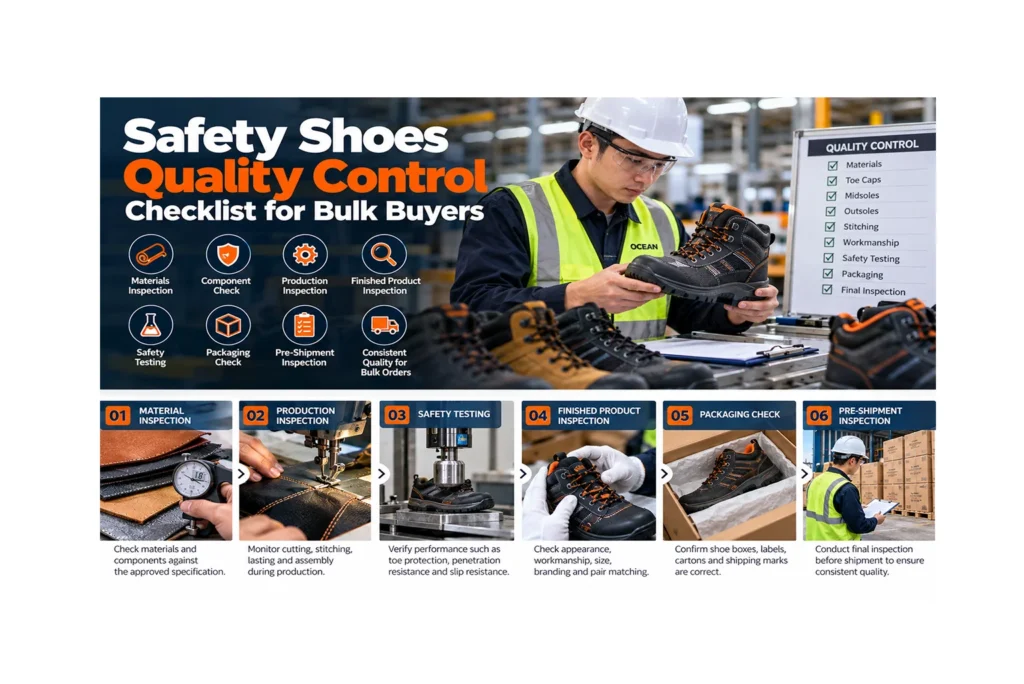
When an importer or PPE distributor orders thousands of pairs of safety footwear, receiving products that look correct is not enough. The footwear must also be consistent with the approved specification, use the agreed materials and components, meet applicable safety requirements, and maintain acceptable workmanship across the production batch.
This is why safety shoes quality control should begin before mass production rather than only when finished cartons are ready for shipment.
A quality problem discovered during material preparation may be relatively straightforward to correct. The same problem discovered after 5,000 pairs have been produced, packed, and prepared for export can become expensive and time-consuming.
For importers, wholesalers, PPE distributors, private-label brands, and industrial procurement teams, a structured quality control system helps reduce this risk.
This guide provides a practical safety shoes inspection checklist covering incoming materials, pre-production approval, in-process inspection, finished footwear, safety testing, packaging, and pre-shipment inspection.
What Is Safety Shoes Quality Control?
Safety shoes quality control is the process of checking whether materials, components, manufacturing processes, finished footwear, and packaging conform to agreed specifications and applicable requirements.
It is different from simply inspecting finished shoes for visible defects.
An effective quality control process normally includes several stages:
- Product specification confirmation.
- Incoming material inspection.
- Pre-production sample approval.
- In-process quality inspection.
- Finished-product inspection.
- Safety footwear testing where required.
- Packaging verification.
- Pre-shipment inspection.
Each stage addresses a different type of risk.
For example, final inspection may identify poor stitching, but it cannot easily correct thousands of pairs produced using the wrong upper material.
That is why prevention and early detection are important.
Why Safety Footwear Quality Control Matters for Bulk Buyers
Quality inconsistencies that appear minor at factory level can become significant when multiplied across a large order.
Imagine an importer ordering 5,000 pairs of private-label safety boots.
If only 2% of the shipment has a significant workmanship problem, that represents 100 pairs requiring investigation, replacement, credit, repair, or another commercial solution.
Potential consequences include:
- Customer complaints.
- Product returns.
- Replacement costs.
- Delivery delays.
- Inventory shortages.
- Retailer disputes.
- Brand reputation damage.
- Additional inspection expenses.
For protective footwear, there is another concern: safety performance.
Visible appearance alone cannot establish whether a toe cap, penetration-resistant component, outsole, or other protective feature provides the specified performance.
A good safety footwear quality control program therefore combines manufacturing inspection with appropriate product testing and documentation.
Safety Shoes Quality Control Starts With the Product Specification
One of the biggest sourcing mistakes is attempting to inspect a product without establishing exactly what the factory is supposed to produce.
Before mass production begins, the buyer and manufacturer should agree on a detailed product specification.
Create a Technical Specification Sheet
The specification should identify important product details such as:
| Item | Information to Confirm |
|---|---|
| Model | Product code and approved design |
| Upper | Material, colour, thickness and finish |
| Toe cap | Type and required specification |
| Penetration protection | Component and requirement, if applicable |
| Outsole | Material, construction and colour |
| Lining | Material and colour |
| Insole | Material, thickness and branding |
| Fastening | Laces, zipper, rotary closure or other system |
| Size range | Approved sizes |
| Logo | Position, dimensions and method |
| Labels | Content and placement |
| Packaging | Shoe box, labels and master carton |
| Applicable requirements | Target market and agreed safety specification |
The more precise the specification, the easier it becomes to determine whether production conforms to the order.
Establish an Approved Reference Sample
A final approved sample should serve as a physical reference for mass production.
The sample can help inspectors compare:
- Shape.
- Colour.
- Material appearance.
- Stitching.
- Branding.
- Component positioning.
- General workmanship.
Both buyer and manufacturer should clearly identify which sample represents final approval.
Changes made after approval should be documented rather than agreed informally.
Stage 1: Incoming Material Inspection
Quality control should begin when materials and components arrive at the factory.
Finding incorrect materials before production is far easier than discovering them after the footwear has been assembled.
Upper Material Inspection
Depending on the product, inspect:
- Material type.
- Colour.
- Thickness.
- Surface appearance.
- Texture.
- Visible defects.
- Consistency between batches.
For leather products, natural variation is expected, but the acceptable range should still be defined.
For synthetic and textile materials, inspectors should watch for colour differences, surface defects, contamination, or inconsistencies.
Protective Component Inspection
Protective components should correspond to the approved product specification.
These can include:
- Steel toe caps.
- Composite toe caps.
- Metallic penetration-resistant inserts.
- Non-metallic penetration-resistant components.
Component identification should be traceable where appropriate.
A toe cap that looks similar to an approved component should not automatically be considered equivalent.
Outsole and Midsole Inspection
Inspectors should verify:
- Correct outsole design.
- Correct colour.
- Material specification.
- Size identification.
- Visible moulding defects.
- Contamination.
- Deformation.
For direct-injection footwear, raw material control and production-process parameters may also be relevant to consistent manufacturing.
Accessories and Packaging Materials
Quality control should also cover:
- Laces.
- Eyelets.
- Zippers.
- Labels.
- Insoles.
- Shoe boxes.
- Cartons.
- Hang tags.
- Printed instructions.
Incorrect branding or packaging can create commercial problems even when the footwear itself is acceptable.
Stage 2: Pre-Production Safety Shoes Quality Inspection
Before full-scale manufacturing begins, the factory should confirm that production teams understand the approved specification.
Check the Pre-Production Sample
The pre-production sample should be reviewed against:
- Technical specification.
- Approved materials.
- Colour standards.
- Logo artwork.
- Labels.
- Packaging.
- Size requirements.
If the sample differs from the approved specification, the issue should be resolved before mass production.
Conduct a Pre-Production Meeting
For larger or more complex orders, a pre-production meeting can help clarify critical requirements.
Participants may include representatives from:
- Production.
- Quality control.
- Technical development.
- Purchasing.
- Factory management.
The objective is to identify potential manufacturing risks before they become production problems.
Stage 3: Cutting and Upper Preparation Inspection
The cutting stage affects both appearance and assembly accuracy.
Incorrectly cut components can cause shape differences, poor stitching alignment, or sizing inconsistencies later in production.
What Should Be Checked During Cutting?
Inspectors can evaluate:
- Pattern accuracy.
- Cutting direction.
- Material defects.
- Component dimensions.
- Left/right matching.
- Colour consistency.
- Material utilisation.
For leather footwear, inspectors should also ensure that unsuitable areas of the hide are not used in critical visible or structural locations.
Stage 4: Stitching Quality Inspection
The upper is assembled through multiple stitching operations.
Poor stitching can affect appearance, durability, and component positioning.
Safety Shoes Stitching Checklist
Inspect:
- Stitch consistency.
- Stitch density according to specification.
- Loose threads.
- Broken stitching.
- Skipped stitches.
- Uneven seams.
- Incorrect thread colour.
- Misaligned panels.
- Logo positioning.
- Reinforcement areas.
Inspectors should compare production with the approved reference sample rather than relying solely on subjective appearance.
Stage 5: Lasting and Assembly Quality Control
During lasting, the upper is shaped around the footwear last.
Problems at this stage can affect fit, shape, appearance, and sole attachment.
Check Footwear Shape and Alignment
Inspect:
- Toe shape.
- Heel position.
- Upper symmetry.
- Left/right consistency.
- Wrinkles.
- Component alignment.
Significant variation between left and right footwear may indicate process-control problems.
Check Protective Component Positioning
Protective toe caps and penetration-resistant components must be installed according to the approved footwear construction.
Incorrect positioning may affect comfort or protective performance.
Visual inspection alone does not prove safety compliance, but manufacturing controls can help ensure that approved components are assembled consistently.
Stage 6: Sole Attachment Inspection
Sole attachment is a critical manufacturing stage.
The exact quality checks depend on whether the footwear uses direct injection, cemented construction, or another production method.
Check for Visible Sole Defects
Common inspection points include:
- Gaps.
- Separation.
- Excess adhesive.
- Poor bonding areas.
- Incorrect alignment.
- Surface contamination.
- Moulding defects.
- Colour inconsistency.
- Deformation.
The sole should also match the correct footwear size.
Bond Strength Testing
Where required by the applicable product specification or quality plan, sole bond strength should be evaluated using appropriate test methods.
Simply pulling the outsole by hand is not a substitute for controlled laboratory testing.
Stage 7: Safety Shoes Testing
A factory quality inspection and a laboratory safety test serve different purposes.
Inspection asks: Was the product manufactured according to the approved specification?
Testing asks: Does the product meet defined performance requirements?
Both can be important.
Toe Protection Testing
Depending on the applicable standard and product classification, protective toe testing may evaluate impact and compression performance.
The test should apply to the actual footwear configuration or relevant specimens according to the applicable method.
Penetration Resistance Testing
Where penetration resistance is claimed or required, the appropriate component and footwear construction should be tested according to the applicable requirements.
Slip Resistance Testing
Slip resistance cannot be reliably assessed by looking at outsole tread patterns.
Appropriate laboratory testing uses defined surfaces, contaminants, conditions, and test procedures.
Additional Safety Shoes Testing
Depending on the product specification, other tests may address:
- Water resistance.
- Upper performance.
- Outsole properties.
- Electrical characteristics.
- Flexing.
- Abrasion.
- Tear strength.
- Other required characteristics.
Not every product needs every test.
The test program should correspond to the footwear’s intended claims, target market, applicable standards, and buyer requirements.
Stage 8: Finished Safety Shoes Quality Inspection
Once production is complete, finished products should be evaluated against the approved specification.
This inspection should cover more than general appearance.
Visual Workmanship
Check for:
- Scratches.
- Stains.
- Excess adhesive.
- Loose threads.
- Poor stitching.
- Colour differences.
- Wrinkles outside agreed tolerances.
- Damaged materials.
- Incorrect components.
Size and Measurement
Inspectors may check relevant dimensions according to the agreed inspection procedure.
Size markings should also correspond to the actual product and order requirements.
Pair Matching
Each pair should be checked for consistency between the left and right shoe.
Compare:
- Colour.
- Height.
- Shape.
- Material appearance.
- Logo position.
- Outsole.
- Accessories.
Branding and Markings
Private-label orders require additional attention.
Inspect:
- Logo spelling.
- Logo orientation.
- Logo size.
- Colour.
- Tongue labels.
- Insole branding.
- Product markings.
- Box labels.
A small artwork mistake can affect an entire shipment if it is not detected early.
Stage 9: Packaging Quality Control
Packaging should be included in the safety shoes quality inspection, particularly for retail and private-label orders.
Individual Shoe Box Inspection
Check:
- Correct box.
- Product label.
- Model number.
- Size.
- Colour.
- Barcode where applicable.
- Printed information.
- Packaging condition.
Master Carton Inspection
Check:
- Number of pairs per carton.
- Size assortment.
- Shipping marks.
- Carton dimensions where specified.
- Carton condition.
- Gross and net weight where required.
Random cartons should be opened to verify that their contents match exterior markings.
Stage 10: Pre-Shipment Inspection
A pre-shipment inspection provides the buyer with an opportunity to evaluate the completed order before it leaves the factory.
For larger international orders, this can be performed by the manufacturer’s QC team, the buyer’s representative, or an independent inspection company.
When Should Pre-Shipment Inspection Take Place?
The order should generally be sufficiently complete and packed for inspectors to evaluate representative finished products and packaging.
The exact timing should be agreed between buyer, supplier, and inspection provider.
Sampling Inspection
Bulk footwear orders are commonly evaluated using a defined sampling plan rather than inspecting every pair.
The buyer and supplier should agree in advance on:
- Sampling method.
- Inspection level.
- Defect categories.
- Acceptance criteria.
- Actions following inspection failure.
AQL-based sampling is commonly used in consumer-goods inspections, but the appropriate sampling plan and acceptance limits should be defined for the specific purchasing program.
How to Classify Safety Shoes Inspection Defects
A practical inspection system often separates defects according to severity.
Critical Defects
These are issues that may create an unacceptable safety, regulatory, or serious product risk.
They typically require immediate investigation.
Major Defects
Major defects can materially affect product function, durability, appearance, saleability, or conformity with agreed specifications.
Examples might include incorrect components, significant sole defects, or substantial construction problems.
Minor Defects
Minor defects are generally smaller workmanship or appearance issues that do not materially affect normal use.
The exact classification should be agreed before inspection because the same defect may have different significance depending on the product and customer requirements.
Safety Shoes Inspection Checklist for Bulk Buyers
The following checklist can be used as a starting point when preparing an inspection plan.
| Inspection Area | What to Check | Stage |
|---|---|---|
| Product specification | Correct model and construction | Pre-production |
| Upper material | Type, colour, thickness, appearance | Incoming |
| Toe cap | Correct approved component | Incoming/Assembly |
| Penetration component | Correct material and positioning | Incoming/Assembly |
| Outsole | Design, size, material and defects | Incoming/Production |
| Cutting | Pattern and component consistency | Production |
| Stitching | Seams, thread and workmanship | Production |
| Lasting | Shape and alignment | Production |
| Sole attachment | Bonding and visible defects | Production/Final |
| Size | Marking and relevant dimensions | Final |
| Pair matching | Left/right consistency | Final |
| Logo | Position, colour and spelling | Production/Final |
| Safety testing | Required performance tests | Development/Production |
| Packaging | Labels, boxes and cartons | Final |
| Quantity | Order and carton quantities | Pre-shipment |
| Shipping marks | Accuracy | Pre-shipment |
This checklist should be adapted to the specific footwear model and purchasing requirements rather than used as a universal pass/fail standard.
Common Quality Control Mistakes Bulk Buyers Should Avoid
Inspecting Only After Production Is Finished
Waiting until final inspection makes some problems much more difficult to correct.
Better approach: Establish checkpoints from incoming materials through final production.
Approving Changes Through Informal Messages
Small material substitutions can become difficult to track.
Better approach: Record specification changes and maintain an updated approved product file.
Assuming a Test Report Applies to Every Similar Shoe
Products that look similar may use different components or constructions.
Better approach: Verify that documentation corresponds to the actual model and specification being purchased.
Using Appearance to Judge Safety Performance
A thick outsole or large toe cap does not prove compliance.
Better approach: Use appropriate product testing and documentation for performance claims.
Having No Defined Acceptance Criteria
Without agreed defect definitions and inspection standards, buyers and factories may interpret quality differently.
Better approach: Define inspection criteria before mass production.
What Documents Should Bulk Buyers Request?
Documentation requirements vary by market and product, but buyers may need to review:
- Technical specification sheets.
- Approved sample records.
- Material specifications.
- Test reports.
- Applicable conformity documentation.
- Inspection reports.
- Packaging specifications.
- Production records where relevant.
For safety products, document control should be treated as part of procurement rather than simply an administrative exercise.
How to Evaluate a Safety Shoes Manufacturer’s Quality Control System
A factory’s ability to produce a good sample is useful, but bulk buyers also need to understand whether that quality can be reproduced consistently.
Ask potential manufacturers:
- How are incoming materials inspected?
- How are approved specifications communicated to production?
- What in-process inspection points are used?
- How are defective products identified and handled?
- How are production changes controlled?
- Can inspection records be provided?
- How are test samples selected?
- How is traceability managed?
- Can third-party inspectors access the finished order?
- How are customer complaints investigated?
The answers can provide valuable insight into the supplier’s approach to quality management.
Frequently Asked Questions About Safety Shoes Quality Control
What Is Safety Shoes Quality Control?
Safety shoes quality control is a structured process for verifying materials, components, manufacturing, finished products, packaging, and relevant product requirements against agreed specifications.
What Should Be Included in a Safety Shoes Inspection Checklist?
A checklist should cover materials, protective components, cutting, stitching, assembly, outsole attachment, sizing, workmanship, branding, required testing, packaging, quantities, and shipping marks.
When Should Safety Shoes Be Inspected?
Inspection should occur at multiple stages, including incoming materials, pre-production, manufacturing, finished-product inspection, and pre-shipment verification.
Is Final Inspection Enough for Bulk Safety Shoes?
Final inspection is important but cannot replace earlier process controls. Some problems are much easier to prevent or correct before thousands of pairs have been completed.
What Is the Difference Between Safety Shoes Testing and Inspection?
Inspection checks whether production conforms to specifications and workmanship requirements. Testing evaluates defined technical performance using specified test methods.
Should Buyers Use Third-Party Inspection Companies?
Third-party inspection can provide additional independent verification, particularly for larger international orders. Whether it is necessary depends on order value, supplier history, product risk, and the buyer’s own quality-control resources.
What Is AQL in Safety Shoes Inspection?
AQL is commonly used as part of statistical sampling inspection to establish acceptance criteria for a production lot. Buyers should define the sampling plan, inspection level, defect categories, and acceptance limits before inspection rather than relying on an unspecified “standard AQL.”
Can Safety Shoes Pass Visual Inspection but Fail Safety Testing?
Yes. Visual inspection cannot establish performance characteristics such as impact resistance or slip resistance. This is why manufacturing inspection and appropriate technical testing perform different roles.
Conclusion
Effective safety shoes quality control is not a single inspection performed immediately before shipment.
It is a process that begins with a clear product specification and continues through material inspection, sample approval, manufacturing, safety testing, finished-product inspection, packaging, and shipment preparation.
For importers, distributors, PPE suppliers, and private-label brands purchasing safety footwear in bulk, this approach provides better visibility into product consistency and helps identify problems before they affect an entire order.
The key principle is simple:
Do not wait until the container is ready to discover whether the footwear matches what you ordered.
Build quality requirements into the purchasing process from the beginning.
Build a Reliable Safety Footwear Quality Control Process With Ocean Safety Shoes
Ocean Safety Shoes is a professional safety footwear manufacturer supporting global importers, distributors, wholesalers, PPE suppliers, and private-label brands.
Our B2B manufacturing process can support product specification development, sample approval, production quality control, inspection coordination, OEM/ODM development, and bulk safety footwear manufacturing.
For buyers planning a new safety footwear order, establishing the product specification and quality requirements before mass production can help create a clearer and more consistent sourcing process.
Visit Ocean Safety Shoes to explore our safety footwear range or discuss your bulk manufacturing requirements.