When importers, distributors, PPE suppliers, and private-label brands begin sourcing safety footwear, one of the first questions they usually ask is:
What is the safety shoes wholesale price per pair?
There is no single answer.
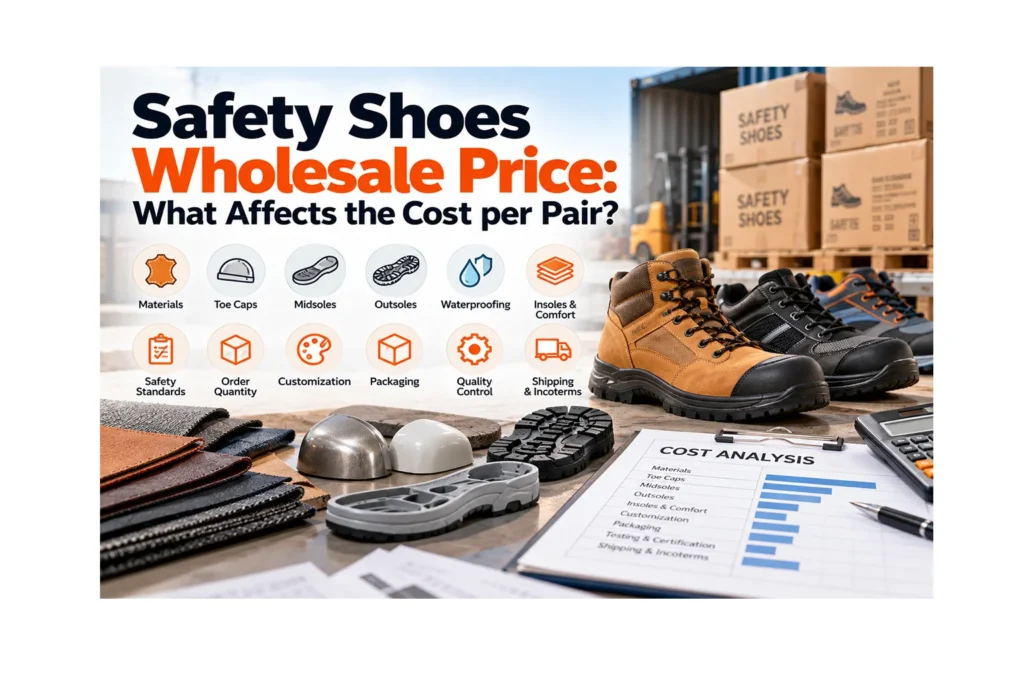
Two safety shoes that look similar in a product photo can have significantly different manufacturing costs because of differences in upper materials, protective components, outsole construction, order quantity, testing requirements, packaging, and customization.
For B2B buyers, focusing only on the quoted safety shoes price can therefore lead to misleading comparisons. A lower quotation may represent a different specification rather than a genuinely better purchasing deal.
Understanding what determines the safety shoes cost per pair makes it easier to compare suppliers, negotiate quotations, establish realistic target prices, and calculate the true landed cost of a bulk order.
This guide explains the major factors affecting safety footwear wholesale pricing and shows what buyers should check before requesting quotations from a safety shoes manufacturer.
How Is a Safety Shoes Wholesale Price Calculated?
A factory quotation is ultimately based on the materials, components, labor, production processes, order requirements, packaging, quality requirements, and commercial terms associated with producing the footwear.
A simplified way to understand the calculation is:
Materials + Components + Manufacturing + Quality Control + Packaging + Customization + Commercial Costs = Factory Cost per Pair
The actual quotation may then vary depending on order quantity, Incoterms, payment terms, and other commercial conditions.
For example, consider two visually similar leather safety boots.
One uses a basic split-leather upper, steel toe cap, standard insole, and existing PU outsole. Another uses premium nubuck leather, composite protection, a waterproof membrane, upgraded footbed, and a rubber outsole.
Their external appearance may be similar, but their manufacturing costs will not be.
This is why professional buyers should compare specification against specification, not simply quotation against quotation.
1. Upper Material Has a Major Impact on Safety Shoes Price
The footwear upper represents an important part of material cost.
Different materials vary in purchase price, cutting efficiency, appearance, durability, consistency, and processing requirements.
Leather Safety Shoes
Common leather options include:
- Full-grain leather
- Nubuck leather
- Crazy horse leather
- Split leather
- Suede
Premium leather generally costs more than basic split leather, but even products described using the same material category can differ considerably.
Buyers should therefore specify details such as leather type, thickness, finish, colour, and quality expectations.
Simply requesting a quotation for “leather safety shoes” leaves too much room for interpretation.
Microfiber and Synthetic Materials
Microfiber and synthetic materials are widely used in modern safety footwear, particularly lightweight and sport-style designs.
Depending on the specification, they may offer advantages such as lower weight, consistent appearance, flexibility, and easier colour development.
However, synthetic does not automatically mean inexpensive.
High-performance technical textiles and engineered microfiber materials can cost more than basic leather alternatives.
2. Protective Toe Caps Affect the Cost per Pair
Protective toe caps are another important cost component.
The two common categories are steel and non-metallic composite toe caps.
Steel Toe Caps
Steel toe caps are widely used because they provide established protective performance and can be cost-effective for many industrial footwear applications.
They are commonly found in:
- Construction boots
- Industrial safety shoes
- Warehouse footwear
- Heavy-duty work boots
Composite Toe Caps
Composite protective toe caps use non-metallic materials.
Depending on the component and footwear design, they can help manufacturers develop products with different weight, thermal, or metal-free characteristics.
Composite components can also have different procurement costs from conventional steel components.
However, buyers should avoid comparing toe caps based only on material.
The critical issue is whether the complete footwear meets the applicable protection requirements for its intended market.
3. Penetration-Resistant Midsoles Influence Pricing
If the product specification requires penetration resistance, another protective component must be incorporated into the footwear.
Depending on the design, manufacturers may use metallic or appropriate non-metallic penetration-resistant components.
The selection affects:
- Component cost
- Footwear construction
- Flexibility
- Weight
- Production process
- Testing requirements
Therefore, when comparing wholesale safety shoes, buyers should confirm whether penetration protection is included in each quotation.
A quotation without this feature should not be directly compared with one that includes it.
4. Outsole Construction Can Significantly Change the Price
The outsole is one of the most important components affecting both performance and manufacturing cost.
Common safety footwear constructions include:
| Outsole Type | Typical Characteristics | Relative Cost Influence |
|---|---|---|
| Single-density PU | Lightweight, relatively simple construction | Lower |
| Dual-density PU | Combines different layers/functions | Low–Medium |
| PU/TPU | Can combine cushioning with durable outsole characteristics | Medium |
| PU/Rubber | Common for more demanding applications | Medium–High |
| Rubber-based construction | Often selected for particular durability or performance requirements | Medium–High |
These are general comparisons rather than fixed pricing rules. Actual cost depends on compound specifications, outsole weight, tooling, manufacturing method, and order volume.
Existing Outsole vs Custom Outsole
Using an existing factory outsole usually reduces development requirements.
A proprietary outsole may require:
- New mould design
- Tooling development
- Prototype production
- Testing
- Minimum production quantities
For a private-label brand launching its first range, using an existing outsole platform can sometimes reduce initial development investment.
For larger established brands, proprietary tooling may provide stronger product differentiation.
5. Waterproof Construction Adds Material and Manufacturing Costs
Waterproof safety footwear generally requires more than using water-resistant leather.
Depending on the design, waterproof construction may involve:
- Waterproof membranes
- Special bootie constructions
- Seam management
- Additional lining materials
- Different assembly procedures
- Additional testing
These elements increase both material and production complexity.
Buyers should distinguish between water-resistant and waterproof claims when requesting quotations because they may represent different product constructions and performance expectations.
6. Insole, Lining, and Comfort Features Affect Wholesale Cost
Comfort components may appear relatively small, but their costs become important across large quantities.
An entry-level removable insole will not cost the same as a more complex footbed incorporating additional cushioning, heel support, or specialised materials.
Other cost variables include:
- Mesh lining
- Moisture-management materials
- Padded collars
- Tongue construction
- Heel cushioning
- Arch-support features
- Antimicrobial treatments where specified
- Insulation for cold environments
For an order of thousands of pairs, even a small component cost difference per pair can materially change the total purchase value.
7. Safety Standards and Testing Requirements Affect Cost
Safety footwear is protective equipment, so product requirements should be established before price negotiations are completed.
Different destination markets may require products to comply with different standards or conformity frameworks.
Examples include EN ISO 20345-related requirements for relevant European safety footwear and ASTM standards used for protective footwear in the United States.
Testing requirements may involve characteristics such as:
- Toe impact resistance
- Toe compression resistance
- Penetration resistance
- Slip resistance
- Electrical properties
- Water-related performance
- Outsole properties
The applicable requirements depend on the product, intended use, target market, and current standard.
Existing Tested Model vs New Development
If a buyer selects an established model with relevant documentation, development requirements may be different from those for a completely new design.
Customising major components can also affect whether existing test results remain applicable.
B2B buyers should therefore discuss testing and documentation before approving a final specification—not after mass production has started.
8. Order Quantity Is a Major Wholesale Pricing Factor
MOQ and order volume have an important influence on safety footwear wholesale economics.
Larger production runs can allow certain fixed costs and production activities to be distributed across more pairs.
This does not mean that doubling the order automatically cuts the price dramatically.
However, quantity can influence:
- Material purchasing
- Production efficiency
- Component procurement
- Packaging costs
- Factory planning
- Setup costs
Why Small Orders Often Cost More per Pair
Imagine two buyers requesting the same safety boot.
Buyer A orders 300 pairs.
Buyer B orders 3,000 pairs.
The factory still needs to prepare materials, organise production, manage quality requirements, and coordinate packaging for both orders.
The larger order may provide better manufacturing efficiency and purchasing leverage, potentially reducing the cost per pair.
9. Size Range and Colour Quantity Can Affect Pricing
Buyers sometimes focus on total quantity without considering how that quantity is divided.
For example:
2,000 pairs of one colour can be commercially different from 2,000 pairs divided across five colours.
Multiple colours can require separate material purchasing, production planning, packaging management, and smaller quantities of each material.
Similarly, unusually broad size ranges can affect component availability and production planning.
When requesting quotations for bulk safety shoes, provide a preliminary size breakdown and colour plan whenever possible.
10. OEM and Private-Label Customization Affects Cost
Custom branding can range from a simple logo change to complete product development.
Basic Private-Label Customization
Lower-complexity customization may include:
- Printed logo
- Embossed logo
- Branded insole
- Custom tongue label
- Custom shoe box
These modifications can often use an existing footwear platform.
Advanced OEM Development
More extensive customization may include:
- New upper patterns
- Custom materials
- Custom colour combinations
- New lasts
- Proprietary outsoles
- New moulds
- Special components
- Custom packaging systems
The greater the development scope, the more likely the project will involve additional sampling, tooling, testing, and minimum-order requirements.
11. Packaging Can Change the Safety Shoes Cost per Pair
Packaging is sometimes overlooked when buyers compare factory quotations.
A basic shoe box and master carton cost less than a fully customised retail packaging system.
Custom packaging can include:
- Printed shoe boxes
- Branded tissue paper
- Hang tags
- Instruction sheets
- Product labels
- Barcodes
- Retail-ready packaging
- Custom master cartons
The effect per pair may appear modest, but it becomes significant when multiplied across thousands of pairs.
12. Quality Control Requirements Influence Total Purchasing Cost
Quality control should not be treated simply as an unnecessary cost.
For B2B buyers, inconsistent production can generate expenses through returns, complaints, replacements, delayed deliveries, and damage to customer relationships.
A manufacturing quality plan may include:
Incoming Material Inspection
Materials and components are checked against approved specifications before production.
In-Process Inspection
Production teams monitor areas such as cutting, stitching, assembly, and sole attachment.
Final Inspection
Finished footwear is checked against agreed quality criteria.
Third-Party Inspection
Some importers arrange independent pre-shipment inspections for larger orders.
These procedures contribute to the total sourcing process but can also help reduce commercial risk.
13. Incoterms Can Make Two Quotations Look Very Different
A critical mistake is comparing quotations that use different Incoterms.
For example, an EXW quotation should not be directly compared with a CIF quotation without understanding which costs are included.
Depending on the agreed Incoterm, pricing may incorporate different portions of:
- Factory pickup
- Domestic transportation
- Export handling
- Port charges
- International freight
- Insurance
Import duties, taxes, customs clearance, and final delivery may still need to be added depending on the arrangement and destination.
Always confirm the Incoterm when comparing supplier quotations.
Factory Price vs Landed Cost per Pair
The lowest factory price does not necessarily produce the lowest final purchasing cost.
Professional importers should calculate the landed cost per pair.
A simplified model is:
Landed Cost = Product Cost + Packaging + Freight + Insurance + Import Charges + Customs/Clearance + Local Transport + Other Applicable Costs
For example, suppose an importer purchases 2,000 pairs.
| Cost Component | Example Calculation |
|---|---|
| Product value | $30,000 |
| International freight and insurance | $4,000 |
| Applicable import/clearance costs | $2,000 |
| Domestic logistics | $1,000 |
| Total landed cost | $37,000 |
| Quantity | 2,000 pairs |
| Illustrative landed cost | $18.50/pair |
This example is purely illustrative and should not be interpreted as a market quotation.
Actual costs vary substantially by product, country, shipment size, freight conditions, duties, taxes, and commercial terms.
Why Very Low Safety Shoes Prices Can Be Misleading
When one supplier offers a substantially lower quotation, buyers should determine why before assuming it represents better value.
Possible differences may include:
- Different leather grades
- Different upper thicknesses
- Lower-cost lining materials
- Different toe protection
- No penetration-resistant component
- Simpler outsole construction
- Different insoles
- Different packaging
- Different testing scope
- Different quality requirements
- Different Incoterms
The objective is not automatically to reject the lowest quotation.
Instead, buyers should make sure every supplier is quoting against the same specification.
How to Request an Accurate Safety Shoes Wholesale Price
A detailed RFQ—or Request for Quotation—can dramatically improve quotation accuracy.
Instead of sending:
“Please quote your best price for safety shoes.”
provide the supplier with a clear product brief.
A useful RFQ should include:
| RFQ Information | Example |
|---|---|
| Product type | Mid-cut industrial safety boot |
| Target market | EU / US / Australia / other |
| Required protection | Defined according to application |
| Upper material | Specified leather or textile |
| Toe cap | Steel or composite |
| Penetration protection | Required / not required |
| Outsole | Preferred construction |
| Waterproofing | Required / not required |
| Quantity | Estimated pairs |
| Size range | Required sizes |
| Colours | Number of colours |
| Branding | OEM/private label requirements |
| Packaging | Standard or customised |
| Incoterm | EXW, FOB, CIF, etc. |
| Destination | Port/country |
This gives factories enough information to produce a more meaningful quotation.
How B2B Buyers Can Reduce Safety Shoes Cost Without Sacrificing Essential Requirements
Reducing cost does not necessarily mean reducing quality.
Strategic product development can sometimes produce better cost efficiency.
Use Existing Tooling Where Appropriate
Using an existing last and outsole can avoid unnecessary tooling investment.
Consolidate Colours
Fewer colour variations may improve material purchasing and production efficiency.
Plan Larger Orders
Where inventory capacity allows, larger production runs may improve manufacturing economics.
Standardise Components Across Models
A footwear range using common outsoles, insoles, or components can sometimes improve purchasing efficiency.
Avoid Unnecessary Features
Not every market needs every possible feature.
Specify protection based on the actual workplace and target customer rather than adding features simply for marketing purposes.
However, mandatory safety requirements should never be removed solely to reduce cost.
How to Compare Safety Footwear Wholesale Suppliers
Price should be one part of supplier evaluation rather than the entire decision.
| Evaluation Area | Questions to Ask |
|---|---|
| Product specification | Are all suppliers quoting the same construction? |
| Documentation | Can relevant product/test documentation be provided? |
| Manufacturing | Is the supplier a manufacturer or intermediary? |
| MOQ | Does the order quantity fit your purchasing plan? |
| Customization | Can OEM/private-label requirements be supported? |
| Quality control | How is production consistency managed? |
| Samples | Can pre-production samples be approved? |
| Delivery | What is the expected production lead time? |
| Commercial terms | Which Incoterm and payment terms apply? |
For long-term B2B sourcing, consistency and communication can be just as important as a small difference in unit price.
Frequently Asked Questions About Safety Shoes Wholesale Pricing
What Is the Average Safety Shoes Wholesale Price?
There is no reliable universal average because the price depends on materials, protective features, outsole construction, quantity, customization, testing requirements, packaging, and commercial terms.
A detailed product specification is necessary before meaningful price comparisons can be made.
Why Are Some Wholesale Safety Shoes Much Cheaper Than Others?
Lower prices may result from simpler materials, different components, higher order quantities, less customization, different quality requirements, or different commercial terms.
Always compare specifications before comparing prices.
Does MOQ Affect the Safety Shoes Price per Pair?
It can. Larger production quantities may improve material purchasing and manufacturing efficiency, while small runs can carry higher per-pair costs.
Are Steel Toe Safety Shoes Cheaper Than Composite Toe Shoes?
Component costs can differ, but toe-cap material is only one part of the complete footwear price. The upper, outsole, midsole, construction, and other features can have a greater effect on the final quotation.
Are Waterproof Safety Shoes More Expensive?
Waterproof footwear can involve additional materials, membranes, construction procedures, and testing, which may increase manufacturing cost compared with a simpler non-waterproof design.
Can I Order Custom Logo Safety Shoes in Bulk?
Yes. Many manufacturers provide OEM and private-label options such as logos, insoles, labels, colours, and packaging. MOQ and additional costs depend on the customization method.
How Can I Get an Accurate Wholesale Quotation?
Provide the manufacturer with your target market, technical specification, materials, protection requirements, quantity, sizes, branding, packaging, Incoterm, and destination.
Should I Choose the Cheapest Safety Shoes Supplier?
Unit price should be evaluated alongside product specifications, documentation, manufacturing capability, quality control, consistency, delivery, and total landed cost.
Conclusion
Understanding safety shoes wholesale price requires looking beyond a single number.
The cost per pair is influenced by upper materials, toe protection, penetration-resistant components, outsole construction, waterproofing, comfort features, order quantity, customization, testing, packaging, quality control, and commercial terms.
For importers, PPE distributors, wholesalers, and private-label brands, the most effective approach is to create a clear technical specification first and request comparable quotations from suppliers based on that specification.
Instead of asking only:
“What is your lowest price?”
a more useful question is:
“What specification am I receiving for this price?”
That distinction can make a significant difference when purchasing thousands of pairs of safety footwear.
Request a Safety Shoes Wholesale Quotation From Ocean Safety Shoes
Ocean Safety Shoes is a professional safety footwear manufacturer supplying international importers, distributors, wholesalers, PPE suppliers, and private-label brands.
We support B2B projects covering standard wholesale safety shoes, OEM/ODM development, custom branding, packaging, and bulk production.
To receive a more accurate quotation, provide your target market, product type, required protection, materials, estimated quantity, size range, and customization requirements.
Our team can then evaluate the specification and discuss suitable manufacturing options for your project.