
A construction worker arrives at a new project wearing the same safety shoes used at a previous site. Both workplaces are in Australia, but the hazards are different. The first site involved dry indoor finishing work; the new one has exposed nails, moving plant, uneven ground, and wet concrete. The footwear may look suitable, yet it may not provide the protection required for the new tasks.
This situation illustrates an important principle behind Australia’s work health and safety system: PPE must be selected according to actual workplace risks rather than job title, habit, or appearance.
When people ask, “What is the SafeWork model in Australia?”, they are usually referring to the model Work Health and Safety laws developed by Safe Work Australia. The expression can be confusing because Safe Work Australia, SafeWork NSW, WorkSafe Victoria, WorkSafe Queensland, and other jurisdictional authorities have different roles.
Safe Work Australia is the national policy body responsible for developing and evaluating the model WHS framework. It does not normally inspect individual workplaces or enforce WHS laws. The Commonwealth, states, and territories implement and enforce their own legislation through their respective regulators.
This guide explains:
- What the model WHS framework is
- How it operates across Australia
- Who has duties under the system
- How workplace risks should be controlled
- Where safety footwear fits within the hierarchy of controls
- How businesses should select industrial safety shoes
- Which Australian safety footwear standards buyers should check
- How procurement teams can create a defensible PPE purchasing process
The article provides general information and should not be treated as legal advice. Businesses must verify the current legislation and approved codes that apply in their jurisdiction.
What Is the Safe Work Australia Model?
The correct formal term is the model Work Health and Safety laws, often shortened to the model WHS laws.
Safe Work Australia developed the model laws in 2011 to create a more balanced and nationally consistent approach to protecting workers and other people from workplace harm. The framework contains three main parts:
- The model WHS Act
- The model WHS Regulations
- Model Codes of Practice
These documents are designed as a national template. They do not automatically operate as law simply because Safe Work Australia publishes or amends them. Each Commonwealth, state, or territory jurisdiction must take separate action to implement the model provisions in its own legislation.
According to Safe Work Australia, the model WHS laws have been implemented by the Commonwealth and every state and territory except Victoria. Jurisdictions that have implemented the model may still make local variations. Victoria continues to operate under its own occupational health and safety framework. (Safe Work Australia: Model WHS laws)
This distinction matters for employers operating across Australia. A national company can use the model framework as the foundation for its safety-management system, but it must still check the legislation, regulations, codes, regulator guidance, and local variations applying at each workplace.
Is Safe Work Australia a Regulator?
No. Safe Work Australia is a national policy body, not the regulator that normally visits a worksite, investigates a local incident, or prosecutes a business for a jurisdictional breach.
Its functions include:
- Developing and evaluating model WHS policy
- Maintaining the model WHS laws
- Producing national guidance and research
- Collecting and analysing safety data
- Supporting national approaches to workers’ compensation
- Encouraging greater consistency between jurisdictions
Workplace regulation and enforcement are handled by the relevant Commonwealth, state, or territory authority.
Examples include:
- SafeWork NSW
- WorkSafe Victoria
- Workplace Health and Safety Queensland
- SafeWork SA
- WorkSafe WA
- WorkSafe Tasmania
- WorkSafe ACT
- NT WorkSafe
- Comcare for covered Commonwealth workplaces
The regulator, legislation, and approved codes that apply depend on the location and nature of the business.
How the Model WHS Framework Works
The Model WHS Act
The model WHS Act establishes the broad legal framework. Its central objective is to protect workers and other people by requiring duty holders to eliminate risks to health and safety or, where elimination is not reasonably practicable, minimise those risks so far as is reasonably practicable.
The Act addresses matters such as:
- Primary health and safety duties
- Duties of officers, workers, and other persons
- Worker consultation
- Health and safety representatives
- Incident notification
- Authorisations
- Enforcement
- Offences and penalties
The Act is principle-based. It does not attempt to list every possible hazard or prescribe one control for every workplace.
The Model WHS Regulations
The model WHS Regulations provide more detailed requirements supporting the Act. They address specific risks, work activities, licences, records, plant, hazardous chemicals, construction, and other operational matters.
The current model Regulations incorporate amendments published through December 2025. However, changes to the model legislation do not automatically amend the law in each jurisdiction. Businesses must check whether and how their jurisdiction has adopted a particular amendment. (Safe Work Australia: Model WHS Regulations)
Model Codes of Practice
Model Codes of Practice offer practical guidance on meeting standards required by the WHS Act and Regulations.
A model code does not have legal effect in a jurisdiction until it has been approved there. An approved code is not legislation in the same sense as an Act or regulation, but it can be admitted in court proceedings as evidence of what was known about a hazard, risk, or control. A court may also use it when considering what was reasonably practicable. (Safe Work Australia: Codes of Practice)
A business may use another method instead of following an approved code, but the alternative must provide an equivalent or higher level of health and safety.
Who Has Duties Under the Model WHS Laws?
Persons Conducting a Business or Undertaking
The model WHS framework uses the term person conducting a business or undertaking, commonly abbreviated to PCBU.
A PCBU may be:
- A company
- A partnership
- A sole trader
- A government department
- An association
- Certain other organisations conducting work
The primary duty is broader than a traditional employer–employee relationship. A PCBU must, so far as is reasonably practicable, ensure the health and safety of workers it engages, influences, or directs while they are at work. It must also ensure that other people are not put at risk by the work.
Relevant responsibilities can include providing and maintaining:
- A safe work environment
- Safe plant and structures
- Safe systems of work
- Safe handling and storage arrangements
- Adequate welfare facilities
- Necessary information, training, instruction, and supervision
- Monitoring of worker health and workplace conditions where required
For safety footwear, this means a business should not simply state that “safety boots are mandatory.” It should identify the hazards, determine the required protection, select appropriate products, provide information and training, and monitor whether the control remains effective.
Officers
Officers must exercise due diligence to ensure the PCBU complies with its WHS duties.
In practical terms, senior decision-makers should understand key workplace risks and confirm that adequate resources and processes exist to control them. For PPE procurement, this may involve ensuring that purchasing systems do not prioritise price at the expense of required protection, certification, fit, or replacement.
Workers
Workers must take reasonable care for their own health and safety and avoid adversely affecting other people. They must comply, so far as reasonably able, with reasonable instructions and cooperate with reasonable WHS policies.
Workers should therefore:
- Wear prescribed safety footwear correctly
- Follow care and inspection instructions
- Report damaged PPE
- Report discomfort or fitting problems
- Avoid unauthorised modifications
- Participate honestly in wear trials and consultation
Other Persons at the Workplace
Visitors, customers, contractors, and other people must also take reasonable care and comply with reasonable safety instructions.
A visitor entering an active production or construction area may require suitable protective work shoes rather than normal office footwear.
What Does “Reasonably Practicable” Mean?
The model WHS framework requires risks to be eliminated or minimised so far as is reasonably practicable.
This generally involves considering:
- The likelihood of the hazard or risk occurring
- The degree of harm that could result
- What the duty holder knows, or ought reasonably to know
- Available and suitable ways to eliminate or minimise the risk
- The cost of a control, including whether the cost is grossly disproportionate to the risk
Cost is relevant, but it is not the starting point. A company should not select cheap, unsuitable safety shoes merely because compliant footwear costs more.
For example, if workers are exposed to sharp objects underfoot, purchasing basic toe-protection footwear without penetration resistance may leave a foreseeable risk uncontrolled. If a lighter certified model is readily available for employees walking long warehouse shifts, continuing to issue unnecessarily heavy boots without considering fatigue and worker feedback may also be difficult to justify as good practice.
The Hierarchy of Controls: Where Safety Shoes Fit
The hierarchy of controls ranks risk-control methods from the most effective and reliable to the least.
A typical sequence is:
- Eliminate the hazard
- Substitute the hazard
- Isolate people from the hazard
- Apply engineering controls
- Use administrative controls
- Use personal protective equipment
PPE, including safety footwear, is usually a lower-order control. This is because its effectiveness depends on correct selection, fit, use, maintenance, supervision, and replacement.
Safe Work Australia advises that PPE should generally be used after other possible control measures, as an interim measure, or as a backup alongside stronger controls. (Safe Work Australia: Slips, trips and falls)
Consider a slippery warehouse floor. Slip resistant safety shoes may improve traction, but the business should also:
- Repair leaking equipment
- Improve drainage
- Separate pedestrians from wet processes
- Clean spills promptly
- Use suitable floor surfaces
- Mark temporary hazards
- Train workers
- Review walking routes
Similarly, steel toe safety shoes do not replace safe stacking, mechanical lifting equipment, exclusion zones, or controls preventing loads from falling.
The model is therefore not “identify a hazard and issue PPE.” It is “eliminate the risk where possible, minimise what remains, and use suitable PPE as part of an integrated control system.”
What Are Safety Shoes and Why Are They Important?
Safety shoes are workplace PPE designed and tested to protect against specified foot hazards. They differ from ordinary work shoes because their protective features are subject to defined performance requirements.
Depending on their classification, safety footwear may provide:
- Impact protection
- Compression resistance
- Penetration resistance
- Slip resistance
- Heel energy absorption
- Antistatic properties
- Water resistance
- Fuel- and oil-resistant outsole performance
- Heat-resistant outsole performance
- Electrical protection under specified conditions
Industrial safety shoes are widely used in:
- Construction
- Manufacturing
- Mining
- Engineering
- Warehousing
- Logistics
- Transport
- Agriculture
- Utilities
- Oil and gas
- Food processing
- Maintenance operations
Foot injuries can create lost working time, treatment costs, workers’ compensation exposure, production disruption, and personal hardship. Poorly fitted footwear can also contribute to fatigue, discomfort, reduced PPE acceptance, and unstable movement.
The correct workplace safety footwear must protect against identified hazards while remaining practical enough to wear throughout the shift.
Different Types of Safety Shoes Explained
Steel Toe Safety Shoes
Steel toe safety shoes contain a metal toe cap designed to resist impact and compression.
Features:
- Strong protective performance
- Thin and durable cap construction
- Proven industrial use
- Competitive cost
- Wide availability
Benefits: Steel toe caps are suitable for heavy work involving tools, machinery, building materials, and rolling loads.
Best applications: Construction, manufacturing, mining, engineering, workshops, and heavy logistics.
Steel toe protection is not automatically required in every job. It can add weight and transmit temperature more readily than some non-metallic alternatives.
Composite Toe Safety Shoes
Composite toe caps use materials such as fiberglass, reinforced polymer, or carbon composites.
Features:
- Metal-free protection
- Lower weight in many designs
- Reduced heat and cold transfer
- Suitability for metal-sensitive environments
Benefits: Composite toe safety shoes can improve comfort for employees who walk long distances and may be more suitable for security-controlled or temperature-sensitive workplaces.
Best applications: Warehousing, airports, logistics, cold storage, electronics, utilities, and light industry.
A composite toe must be tested as part of the complete shoe. The word “composite” alone does not prove performance.
Slip Resistant Safety Shoes
Slip resistance depends on the outsole compound, tread design, surface, contamination, and worker movement.
Features:
- Rubber, PU, TPU, or combined outsole systems
- Multi-directional tread
- Channels for liquid dispersion
- Defined heel and forefoot contact zones
Benefits: Suitable slip resistant safety shoes help workers maintain more secure footing on contaminated surfaces.
Best applications: Warehousing, food processing, kitchens, healthcare, workshops, and cleaning services.
No shoe is slip-proof under all conditions. Grease, detergent, water, ice, and metal dust create different performance challenges.
Waterproof Safety Shoes
Waterproof safety shoes normally use a membrane or waterproof bootie inside an appropriate upper.
Features:
- Water-resistant leather or synthetic upper
- Waterproof internal membrane
- Sealed seams
- Gusseted tongue
- Water-resistant construction details
Benefits: Dry feet can improve comfort and reduce distraction during long outdoor shifts.
Best applications: Construction, utilities, road maintenance, agriculture, landscaping, and wet industrial work.
A water-resistant upper is not the same as a completely waterproof shoe. Buyers should verify the product claim and applicable certification.
Electrical Hazard, Antistatic, and ESD Safety Shoes
Electrical terminology requires care. Electrical-hazard, antistatic, conductive, ESD, and electrically insulating footwear are not interchangeable.
Features may include:
- Controlled electrical resistance
- Special outsole compounds
- Non-metallic components
- ESD-compatible footbeds
- Tested insulating properties
Best applications: Electrical maintenance, utilities, electronics production, laboratories, and specialised industrial environments, depending on the exact classification.
A metal-free shoe is not automatically electrical hazard safety footwear. Selection should follow a specific electrical risk assessment.
How to Choose the Right Safety Shoes Under the WHS Model
1. Start With the Workplace Environment
Do not begin with a catalogue or preferred brand. Begin with the work.
Construction Sites
Common risks include falling tools, rolling materials, nails, sharp debris, wet concrete, mud, uneven surfaces, and abrasion.
Potential requirements include:
- Certified toe protection
- Penetration-resistant midsole
- Deep slip-resistant tread
- Water-resistant or waterproof construction
- Ankle support
- Reinforced scuff toe
Factories
Manufacturing risks may include heavy components, metal swarf, hot floors, oily surfaces, and prolonged standing.
Potential requirements include:
- Toe and penetration protection
- Metatarsal protection where necessary
- Fuel- and oil-resistant outsole
- Heat resistance
- Stable cushioning
- Secure fitting
Warehouses
Warehouse employees often walk long distances on hard floors and work around pallets, forklifts, carts, and loading docks.
Potential requirements include:
- Lightweight composite toe
- Flexible penetration resistance where needed
- Slip-resistant outsole
- Shock absorption
- Breathable upper
- Wide-fit options
Outdoor Work
Utilities, agriculture, landscaping, and civil projects may involve water, mud, temperature changes, chemicals, and uneven terrain.
Potential requirements include:
- Waterproof construction
- Aggressive tread
- Toe protection
- Penetration resistance
- Insulation where needed
- Material resistance suitable for identified substances
2. Match Protection to the Hazard
Ask specific questions:
- Can objects fall onto the toes?
- Can vehicles or materials roll over the foot?
- Are nails or sharp objects present?
- Are floors wet, oily, or smooth?
- Is electrical exposure possible?
- Are workers exposed to heat, cold, water, or chemicals?
- Is ankle coverage necessary?
- Will workers climb ladders or operate pedals?
Each specified feature should have a clear connection to a documented risk.
3. Consult Workers
Worker consultation is a central feature of the model WHS approach.
Footwear selection should involve people who perform the work. They can explain practical issues that may not appear in a written risk assessment, such as:
- Heel movement during ladder climbing
- Pressure on the toes while kneeling
- Heat build-up
- Difficulty operating vehicle pedals
- Outsole clogging with mud
- Lack of grip on a specific floor
- Excessive weight during long walking shifts
- Zippers or laces catching on equipment
Consultation does not mean every worker chooses any shoe they prefer. It means the business considers their knowledge and feedback while meeting established protection requirements.
4. Prioritise Comfort and Fit
PPE must be wearable to be effective. Important factors include:
- Correct length
- Appropriate width
- Adequate toe clearance
- Secure heel retention
- Arch and midfoot support
- Breathable lining
- Shock-absorbing footbed
- Suitable footwear weight
- Natural forefoot flex
- Compatibility with work socks and orthotics
Offer more than one fit where reasonably necessary. A single unisex model may not accommodate a diverse workforce.
5. Evaluate Durability
Review:
- Leather grade and thickness
- Abrasion-resistant reinforcement
- Stitching quality
- Upper-to-sole bonding
- Outsole wear resistance
- Flex resistance
- Toe-bumper durability
- Closure quality
- Waterproof construction
- Performance under the intended environment
The cheapest purchase price is not necessarily the lowest total cost. Premature replacement, returns, worker complaints, and downtime should be considered.
Australian Safety Footwear Standards
AS 2210.3:2019
AS 2210.3:2019 is the principal Australian standard specifying basic and additional requirements for general-purpose safety footwear. It is based on ISO 20345:2011 with Australian modifications. (Standards Australia: AS 2210.3:2019)
The standard addresses footwear equipped with protective toe caps and includes basic and optional performance characteristics.
Depending on the product classification, testing may cover:
- Toe impact resistance
- Toe compression resistance
- Upper performance
- Sole performance
- Heel energy absorption
- Antistatic properties
- Penetration resistance
- Water resistance
- Fuel- and oil-resistant outsoles
- Slip resistance
AS 2210.5:2019
Some workplaces use occupational footwear without a protective toe cap. These products fall under a different category and should not be represented as safety-toe footwear.
Procurement teams must distinguish among:
- Safety footwear
- Protective footwear
- Occupational footwear
- Specialised footwear for particular hazards
Compliance Is More Than a Standard Number
A product page displaying “AS 2210.3” is not enough.
Buyers should request and review:
- Certificate
- Test report
- Product photographs
- Exact model identification
- Safety classification
- Certified size range
- Factory information
- Toe-cap and midsole type
- User instructions
- Product markings
- Packaging details
Confirm that the documents apply to the exact footwear being supplied. A different outsole, toe cap, upper, or penetration-resistant insert may change the certified construction.
International Standards
Businesses importing or exporting footwear may also encounter:
- EN ISO 20345 for European and international markets
- ASTM F2413 for safety-toe footwear in the United States
- CSA Z195 in Canada
- ISO 20345 in other international specifications
International certification does not automatically replace Australian obligations. Procurement managers should confirm acceptance for the intended workplace and jurisdiction.
Common Mistakes When Buying Safety Shoes
Choosing Price Over Risk Control
A cheap boot that lacks required protection or fails early is not economical.
Solution: Compare certification, materials, expected service life, warranty rates, and total cost of ownership.
Ignoring Comfort
Uncomfortable PPE may be worn incorrectly, modified, or removed.
Solution: Conduct fitting and wear trials involving different workers, sizes, and job roles.
Buying the Wrong Protection Level
Too little protection leaves risk uncontrolled. Unnecessary features increase weight, heat, and cost.
Solution: Link every mandatory feature to the risk assessment.
Treating Every Site the Same
A national uniform policy may overlook local surfaces, climate, chemicals, and work methods.
Solution: Establish a core specification with site-specific variations.
Relying on Appearance
A rugged boot is not necessarily certified safety footwear.
Solution: Verify markings and supporting compliance documentation.
Ignoring Maintenance and Replacement
Even high-quality industrial safety shoes lose performance when damaged or badly worn.
Solution: Create documented inspection, care, reporting, and replacement procedures.
Safety Shoes Materials and Technologies
Upper Materials
Full-grain leather provides structure, durability, and abrasion resistance for construction, mining, and heavy industry.
Nubuck leather offers durability with a softer finish and is widely used in Australian-style safety boots.
Microfiber provides consistent thickness, colour, and easy cleaning. It suits food production, logistics, and general industrial applications.
Mesh and knitted textiles improve breathability and reduce weight in sport-style safety footwear. High-wear areas should be reinforced.
Sole Technologies
PU/PU outsoles combine lightweight cushioning with practical industrial durability.
PU/TPU outsoles offer cushioning with an abrasion-resistant TPU contact surface.
Rubber outsoles can provide strong traction, heat resistance, and wear performance.
EVA/rubber and PU/rubber constructions combine a shock-absorbing midsole with a durable traction layer.
Outsole selection should consider the floor, contaminants, temperature, abrasion, and required flexibility.
Toe and Midsole Protection
Steel toe caps offer proven protection and a compact profile.
Composite toe caps can reduce weight and metal content.
Steel penetration-resistant midsoles provide traditional underfoot protection.
Non-metallic textile midsoles offer greater flexibility and support metal-free designs.
Performance must be confirmed through testing of the completed footwear.
Benefits of Investing in Quality Safety Shoes
Reduced Injury Risk
Correctly selected footwear helps control impact, compression, penetration, slip, and environmental hazards.
Improved Worker Comfort
Suitable fit, cushioning, breathability, and weight can reduce discomfort during long shifts.
Better PPE Compliance
Workers are more likely to wear footwear consistently when it fits correctly and suits their tasks.
Higher Productivity
Employees distracted by wet feet, pressure points, unstable traction, or heavy footwear may work less confidently and efficiently.
Lower Replacement Costs
Durable products can reduce purchasing frequency, returns, and disruptions caused by premature failure.
Stronger Safety Culture
A thoughtful PPE programme demonstrates that the business responds to hazards and worker feedback instead of treating safety as a box-ticking exercise.
How to Maintain Safety Shoes for a Longer Lifespan
Clean Footwear Regularly
Remove dirt with a soft brush and use cleaning products suitable for the upper material. Clear mud, stones, grease, and debris from the tread.
Dry Shoes Naturally
Remove the footbeds, loosen the closures, and allow footwear to dry in a ventilated area. Avoid direct heaters or flames, which can damage leather, membranes, adhesives, and sole materials.
Store Footwear Correctly
Keep shoes in a dry place away from direct sunlight, chemicals, and extreme temperatures.
Conduct Routine Inspections
Check for:
- Smooth or uneven tread wear
- Cracks and cuts
- Sole separation
- Damaged stitching
- Broken zippers, laces, or eyelets
- Exposed or displaced toe caps
- Penetration damage
- Waterproof-lining failure
- Chemical contamination
- Loss of cushioning or fit
Replace Shoes When Protection May Be Compromised
There is no single replacement period suitable for every workplace. Replace footwear based on condition, exposure, usage, and manufacturer guidance. A shoe subjected to a severe impact should be removed from service even when damage is not immediately visible.
Safety Shoes Buying Guide for Australian Businesses
Create a Hazard-Based Specification
Document:
- Work activity
- Identified hazards
- Required protection
- Australian standard
- Safety classification
- Materials
- Construction
- Fit and width
- Climate requirements
- Inspection criteria
- Packaging and documentation
Conduct a Wear Trial
Select representative workers and test the footwear during normal shifts.
Collect feedback on:
- Fit
- Pressure points
- Heel movement
- Breathability
- Weight
- Flexibility
- Traction
- Closure performance
- Fatigue
- Compatibility with work tasks
Record the results and any resulting changes. This supports both better procurement and a more credible consultation process.
Evaluate the Supplier
For manufacturers, importers, distributors, and wholesalers, check:
- Factory experience
- Certification capability
- Test-report traceability
- Material controls
- Production capacity
- Quality inspections
- Sample consistency
- Complaint procedures
- Corrective-action support
- Product liability arrangements
- Ability to supply repeat orders consistently
Control Customisation
OEM and private-label buyers may request custom colours, wide-fitting lasts, side zippers, toe bumpers, waterproof membranes, composite protection, logos, and packaging.
Any construction change should be reviewed against the certified specification. Branding a certified model may be straightforward; changing safety-critical components is not.
Inspect Production
A practical quality plan may include:
- Incoming-material checks
- Leather thickness and colour inspection
- Toe-cap and midsole verification
- Cutting and stitching checks
- Lasting inspection
- Sole injection or bonding control
- Size verification
- Finished-product inspection
- Label and packaging checks
- Pre-shipment inspection
Maintain Procurement Records
Keep:
- Risk assessments
- Consultation records
- Product specifications
- Certificates and test reports
- Approved samples
- Supplier assessments
- Inspection results
- Distribution records
- Worker instructions
- Complaints and corrective actions
- Replacement history
These records help businesses review whether the PPE programme remains suitable and effective.
Practical Example: Applying the Model to Warehouse Safety Footwear
Consider an Australian distribution centre where workers pick products, operate pallet jacks, and move between an indoor concrete floor and an outdoor loading dock.
Step 1: Identify Hazards
The business identifies:
- Pallets and cartons falling onto feet
- Pallet-jack wheels
- Sharp packaging debris
- Smooth floors exposed to water
- Long walking distances
- Outdoor rain near the loading dock
Step 2: Consider Higher-Order Controls
It improves pallet stacking, separates pedestrian routes, repairs drainage, strengthens housekeeping, and introduces loading-dock inspection procedures.
Step 3: Identify Remaining Foot Risks
Residual risks still require toe protection, traction, and weather-related controls.
Step 4: Define Footwear Requirements
The specification includes:
- Certified toe protection
- Lightweight construction
- Slip-resistant outsole
- Water-resistant or waterproof option for dock workers
- Cushioned footbed
- Wide size availability
- Flexible forefoot
- Appropriate Australian certification
Step 5: Consult Workers and Trial Products
Several models are tested. Workers reject one because of heel movement and another because it becomes hot during long shifts. A third model provides secure fit, lower weight, and acceptable traction.
Step 6: Train, Inspect, and Review
Workers receive instructions on use, cleaning, damage reporting, and replacement. The company reviews slip incidents, returns, and wearer feedback after implementation.
This is a more accurate application of the WHS model than simply purchasing the heaviest available steel toe boots.
Frequently Asked Questions About the Safe Work Australia Model and Safety Shoes
1. Is Safe Work Australia responsible for inspecting workplaces?
Generally, no. Safe Work Australia develops national policy and the model WHS framework. Commonwealth, state, and territory regulators implement and enforce the applicable laws.
2. Do the model WHS laws apply directly throughout Australia?
No. A jurisdiction must implement the model provisions through its own legislation. All jurisdictions except Victoria have implemented versions of the model laws, but local variations may apply.
3. Does the WHS model require steel toe safety shoes?
It does not make steel toe caps universally compulsory for every worker. Footwear protection should be selected according to the hazards, applicable regulations, codes, workplace procedures, and relevant standards.
4. Are composite toe safety shoes acceptable in Australia?
They can be, provided the complete footwear meets the required Australian performance standard and is suitable for the workplace risk.
5. Must an employer provide safety footwear?
Under the model framework, PCBUs generally provide required PPE unless it has already been provided by another responsible party, such as a labour-hire agency in relevant circumstances. Businesses should verify their jurisdictional requirements and employment arrangements. (Safe Work Australia: PPE for workers)
6. How long do safety shoes normally last?
Many products remain serviceable for approximately six to eighteen months, but conditions vary. Walking distance, abrasion, water, chemicals, heat, maintenance, and product construction all affect lifespan.
7. Are safety shoes enough to control foot injuries?
No. Safety footwear is normally one part of a broader control system. Businesses should first consider eliminating hazards and applying substitution, isolation, engineering, and administrative controls.
8. What standard should Australian safety shoes meet?
General-purpose safety-toe footwear is commonly assessed to AS 2210.3:2019. Buyers must confirm the classification and optional properties required for the particular job.
Conclusion
The Safe Work Australia model is not a single safety programme, certification, or footwear rule. It is a nationally developed framework consisting of the model WHS Act, model WHS Regulations, and model Codes of Practice. These documents guide a more consistent approach to workplace health and safety, but each jurisdiction must implement and enforce its own laws.
For safety footwear, the model’s practical message is clear: identify hazards, consult workers, apply the hierarchy of controls, select suitable PPE for the remaining risks, verify compliance, train users, and review effectiveness.
Safety shoes are essential workplace protection equipment, but they are not a substitute for safer equipment, better workplace design, good housekeeping, or effective procedures. Steel toe safety shoes, composite toe safety shoes, slip resistant safety shoes, waterproof safety shoes, and specialised electrical footwear each have appropriate applications. The correct choice depends on the work—not simply the product name.
Businesses that invest in quality industrial safety shoes, proper fitting, reliable documentation, worker consultation, and planned maintenance can improve comfort and protection while building a stronger safety culture. Always confirm current requirements with the regulator and legislation applicable to your Australian jurisdiction.
Professional Safety Footwear Solutions for the Australian Market
Ocean Safety Shoes works with safety footwear brands, importers, distributors, wholesalers, and industrial suppliers developing products for Australian workplaces.
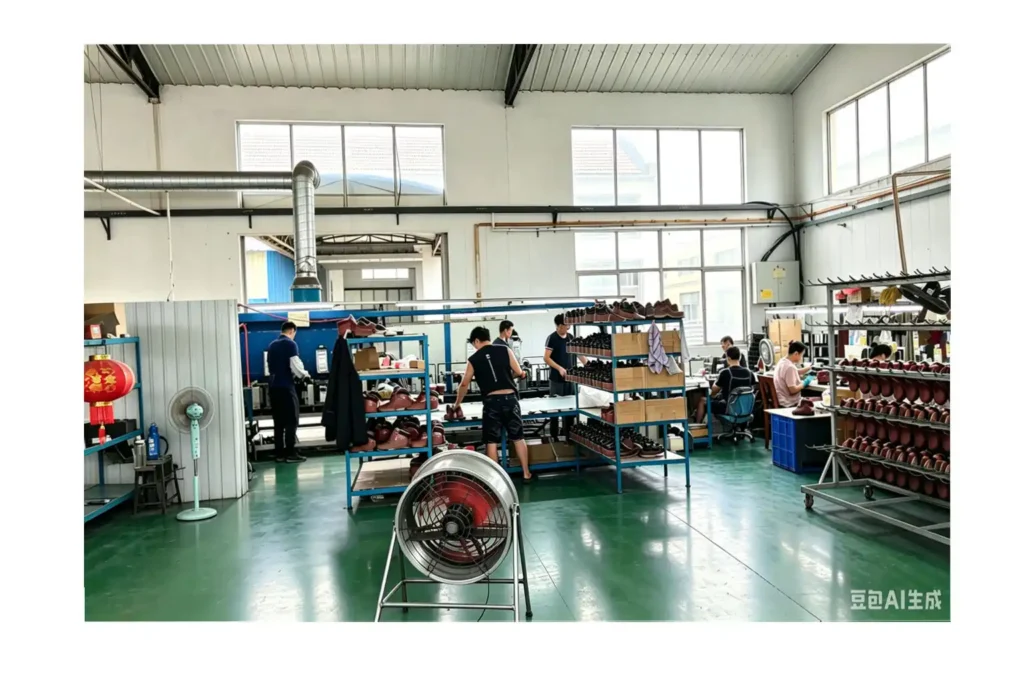
With extensive experience producing Australian-style safety boots, our factory can support steel or composite toe protection, penetration-resistant midsoles, wide-fitting lasts, premium nubuck and full-grain leather, side-zip constructions, waterproof systems, slip-resistant outsoles, lightweight safety sneakers, and private-label packaging.
Our Australian-focused manufacturing experience includes OEM production for established footwear and retail customers, supported by Australian factory-audit experience and BSI product certification for selected models. Product development can be matched to the intended industry, protection category, comfort expectations, and wholesale positioning.
Looking for reliable safety shoes for your Australian product range? Contact Ocean Safety Shoes to discuss certified product options, samples, custom designs, OEM or ODM development, quality inspection, and bulk production.