
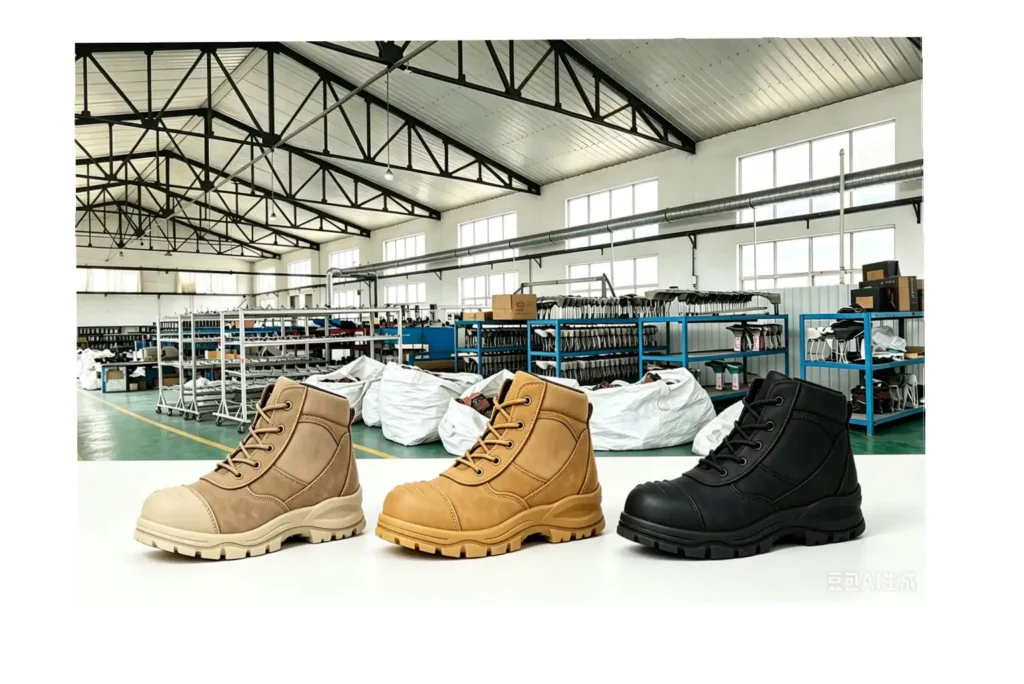
A PPE distributor wins a contract to supply 2,000 warehouse workers. The customer wants lightweight safety shoes with reliable slip resistance, a wide fit, and a colour scheme that matches its uniform. The distributor could offer a standard product already sold by several competitors—or create a private label model designed around the customer’s requirements.
That decision is becoming increasingly important.
Industrial buyers no longer evaluate safety footwear only by its toe cap. They compare comfort, weight, appearance, outsole performance, environmental suitability, certification, warranty support, and total cost of ownership. Distributors and workwear brands therefore need products that meet recognised safety requirements while giving customers a clear reason to choose their range.
Private label safety shoes manufacturers help businesses meet this demand. Instead of operating their own footwear factory, brands can work with an experienced manufacturing partner to develop protective work shoes under their own name. Depending on the project, customisation may cover materials, colours, lasts, toe caps, outsoles, safety features, labels, packaging, and complete original designs.
However, placing a logo on an existing shoe is not enough to build a successful private label programme. Safety footwear is PPE. Every design decision can affect comfort, durability, production consistency, certification, and legal compliance.
This guide explains why private label industrial safety shoes are becoming more attractive, what product options are available, how to select a manufacturer, which mistakes to avoid, and how brands can develop a reliable footwear range for European, American, and Australian markets.
What Are Private Label Safety Shoes?
Private label safety shoes are manufactured by a specialist factory and sold under another company’s brand. The brand owner may be a:
- PPE distributor
- Workwear company
- Safety footwear wholesaler
- Industrial supply business
- Retail chain
- Importer
- Online seller
- Uniform supplier
- Construction equipment company
- Regional footwear brand
The level of private labelling can vary considerably.
At the simplest level, a manufacturer supplies an existing certified model with the buyer’s logo, footbed, label, carton, and packaging. This approach normally involves less development work and can allow a lower minimum order quantity.
A more advanced project may include custom colours, upgraded leather, a different outsole, a wider last, a composite toe cap, a waterproof membrane, or market-specific performance features.
At the highest level, the manufacturer develops an original model from the buyer’s design brief. This may require new patterns, prototypes, tooling, wear trials, laboratory testing, certification, and dedicated production specifications.
Private Label, OEM, and ODM: What Is the Difference?
These terms often overlap, but there are useful distinctions:
- Private label manufacturing generally means producing footwear sold under the buyer’s brand.
- OEM manufacturing involves producing a product according to the buyer’s design or technical specification.
- ODM manufacturing involves the factory contributing product design, engineering, material selection, and development expertise.
A project can involve all three. For example, a distributor may choose an existing factory outsole, ask the manufacturer to design a new upper, and sell the completed model under its own brand.
The important question is not which acronym appears in the sales contract. It is who controls the design, intellectual property, certification, production specification, and future supply.
Why More Brands Are Choosing Private Label Safety Footwear Manufacturers
1. Stronger Brand Differentiation
Selling the same general product as every competitor usually leads to price comparison. Private label safety footwear gives a distributor more control over its market position.
A brand can develop products for a specific customer group, such as:
- Wide-fit safety boots for Australian tradespeople
- Lightweight safety sneakers for warehouse employees
- Waterproof safety shoes for utilities and outdoor maintenance
- Metal-free footwear for airports and controlled facilities
- Heavy-duty mining boots with reinforced protection
- Easy-clean slip resistant safety shoes for food processing
A well-planned range creates a recognisable brand identity through consistent colours, design language, comfort features, packaging, and product names. Customers begin to compare the overall value of the brand rather than only the price of an unbranded boot.
2. Better Control Over Product Specifications
A distributor buying standard wholesale stock must accept the supplier’s choices. Private label development allows the buyer to influence the complete specification.
Customisable elements may include:
- Upper material and thickness
- Leather colour and finish
- Toe-cap material
- Penetration-resistant insert
- Waterproof construction
- Outsole compound and tread
- Footbed density
- Shoe width and last shape
- Lacing, zipper, or dial closure
- Scuff protection
- Stitching colours
- Reflective details
- Product markings
- Packaging
This control makes it easier to match safety shoes to the hazards, climate, price range, and fitting expectations of a target market.
3. Improved Commercial Margins
Private label products can offer healthier margins because the brand is not paying for another company’s consumer branding or competing with identical products sold through multiple channels.
The buyer also controls wholesale and retail positioning more effectively. A distributor may create good, better, and best product levels rather than relying on one price point.
Higher margins are not automatic, however. Development expenses, tooling, certification, freight, inventory, returns, and marketing must all be included in the calculation. The strongest programmes improve margin by creating genuine customer value, not by simply choosing the cheapest factory.
4. Faster Entry Into New Product Categories
Building a footwear factory requires specialist machinery, trained workers, supply-chain relationships, quality systems, product engineering, and laboratory knowledge. For most PPE businesses, this would be expensive and unnecessary.
Working with an established private label safety shoes manufacturer gives the buyer access to existing:
- Footwear production lines
- Patterns and lasts
- Outsole moulds
- Material suppliers
- Development technicians
- Quality inspectors
- Safety components
- Testing experience
- Export packaging systems
A business can therefore expand from workwear, gloves, helmets, or general PPE into workplace safety footwear without becoming a footwear manufacturer itself.
5. Flexible Responses to Regional Demand
Safety footwear preferences differ by market.
Australian customers frequently favour sturdy ankle boots, side zippers, wide-fitting lasts, nubuck leather, and durable PU/TPU outsoles. European logistics buyers may prefer lightweight S1PS or S3S safety sneakers with composite protection. North American customers may ask for ASTM markings, electrical-hazard protection, and particular fitting systems.
Private label production allows a brand to adjust the product offer rather than forcing one global model into every region.
6. More Consistent Brand Experience
A private label programme can connect footwear with the rest of a PPE or workwear range.
The brand can coordinate:
- Colours with uniforms
- Product names with existing categories
- Packaging with corporate identity
- Size labels with local conventions
- Technical documents with sales materials
- Warranty procedures with existing service channels
This consistency is valuable for distributors supplying national accounts. Procurement managers generally prefer clear specifications, dependable replenishment, and straightforward product identification.
7. Closer Relationships With End Users
Private label brands can collect feedback directly from workers and use it for product improvement.
For example, warehouse employees may report heel movement during fast walking. Construction workers may request a more abrasion-resistant toe. Electricians may want a lighter metal-free design. A capable manufacturer can turn this feedback into pattern, material, or component changes.
That creates a useful cycle:
- Identify a workplace problem.
- Develop a product response.
- Conduct wearer trials.
- Improve the specification.
- Build a product that is difficult for competitors to copy directly.
What Are Safety Shoes and Why Are They Important?
Safety shoes are PPE designed to reduce exposure to foot injuries and other workplace hazards. Unlike ordinary work shoes, certified safety footwear is tested against specified performance requirements.
Depending on its design and certification, it may provide:
- Toe impact protection
- Compression resistance
- Sole penetration resistance
- Slip resistance
- Heel energy absorption
- Antistatic or electrical-hazard properties
- Resistance to water
- Fuel- and oil-resistant outsole performance
- Heat or cold protection
- Protection against selected chemicals
Safety footwear is used throughout construction, manufacturing, logistics, warehousing, mining, transport, agriculture, oil and gas, food production, utilities, and engineering.
In the United States, OSHA requires protective footwear where workers face risks from falling or rolling objects, objects piercing the sole, or certain electrical hazards that remain after other protective measures have been taken. The employer must first understand the hazard and then select appropriate PPE. (OSHA 29 CFR 1910.136)
For private label brands, this has an important commercial implication: safety shoes cannot be developed as fashion products with a toe cap added at the end. The design must begin with the intended work environment and applicable protection requirements.
Different Types of Private Label Safety Shoes Explained
Steel Toe Safety Shoes
Steel toe safety shoes use a metal cap to protect the toe area against impact and compression.
Features:
- Reliable impact and compression protection
- Thin protective profile
- Proven use in heavy industry
- Competitive component cost
- Good production availability
Benefits: Steel toe caps are a practical choice for high-volume industrial footwear and heavy-duty work boots.
Best applications: Construction, manufacturing, mining, engineering, workshops, transport, and material handling.
Private label options can include different leather colours, toe-bumper designs, outsole constructions, side zippers, pull-on styles, and branded hardware.
Composite Toe Safety Shoes
Composite toe caps may be manufactured from fiberglass, reinforced plastic, carbon composites, or other non-metallic materials.
Features:
- Metal-free construction
- Lower weight in many designs
- Reduced heat and cold transfer
- Suitable for metal-sensitive workplaces
Benefits: Composite toe safety shoes can improve comfort during long walking shifts and support metal-free product specifications.
Best applications: Warehouses, airports, logistics, electronics, light industry, cold storage, and some electrical occupations.
Brands should never assume that “composite” automatically means certified. The complete footwear construction must meet the required impact and compression performance.
Slip Resistant Safety Shoes
Slip resistance depends on the relationship between outsole compound, tread geometry, floor material, contaminants, and worker movement.
Features:
- Rubber, PU, TPU, or combined outsole systems
- Multi-directional tread
- Channels that help disperse liquids
- Defined heel and forefoot contact areas
Benefits: Correctly selected outsoles help workers maintain more secure footing on wet, oily, or smooth surfaces.
Best applications: Food processing, kitchens, healthcare, cleaning, warehousing, logistics, and industrial workshops.
For a private label project, the outsole should be tested for the intended standard and evaluated on representative workplace surfaces. No footwear is slip-proof in every environment.
Waterproof Safety Shoes
A truly waterproof safety shoe normally uses a waterproof membrane or bootie construction, sealed joints, and an appropriate upper.
Features:
- Water-resistant leather or synthetic upper
- Waterproof internal membrane
- Sealed or taped seams
- Gusseted tongue
- Water-resistant closure design
Benefits: Keeping feet dry can improve comfort and reduce distraction during outdoor work.
Best applications: Construction, agriculture, landscaping, road maintenance, utilities, and wet industrial environments.
Private label buyers must distinguish between “water-resistant upper” and “waterproof footwear.” These are different claims and may require different testing and product markings.
Electrical Hazard and ESD Safety Shoes
Electrical protection terminology must be used carefully. Electrical-hazard, antistatic, ESD, conductive, and electrically insulating footwear serve different purposes.
Features may include:
- Specially formulated sole materials
- Controlled electrical resistance
- Non-metallic components
- ESD-compatible footbeds
- Tested electrical performance
Best applications: Utilities, electrical maintenance, electronics assembly, laboratories, controlled manufacturing, and other risk-assessed environments.
A metal-free shoe is not automatically electrical-hazard footwear. The claim must be supported by the correct testing and certification.
How Private Label Safety Shoes Are Developed
Stage 1: Define the Market and User
A good development brief answers practical questions:
- Who will wear the shoe?
- What hazards are present?
- How long is a normal shift?
- Does the worker stand, walk, kneel, climb, or drive?
- Is the workplace indoor or outdoor?
- What climate will the footwear be used in?
- Which certification is required?
- What wholesale and retail price is realistic?
- How will the product be sold?
A lightweight warehouse shoe and a mining boot should not begin with the same design priorities.
Stage 2: Choose the Development Route
Brands generally have three routes.
Existing Certified Model
Select an existing factory model and customise branding, colours, footbeds, or packaging.
This route offers:
- Lower development risk
- Faster sampling
- Potentially lower MOQ
- Existing production experience
- Simpler cost control
Modified Platform
Use an existing outsole, last, or certified construction while developing a new upper or changing selected components.
This offers more differentiation but requires careful review of certification scope.
Fully Original Product
Create a new upper, last, outsole, or complete construction.
This provides maximum control but involves higher tooling costs, longer lead times, more testing, and greater commercial risk.
Stage 3: Select Materials and Components
The material specification should cover every significant component:
- Upper material
- Lining
- Collar and tongue foam
- Toe cap
- Penetration-resistant insert
- Footbed
- Midsole
- Outsole
- Thread
- Eyelets
- Laces
- Zippers or dial systems
- Reinforcement materials
- Waterproof membrane
- Labels and packaging
Small substitutions can change fit, appearance, durability, or test performance. The final specification should therefore be documented and approved before bulk production.
Stage 4: Develop and Evaluate Samples
The first sample checks the visual concept and basic construction. Later samples may be required for fitting, wear trials, branding, colour confirmation, and laboratory testing.
Sample evaluation should include:
- Length and width
- Toe-cap position
- Heel retention
- Flex point
- Pressure areas
- Shoe weight
- Closure function
- Stitching quality
- Upper-to-sole bonding
- Outsole grip
- Appearance after wear
- Compatibility with work socks
Wear trials should involve several workers rather than one buyer. Different feet can reveal fitting problems that are invisible on a sample-room table.
Stage 5: Test and Certify the Product
Applicable standards depend on the target market.
European and many international buyers commonly work with EN ISO 20345. The newer framework provides more detailed classifications for penetration resistance, water performance, slip resistance, and optional properties. ISO describes ISO 20345:2021 as covering basic and optional requirements involving mechanical risks, slip resistance, thermal risks, and ergonomic behaviour. (ISO 20345:2021)
The United States commonly uses ASTM F2413 for protective safety-toe footwear. Australia uses AS 2210.3:2019 for general-purpose safety footwear.
The certificate, test report, user instructions, footwear marking, packaging, and marketing claims must refer to the same product specification. Changing a toe cap, puncture insert, outsole compound, or waterproof structure after testing may affect compliance.
Stage 6: Confirm the Production Reference Sample
The approved reference sample should be signed or otherwise clearly identified. It becomes the standard for:
- Materials
- Colour
- Fit
- Stitching
- Logos
- Labels
- Sole appearance
- Workmanship
- Packaging
Both buyer and manufacturer should retain an approved sample.
Stage 7: Begin Controlled Mass Production
Quality checks should take place throughout production rather than only after the order is finished.
A typical control plan includes:
- Incoming-material inspection
- Leather thickness and colour checks
- Toe-cap and midsole verification
- Cutting accuracy
- Stitching inspection
- Lasting checks
- Injection or bonding controls
- Size verification
- Appearance inspection
- Packing and labelling checks
- Pre-shipment inspection
Safety Shoes Materials and Technologies
Leather Uppers
Full-grain leather is valued for strength, structure, and abrasion resistance. It is suitable for premium industrial safety shoes, construction boots, and mining footwear.
Nubuck leather provides a softer surface and is popular in Australian-style work boots. Split suede offers a more economical option for general industrial footwear.
Leather grade, thickness, colour consistency, and treatment should be specified. Descriptions such as “genuine leather” are too broad for controlled production.
Mesh and Knitted Uppers
Mesh, flyknit, and technical textiles reduce weight and improve ventilation. They work well in safety sneakers for warehousing, logistics, and light industry.
High-wear areas should include reinforcement such as microfiber, hot-cut TPU, printing, or abrasion-resistant overlays.
Synthetic and Microfiber Uppers
Microfiber can offer consistent colour, easy cleaning, controlled thickness, and flexible design possibilities. It is commonly used for sport safety shoes, food-industry footwear, and budget-sensitive product lines.
PU Outsoles
PU/PU outsoles are lightweight and provide good cushioning. Dual-density constructions combine a softer midsole with a harder wearing layer.
PU/TPU constructions add a durable, abrasion-resistant TPU contact surface and are common in premium work boots.
Rubber Outsoles
Rubber provides strong abrasion resistance, traction, and heat performance when formulated for the application. EVA/rubber and PU/rubber constructions combine cushioning with a durable outer sole.
The exact compound matters. A tread pattern cannot compensate for an unsuitable or inconsistent rubber formula.
Comfort Technologies
Private label brands can improve all-day comfort through:
- Wide-fitting lasts
- Removable PU footbeds
- EVA cushioning
- Shock-absorbing heel structures
- Breathable linings
- Padded collars
- Flexible textile midsoles
- Lightweight composite toe caps
- Reduced shoe weight
- Correct forefoot flex
Comfort should not be treated as decoration. It affects worker acceptance, repeat purchases, and product returns.
How to Choose a Private Label Safety Shoes Manufacturer
1. Confirm That It Is a Real Factory
A factory should be able to explain its production processes, equipment, capacity, quality controls, material sourcing, and sample-development workflow.
Request:
- Factory profile
- Production-line photographs or video
- Business and quality documentation
- Current product examples
- Audit reports where relevant
- Details of injection and cemented production capabilities
A trading company can still provide useful service, but buyers should understand who actually controls manufacturing.
2. Review Product-Development Capability
A capable manufacturer should do more than change a logo. Evaluate whether the factory can:
- Interpret a product brief
- Develop patterns
- Modify fitting
- Recommend materials
- Create sport and industrial designs
- Produce technical specifications
- Develop prototypes
- Coordinate testing
- Correct sample problems
Ask who owns new tooling, patterns, moulds, artwork, and designs.
3. Verify Certification Experience
Review original certificates and test reports. Check:
- Model name and photograph
- Standard and protection category
- Certified size range
- Toe-cap and midsole type
- Outsole construction
- Issuing body
- Report date and validity
- Factory identity
- Required markings
Do not accept a certificate simply because the tested shoe looks similar.
4. Examine Quality-Control Systems
The factory should control incoming materials, in-process production, finished footwear, and packaging.
Important tests may include:
- Upper thickness
- Colour consistency
- Stitch strength
- Flex resistance
- Sole adhesion
- Size and fitting
- Toe-cap positioning
- Waterproof performance
- Outsole hardness
- Product weight
- Metal detection where required
Ask how non-conforming production is identified, separated, corrected, and documented.
5. Discuss MOQ and Scalability
A low MOQ is useful for testing a new market, but it must be commercially realistic. Custom materials, colours, outsoles, and packaging often have their own supplier minimums.
Ask separately about:
- MOQ per style
- MOQ per colour
- MOQ per outsole
- Size-ratio requirements
- Packaging minimums
- Repeat-order quantities
- Maximum monthly capacity
The ideal manufacturer can support a trial order and scale production if the model succeeds.
6. Evaluate Communication
Private label development involves numerous decisions. Slow or unclear communication can cause expensive errors.
A strong supplier should provide:
- Written specifications
- Clear sample comments
- Updated timelines
- Photographs of key stages
- Transparent cost changes
- Fast identification of technical risks
- Corrective-action support
The best answer is not always “yes.” A factory that explains why a requested change may affect fit, durability, or certification is providing valuable technical guidance.
Common Mistakes When Buying Private Label Safety Shoes
Choosing Price Over Quality
A low quotation may hide thinner materials, inconsistent components, weak bonding, or limited quality control.
Solution: Compare the full bill of materials, construction, certification, inspection plan, warranty exposure, and expected service life.
Ignoring Comfort and Fit
A visually attractive shoe can still fail commercially if workers experience tight toe space, heel movement, pressure points, or excessive weight.
Solution: Conduct multi-user fitting and wear trials across several sizes.
Selecting the Wrong Protection Level
Adding every possible feature increases cost and weight. Removing essential protection creates safety and compliance risks.
Solution: Connect each feature to a documented workplace hazard or customer requirement.
Changing Materials After Certification
A supplier may propose a cheaper outsole compound or alternative toe cap after testing.
Solution: Establish a change-control process. No safety-critical material should be substituted without technical and certification review.
Focusing Only on the Shoe
Incorrect labels, cartons, user instructions, online claims, and declarations can create compliance problems even when the footwear itself performs correctly.
Solution: Include all documentation and packaging in the approval process.
Ordering Too Much Too Early
A new design may look promising but still require market feedback.
Solution: Begin with a commercially sensible trial order, measure sell-through and returns, and scale carefully.
Ignoring Maintenance Information
Workers may damage waterproof footwear with direct heat or allow tread to fill with grease and debris.
Solution: Include simple, market-appropriate care and inspection instructions with every pair.
Benefits of Investing in Quality Private Label Safety Shoes
Reduced Workplace Injury Risk
Certified products matched to the intended hazards support a safer working environment.
Better Employee Comfort
Proper fit, lower weight, breathability, and effective cushioning can improve acceptance during long shifts.
Greater Customer Loyalty
When workers trust the fit and durability of a model, they are more likely to request the same product again.
Lower Replacement and Return Costs
Consistent materials and controlled production can reduce premature failure, warranty claims, and sizing returns.
Improved Market Position
A distinctive range allows the brand to compete through product value rather than price alone.
More Valuable Customer Conversations
A distributor with its own safety footwear range can discuss workplace hazards, fitting, and product development directly with customers. This strengthens its role as a safety partner instead of a catalogue reseller.
How to Maintain Safety Shoes for a Longer Lifespan
Private label brands should provide clear maintenance instructions because correct care protects both the worker and the brand’s reputation.
Cleaning
Remove loose dirt with a soft brush. Clean leather, textile, or microfiber uppers with products suitable for the material. Remove mud, grease, and stones from the tread.
Drying
Allow footwear to dry naturally in a ventilated area. Remove footbeds and loosen laces. Do not place shoes against heaters or open flames, as excessive heat can damage leather, membranes, adhesives, and sole materials.
Storage
Store safety footwear in a dry location away from sunlight, extreme temperatures, and chemicals.
Inspection Checklist
Workers should check for:
- Worn or smooth tread
- Cuts and cracks
- Sole separation
- Damaged stitching
- Exposed toe caps
- Penetration damage
- Broken closures
- Waterproof-lining failure
- Permanent chemical contamination
- Loss of fit or support
Replacement Timing
There is no universal replacement schedule. Safety shoes should be replaced when wear or damage may reduce protection. Footwear involved in a major impact should be removed from service even if the damage is not immediately visible.
Safety Shoes Buying Guide for Private Label Businesses
Develop a Product Matrix
Organise the range by user, hazard, certification, and price level. For example:
- Lightweight composite toe shoe for logistics
- Waterproof leather boot for outdoor construction
- Side-zip safety boot for tradespeople
- Heavy-duty mining boot
- ESD safety sneaker for electronics
- Easy-clean slip-resistant shoe for food processing
This prevents unnecessary duplication and helps sales teams recommend the correct model.
Calculate the Complete Landed Cost
Include:
- Product cost
- Sampling
- Tooling
- Laboratory testing
- Certification
- Packaging
- Inspection
- Freight
- Duties
- Warehousing
- Marketing
- Warranty allowance
- Inventory financing
A product with a slightly higher factory cost may produce better margins if it generates fewer returns and stronger repeat sales.
Protect Product Consistency
Use detailed specifications, signed samples, material records, colour standards, inspection criteria, and change-control procedures.
Plan Packaging for the Market
Packaging requirements may include:
- Branded shoeboxes
- Size and model labels
- Standard and category markings
- User instructions
- Barcodes
- Country-of-origin information
- Importer details
- Carton dimensions and strength
- Retail or e-commerce presentation
Packaging must protect the product during international transport while presenting clear, accurate information.
Build a Long-Term Supplier Relationship
Private label safety footwear improves over several production cycles. A stable relationship allows the factory and buyer to refine fit, materials, quality controls, packaging, and forecasting.
Changing factories purely for a small price reduction can introduce new variations in fit, colour, outsole performance, and workmanship.
Frequently Asked Questions About Private Label Safety Shoes
1. How long do safety shoes usually last?
Quality safety shoes may last approximately six to eighteen months, but usage conditions vary widely. Abrasive surfaces, water, chemicals, long walking distances, and poor maintenance can shorten their service life.
2. Are steel toe safety shoes better than composite toe shoes?
Neither is better for every application. Steel toe caps are durable and cost-effective, while composite toe caps can reduce weight, thermal transfer, and metal content. The complete shoe must meet the required standard.
3. What industries require safety shoes?
Construction, manufacturing, mining, warehousing, logistics, transport, oil and gas, agriculture, utilities, engineering, and food processing commonly use safety footwear. Requirements should be based on workplace risk assessment.
4. Are private label safety shoes comfortable for all-day wear?
They can be designed for long shifts through correct fitting, breathable linings, cushioned footbeds, stable midsoles, lightweight components, and flexible construction. Wear trials remain essential.
5. How do I choose the correct size range for private label production?
Use sales data from the target market and consider local size systems, workforce demographics, last width, and customer fit expectations. Include several fitting sizes during development rather than evaluating only one sample size.
6. How often should safety shoes be replaced?
Replace footwear when the outsole, upper, protective components, stitching, waterproof structure, or support is damaged. Replacement should be based on condition and exposure rather than a fixed date alone.
7. What safety standards should private label safety shoes meet?
Common standards include EN ISO 20345 for European and many international markets, ASTM F2413 for the United States, and AS 2210.3:2019 for Australia. Specialised hazards may require additional standards.
8. Can a factory place our logo on an already-certified model?
Usually, yes, but branding, labels, construction changes, and certification ownership must be reviewed. Confirm that the certificate applies to the exact product and that the required conformity documentation can legally support your brand and market.
Conclusion
More brands are choosing private label safety shoes manufacturers because the model offers a practical combination of product control, brand differentiation, market flexibility, and manufacturing expertise.
For distributors, importers, wholesalers, retailers, and PPE companies, private label safety footwear creates an opportunity to develop products around real customer needs. Steel toe safety shoes can be configured for construction and heavy industry. Composite toe safety shoes can serve logistics and metal-free workplaces. Waterproof safety shoes can address outdoor use, while specialised slip-resistant or electrical products can support more focused applications.
Success, however, depends on disciplined development. Brands must define the user, identify workplace hazards, select the correct materials, verify safety standards, conduct wearer trials, approve accurate samples, and monitor mass production. Quality industrial safety shoes are not created by adding a logo to a generic product. They are built through cooperation between the brand, factory, testing organisations, and end users.
When that process is managed well, private label protective work shoes can deliver reliable protection, all-day comfort, better customer loyalty, and sustainable commercial value.
Build Your Private Label Safety Footwear Range with Ocean Safety Shoes
Ocean Safety Shoes supports safety footwear brands, importers, distributors, wholesalers, and industrial suppliers with OEM, ODM, and private label manufacturing.
Our production group operates three factories covering approximately 15,000 square metres, with four PU injection lines, two cemented production lines, and daily capacity of up to 5,000 pairs. Available development options include industrial leather boots, Australian-style work boots, lightweight sport safety shoes, waterproof footwear, mining boots, steel or composite toe protection, custom colours, branded components, and private label packaging.
For brands testing a new category, selected existing designs may support flexible orders from approximately 300 pairs, subject to material and colour availability. Larger programmes can be developed with dedicated specifications, samples, quality inspections, testing support, and scalable production.
Looking for a reliable private label safety shoes manufacturer? Contact Ocean Safety Shoes to discuss your target industry, certification requirements, price range, design concept, sample development, and wholesale production needs.