
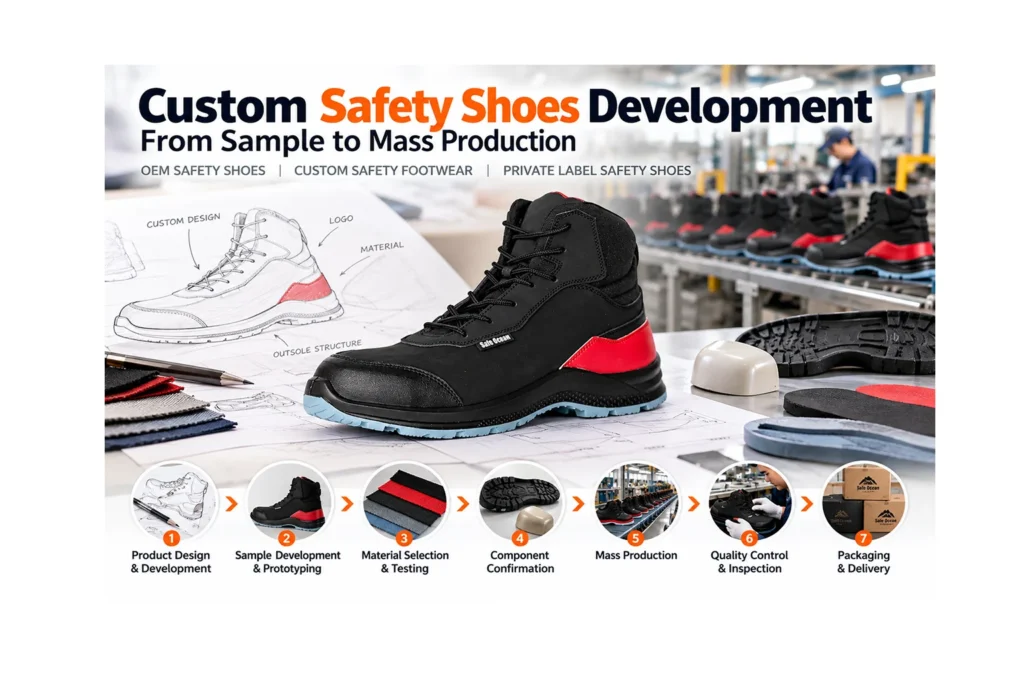
Developing custom safety shoes involves much more than choosing a footwear design and adding a company logo. For PPE distributors, importers, industrial footwear brands, and wholesale buyers, successful product development requires coordination between design, material selection, technical specifications, sampling, testing, and manufacturing.
Imagine a European PPE distributor planning to launch a new range of lightweight safety shoes under its own brand. The company has identified its target customers, selected a preferred design, and established a competitive selling price. However, turning that concept into a commercially viable product requires several important decisions.
Which outsole construction should be used? Will the product need a new mould? How many sample revisions are necessary? What happens if the bulk production differs from the approved sample?
These questions illustrate why working with an experienced safety footwear manufacturer matters.
This guide explains the complete custom safety footwear development process, from the initial product brief to sample approval, quality inspection, and mass production. It also provides practical guidance for businesses developing OEM safety shoes or launching private-label footwear collections.
What Is Custom Safety Shoes Development?
Custom safety shoes development is the process of creating protective footwear according to a buyer’s specific design, branding, performance, and commercial requirements.
Unlike purchasing standard products from an existing catalogue, custom development allows businesses to influence different elements of the footwear.
Depending on the manufacturing arrangement, these may include:
- Upper design and materials.
- Protective toe-cap selection.
- Outsole construction.
- Colour combinations.
- Insole and lining materials.
- Logo placement.
- Packaging and labelling.
- Product specifications for the intended market.
However, not every customisation project requires an entirely new shoe.
OEM Safety Shoes vs Private Label Safety Shoes
OEM and private-label manufacturing are related, but the development scope can differ.
| Development Model | Main Characteristics | Typical Buyer |
|---|---|---|
| Private label | Existing factory model with custom branding and packaging | New footwear brands and distributors |
| Modified OEM | Existing construction with selected material or design changes | Established PPE suppliers |
| Full custom development | New design with potentially new lasts, tooling, and components | Brands developing differentiated product ranges |
Private-label projects generally use an established manufacturing platform, while more extensive OEM projects may involve additional engineering, tooling, and testing.
For businesses entering the protective footwear market, understanding this distinction helps establish realistic development expectations.
Step 1: Define Your Custom Safety Footwear Requirements
A successful development project begins with a clear product brief.
Before contacting a manufacturer, buyers should identify the target market, intended workplace applications, required protective features, and commercial objectives.
Identify the Target Market and Workplace Application
Safety footwear requirements vary between industries and geographical markets.
For example, footwear intended for construction workers may require different characteristics from shoes designed for warehouse employees or food-processing personnel.
Consider the following questions:
- Which industries will use the product?
- Will the footwear be worn indoors or outdoors?
- What workplace hazards must it address?
- Is waterproofing necessary?
- What level of comfort and breathability is expected?
- Which countries will the finished product be sold in?
A clear application profile helps the manufacturer recommend appropriate materials and construction methods.
Establish Technical Specifications
The product brief should identify essential protective and functional requirements.
| Product Component | Possible Specification |
|---|---|
| Upper | Full-grain leather, nubuck, microfiber, or technical textile |
| Toe protection | Steel or composite toe cap |
| Midsole | Appropriate penetration-resistant construction, if required |
| Outsole | PU, rubber, or combined construction |
| Lining | Breathable textile or specified moisture-management material |
| Insole | Removable cushioned footbed |
| Fastening | Laces, side zipper, or rotary closure |
| Branding | Logo, labels, insole printing, and packaging |
These specifications should reflect the intended workplace and applicable product requirements.
Protective features must be verified through appropriate testing rather than assumed from the materials used.
Step 2: Select the Right Safety Shoes Manufacturer
The manufacturer plays an important role throughout the development process.
A capable factory should understand not only footwear production but also how design decisions affect manufacturability, product consistency, and protective performance.
Evaluate Product Development Capability
Before beginning an OEM project, ask whether the manufacturer can support:
- Technical specification development.
- Material sourcing.
- Existing last and outsole selection.
- Custom tooling coordination.
- Sample production.
- Product testing arrangements.
- Bulk manufacturing.
- Quality inspection.
Some suppliers specialise in producing existing models, while others can support more extensive product-development projects.
The appropriate partner depends on the complexity of your requirements.
Confirm Communication and Project Responsibilities
Technical misunderstandings can become expensive during sampling and production.
Establish a clear communication process covering design approval, sample revisions, specification changes, testing responsibilities, and production milestones.
A written development brief helps both parties maintain consistent expectations.
Step 3: Develop the Initial Safety Shoes Design
Once the technical requirements are agreed upon, the manufacturer can begin translating the product concept into a workable design.
This stage may involve sketches, reference images, material selection, component planning, and construction evaluation.
Select an Existing Last and Outsole or Develop New Tooling
The last determines the basic shape and fit of the footwear, while the outsole influences traction, durability, flexibility, and other performance characteristics.
Using existing factory components can simplify development.
A completely new design may require additional work, such as:
- New last development.
- Outsole mould design.
- Tooling preparation.
- Component compatibility evaluation.
- Additional sample revisions.
For buyers launching their first custom collection, using an established construction platform may provide a practical starting point.
Finalise Branding and Product Appearance
Branding can be incorporated into several footwear components.
Common options include upper logos, tongue labels, heel markings, insole printing, custom colours, and branded packaging.
Logo placement should be evaluated during the design stage to ensure it is compatible with the selected materials and manufacturing process.
Branding changes should not interfere with protective components, mandatory product markings, or the integrity of the footwear.
Step 4: Safety Shoes Sample Development and Prototype Evaluation
The sampling stage is one of the most important parts of custom footwear development.
A sample allows the buyer and manufacturer to evaluate whether the proposed design can meet the agreed requirements before committing to mass production.
However, an attractive sample does not automatically demonstrate that a product meets the required safety standards.
First Prototype Development
During the initial sampling stage, the manufacturer assembles the proposed footwear using the selected materials and components.
The first prototype helps evaluate:
- Overall appearance and proportions.
- Upper construction.
- Fit and sizing.
- Outsole compatibility.
- Material combinations.
- Logo positioning.
- Stitching and assembly.
- General comfort.
Buyers should review the prototype against the original product brief rather than making decisions based only on appearance.
Sample Evaluation and Revisions
A common mistake is providing vague feedback such as “make the shoe more comfortable” or “improve the quality.”
Instead, communicate specific changes.
For example:
- Increase the available space around the forefoot.
- Adjust the tongue padding.
- Change the upper material.
- Modify the logo position.
- Improve the heel fit.
- Review the outsole flexibility.
A structured sample evaluation form can help document each revision.
| Evaluation Area | What to Check | Possible Action |
|---|---|---|
| Appearance | Colour, shape, and branding | Confirm or revise design |
| Fit | Length, width, and heel stability | Adjust sizing or construction |
| Comfort | Cushioning and pressure points | Review insole and lining |
| Materials | Texture, thickness, and finish | Approve or replace materials |
| Construction | Stitching and sole attachment | Correct manufacturing details |
| Protection | Required technical specifications | Arrange appropriate testing |
Once revisions are completed, the manufacturer can produce an updated sample for approval.
Approving the Final Reference Sample
The approved sample should become the reference for subsequent manufacturing.
Before production begins, confirm that the sample corresponds to the agreed technical specification.
Retain clear records of approved materials, colours, components, dimensions, branding, and packaging.
Where practical, both the buyer and manufacturer should retain an approved reference sample.
This helps prevent disputes if differences arise during bulk production.
Step 5: Product Testing and Safety Compliance
Safety footwear differs from ordinary fashion footwear because its protective performance must meet the requirements applicable to the intended product and market.
Testing should be considered throughout development, not treated as an administrative task after manufacturing.
Identify Applicable Market Standards
Different markets use different footwear standards and conformity frameworks.
Common references include:
| Target Market | Relevant Standards or Requirements |
|---|---|
| European Union | EN ISO 20345 and applicable PPE conformity requirements |
| United States | ASTM F2413 and applicable workplace requirements |
| Australia and New Zealand | Relevant AS/NZS occupational protective footwear requirements |
| Other international markets | Applicable national standards and customer specifications |
The correct standard, edition, certification procedure, and documentation requirements should be confirmed for each destination market.
For example, a product intended for the European Union may require conformity assessment under the applicable PPE regulatory framework, rather than simply passing an isolated laboratory test.
Verify Protective Performance
Depending on the intended footwear specification, testing may cover:
- Toe impact and compression resistance.
- Penetration resistance.
- Slip resistance.
- Outsole performance.
- Water resistance.
- Electrical characteristics.
- Other applicable protective properties.
Not every safety shoe requires every feature.
Buyers should define the intended protection level before development and ensure that testing corresponds to the actual product configuration.
Changing components after testing may require further evaluation.
Step 6: Prepare Custom Safety Shoes for Mass Production
After the design, specifications, and required testing have been finalised, the project can move into production preparation.
This stage connects product development with commercial manufacturing.
Confirm the Production Specification
The manufacturer and buyer should agree on a final specification sheet covering:
- Approved product design.
- Materials and component references.
- Colour combinations.
- Size range.
- Logo and label requirements.
- Packaging instructions.
- Product markings.
- Quality acceptance criteria.
- Order quantity.
- Production schedule.
Changes should be documented and approved before implementation.
Confirm MOQ and Material Availability
Minimum order quantity (MOQ) depends on factors such as the selected construction, material requirements, colour variations, and production arrangements.
For example, a factory may be able to produce a custom logo on an existing model with fewer development requirements than a project involving a proprietary outsole.
Buyers should clarify whether MOQ applies per model, colour, size assortment, or total order.
Material availability should also be confirmed before establishing the production schedule.
Approve the Pre-Production Sample
A pre-production sample should represent the final approved manufacturing specification, using the intended production materials and components.
It provides an opportunity to verify that the factory has correctly implemented all development changes.
Bulk production should begin only after the agreed approval requirements have been satisfied.
Step 7: Understanding the Safety Shoes Manufacturing Process
The safety shoes manufacturing process involves multiple coordinated operations. The exact sequence depends on the product design, construction method, and factory equipment.
Understanding the main stages helps procurement teams identify appropriate inspection points.
Material Preparation and Cutting
The factory prepares the selected upper materials, lining components, reinforcement materials, and other required parts.
Materials are cut according to the approved patterns and size specifications.
Incoming material inspection is important because variations in thickness, colour, or material properties can affect finished-product consistency.
Upper Stitching and Assembly
Cut components are stitched together to create the footwear upper.
Depending on the design, this stage includes attaching reinforcement components, linings, eyelets, labels, and other accessories.
Stitching accuracy and component positioning should be checked throughout production.
Lasting and Sole Attachment
The upper is shaped around the last before being joined to the sole.
Different footwear constructions may use direct injection, cemented construction, or other suitable manufacturing methods.
The selected method should be compatible with the intended product specification and required performance.
Finishing and Packaging
After assembly, the footwear undergoes finishing operations and final inspection.
Typical checks include appearance, workmanship, sizing, branding, component placement, and packaging accuracy.
The finished products are then packed according to the approved commercial requirements.
Step 8: Quality Control During Bulk Production
One of the biggest concerns for international buyers is whether bulk production will remain consistent with the approved sample.
Quality control should therefore take place throughout manufacturing rather than only after the order has been completed.
Incoming Material Inspection
Before production, materials and components should be checked against the agreed specification.
This may include examining upper materials, protective components, outsole materials, accessories, and packaging.
In-Process Quality Control
During manufacturing, inspection points may cover cutting accuracy, stitching quality, component positioning, assembly, and sole attachment.
Identifying problems early can reduce the number of defective finished products.
Final Product Inspection
Finished footwear should be inspected according to an agreed inspection plan.
For larger orders, buyers may also arrange an independent pre-shipment inspection.
| Inspection Stage | Main Purpose |
|---|---|
| Incoming inspection | Verify materials and components |
| Cutting and stitching | Check workmanship and dimensional consistency |
| Assembly | Verify construction and component positioning |
| Final inspection | Compare finished footwear with approved specifications |
| Pre-shipment inspection | Check order quality, quantities, and packaging |
Visual inspection is not a substitute for laboratory testing or conformity assessment where these are required.
Step 9: Packaging, Shipping, and Delivery Planning
Once production and inspection are complete, the final stage involves preparing the order for international delivery.
For importers and distributors, packaging and logistics should be discussed during development rather than immediately before shipment.
Custom Packaging Requirements
Private-label safety shoes may require branded shoe boxes, carton markings, product labels, and market-specific instructions.
Buyers should provide artwork and packaging specifications early enough to allow printing and approval.
Packaging should protect the footwear during transportation while displaying the necessary product information.
Confirm Shipping and Commercial Terms
Before shipment, agree on the relevant Incoterm, delivery arrangements, shipping documentation, and responsibility for customs clearance.
The buyer should also confirm that the required commercial and product documentation is available.
Clear arrangements help reduce avoidable delays and unexpected costs.
Common Mistakes in Custom Safety Shoes Development
Even experienced buyers can encounter problems when development requirements are not clearly established.
Starting Development Without a Complete Product Brief
Incomplete requirements often lead to repeated revisions.
Prepare a detailed brief covering product applications, protective specifications, design, materials, branding, and commercial expectations.
Changing Materials After Sample Approval
Material changes can affect fit, appearance, durability, and potentially protective performance.
Any proposed substitution should be evaluated and formally approved before implementation.
Focusing Only on the Sample Appearance
A visually attractive prototype does not demonstrate production consistency or compliance.
Review construction, fit, technical documentation, and manufacturing capability alongside appearance.
Skipping Pre-Production Approval
Moving directly from an early prototype into mass production increases the risk of specification differences.
Approve a final production reference before manufacturing begins.
Ignoring Repeat-Order Consistency
Private-label brands need consistency across multiple production batches.
Maintain documented specifications, approved samples, material references, and quality requirements for future orders.
Frequently Asked Questions About Custom Safety Shoes
How Long Does Custom Safety Shoes Development Take?
Development time depends on product complexity, material availability, tooling requirements, sample revisions, and testing. Modifying an existing factory model is generally faster than creating an entirely new footwear construction.
What Is the Difference Between OEM and Private Label Safety Shoes?
Private-label projects commonly use existing factory designs with custom branding. OEM projects may involve more extensive modifications or product development according to the buyer’s specifications.
Do Custom Safety Shoes Require New Moulds?
Not always. Existing lasts and outsole moulds can often be used for customised products. New tooling may be required when developing a proprietary design or construction.
How Many Samples Are Needed Before Mass Production?
There is no universal number. The project may require an initial prototype, revised samples, and a final pre-production sample. More complex designs may need additional development rounds.
Can a Manufacturer Produce Custom Safety Shoes for Different Markets?
Manufacturers may develop footwear for different international markets, but buyers must confirm the applicable standards, testing requirements, conformity procedures, and product documentation for each destination.
Can I Add My Own Brand Logo to Safety Shoes?
Yes. Common branding options include upper logos, tongue labels, insole printing, heel markings, and custom packaging. Available methods depend on the selected materials and footwear construction.
What Should Buyers Check Before Approving Mass Production?
Confirm the final sample, technical specification, materials, size range, required testing, branding, packaging, quality criteria, order quantity, and delivery arrangements.
How Can I Maintain Quality Across Repeat Orders?
Use documented specifications, approved reference samples, consistent material requirements, agreed inspection procedures, and formal approval for any proposed production changes.
Conclusion
Developing custom safety shoes is a structured process that connects product design, technical requirements, sample development, testing, and manufacturing.
For importers, distributors, and private-label brands, successful development depends on defining clear requirements from the beginning and maintaining consistency throughout every production stage.
The most important milestones include establishing a detailed product brief, evaluating prototypes, confirming applicable safety requirements, approving the final production sample, and implementing appropriate quality control during mass production.
A well-managed development process can help businesses reduce unnecessary revisions, improve product consistency, and establish a repeatable manufacturing arrangement for future footwear collections.
Develop Your Custom Safety Shoes With Ocean Safety Shoes
Ocean Safety Shoes is a professional safety footwear manufacturer supporting international B2B customers with OEM/ODM manufacturing, private-label footwear, and custom product development.
Whether you are planning to modify an existing safety shoe model or develop a new branded footwear collection, our manufacturing solutions can support discussions around product specifications, materials, sample development, branding, packaging, and bulk production.
Explore our safety footwear product collection or visit Ocean Safety Shoes to discuss your custom footwear requirements.