
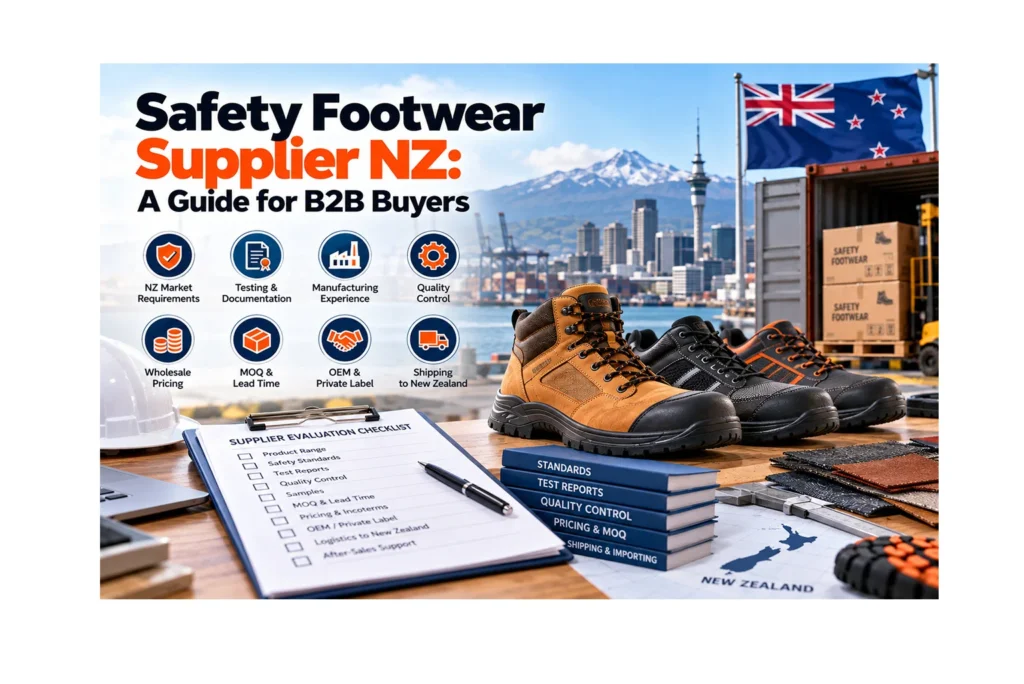
Finding a reliable safety footwear supplier NZ businesses can work with is not simply a matter of comparing product catalogues and asking for the lowest price.
For New Zealand PPE distributors, importers, wholesalers, construction suppliers, industrial companies, and private-label brands, the supplier decision can affect product compliance, worker protection, inventory availability, landed cost, and long-term business reputation.
A supplier may offer attractive pricing but provide incomplete testing documentation. Another may produce an excellent sample but struggle to maintain consistent quality across a 3,000-pair order. A third may manufacture suitable footwear but have little understanding of New Zealand market requirements.
These differences matter.
WorkSafe New Zealand advises PPE suppliers and importers to conduct due diligence on their supply chains, including investigating manufacturers, reviewing quality systems, confirming critical-component supply chains, ensuring traceability, and considering independent testing.
This guide explains how to evaluate a safety footwear manufacturer or supplier for New Zealand, from standards and quality control to wholesale pricing, samples, importing, and long-term supply capability.
What Should a Safety Footwear Supplier NZ Buyers Provide?
A professional supplier should do more than send a price list.
For B2B buyers, the supplier should be capable of supporting the technical and commercial requirements associated with protective footwear.
Important capabilities include:
| Supplier Capability | What NZ Buyers Should Evaluate |
|---|---|
| Product range | Suitable footwear for target industries |
| Technical knowledge | Understanding of protective components and applications |
| Documentation | Relevant test and product documentation |
| Quality control | Incoming, production and finished-product inspections |
| Manufacturing | Capacity and production consistency |
| Samples | Ability to provide representative samples |
| OEM/ODM | Branding and custom development if required |
| MOQ | Suitable for the buyer’s purchasing volume |
| Logistics | Experience with international shipments |
| Communication | Clear technical and commercial responses |
| After-sales support | Process for defects and repeat-order issues |
The relative importance of these factors depends on whether you are buying a standard model, importing a private-label range, or developing new footwear from the factory.
Understand New Zealand PPE Requirements Before Choosing a Supplier
Supplier evaluation should begin with the intended workplace and product requirements—not with a catalogue.
New Zealand’s WorkSafe guidance states that PPE selected by a business must be appropriate for the work and associated risks, suitably sized and reasonably comfortable, compatible with other PPE, and maintained, repaired and replaced so it continues to protect workers.
Safety boots are specifically included as an example of protective clothing in WorkSafe guidance.
Identify the Intended Workplace
Before approaching suppliers, determine where the footwear will be used.
Common New Zealand applications may include:
- Construction
- Warehousing and logistics
- Manufacturing
- Agriculture
- Infrastructure
- Utilities
- Engineering
- Food processing
- Outdoor maintenance
A construction boot and a lightweight warehouse safety shoe can require very different specifications.
For example, an outdoor worker may prioritise weather protection and suitable traction, while a warehouse employee may place greater emphasis on lightweight construction and all-day comfort.
Confirm Applicable Safety Standards
Buyers should establish the relevant standard and product requirements for the intended application before approving an order.
WorkSafe recommends selecting protective clothing that meets applicable Australian/New Zealand standards and says suppliers should be able to advise whether products meet those requirements.
Do not accept vague statements such as:
“Our shoes meet international safety standards.”
Instead, ask:
Which standard? Which edition? Which model was tested? Which laboratory or certification body was involved? Does the documentation correspond to the product I am buying?
Those questions are much more useful during supplier evaluation.
Step 1: Decide What Type of Safety Footwear Supplier You Need
Not every supplier operates under the same business model.
Understanding the differences helps buyers choose an appropriate sourcing strategy.
Local New Zealand Distributor
A local distributor can be useful when businesses need:
- Small quantities
- Fast domestic delivery
- Existing NZ inventory
- Simple replacement ordering
- Multiple brands
- Local sales support
This model can be particularly suitable for smaller companies or businesses requiring frequent low-volume replenishment.
Overseas Safety Footwear Manufacturer
Buying directly from a safety footwear manufacturer can be attractive for larger distributors, wholesalers, importers, and private-label brands.
Potential advantages include:
- Factory-direct purchasing
- OEM/ODM development
- Custom branding
- Packaging customisation
- Material selection
- Product development
- Larger-volume manufacturing
The trade-off is that buyers generally need to manage longer lead times, international freight, customs procedures, inventory planning, and larger order quantities.
Trading Company
A trading company may source footwear from several factories and provide a wider product selection.
This can simplify purchasing when buyers need multiple product categories.
However, buyers should understand who actually manufactures each product and who controls product specifications, testing, and quality.
Step 2: Evaluate the Supplier’s Manufacturing Experience
A professional-looking website does not prove manufacturing capability.
New Zealand buyers sourcing internationally should investigate the organisation behind the quotation.
WorkSafe specifically recommends that PPE suppliers verify manufacturer contact details and company history, examine experience producing PPE, review quality management systems, and confirm the consistency of critical materials and components.
Ask About Production Capability
Useful questions include:
- How long have you manufactured safety footwear?
- Which types of safety footwear do you produce?
- Which production processes are performed internally?
- What is your approximate production capacity?
- Which markets do you currently supply?
- How do you control critical components?
- How are repeat orders kept consistent?
The objective is not simply to find the largest factory.
You need a supplier whose capabilities match your purchasing requirements.
Factory Audit
For significant purchasing programmes, consider conducting a factory audit or using an independent audit company.
An audit can help evaluate:
- Production facilities
- Quality-control procedures
- Material storage
- Traceability
- Testing arrangements
- Production capacity
- Management systems
This provides a much stronger basis for supplier selection than photographs alone.
Step 3: Verify Safety Footwear Testing and Documentation
Documentation is one of the most important areas for New Zealand PPE buyers.
WorkSafe’s guidance for businesses importing and supplying PPE recommends due diligence, including independent testing and verification where appropriate, checking relevant standards information, and reviewing manufacturer and product information.
Ask for Product-Specific Test Reports
A test report should correspond to the product being purchased.
Check:
- Product/model identification
- Tested construction
- Applicable standard
- Test date
- Testing organisation
- Test results
- Relevant protective properties
Be cautious when a supplier sends a report for a visually similar product but cannot establish that it applies to the actual footwear offered.
Do Not Rely Only on Certificates
A certificate can form part of product verification, but buyers should understand exactly what it covers.
For larger or higher-risk orders, independent verification may provide additional confidence.
WorkSafe explicitly recommends that suppliers perform due diligence and notes sending batches for independent testing and verification as one possible measure.
Step 4: Evaluate Safety Footwear Quality Control
An approved sample tells you what the manufacturer can make.
Quality control helps determine whether the factory can repeatedly produce the same specification.
Check the Factory’s QC Process
A structured footwear quality-control system may include:
Incoming inspection → Pre-production approval → In-process inspection → Finished-product inspection → Pre-shipment inspection
Ask the supplier how each stage is managed.
Incoming Material Inspection
The manufacturer should verify critical materials and components such as:
- Upper materials
- Protective toe caps
- Penetration-resistant components
- Outsoles
- Insoles
- Linings
- Zippers and accessories
Material substitutions should not occur without appropriate review and buyer approval.
Production Inspection
Inspection points may include:
- Cutting
- Stitching
- Protective-component positioning
- Lasting
- Sole attachment
- Branding
- Workmanship
Problems identified during production are usually easier to correct than problems discovered after thousands of pairs have been completed.
Final and Pre-Shipment Inspection
Before shipment, buyers may conduct or arrange an inspection covering:
- Appearance
- Sizing
- Pair matching
- Workmanship
- Branding
- Packaging
- Quantities
- Carton markings
Independent third-party inspection can also be considered depending on order value and supplier history.
Step 5: Request Samples Before Ordering Wholesale Safety Footwear NZ
Samples are an essential part of evaluating a new supplier.
A catalogue photograph cannot demonstrate fit, material quality, construction, flexibility, or workmanship.
What Should You Check on the Sample?
Evaluate:
| Area | Questions |
|---|---|
| Upper | Does the material match the specification? |
| Fit | Is sizing suitable for the intended market? |
| Toe area | Is there adequate internal space? |
| Insole | Is it appropriate for the product positioning? |
| Outsole | Does the construction match the specification? |
| Stitching | Is workmanship consistent? |
| Branding | Is logo placement correct? |
| Components | Do they match the approved specification? |
| Documentation | Does it correspond to the sample? |
If possible, retain the final approved sample as a production reference.
Consider Wear Trials
For larger procurement programmes, limited wear trials can provide useful practical feedback.
Workers can evaluate factors such as fit, comfort, perceived weight, fastening, and general wearability.
Wear trials do not replace laboratory safety testing, but they can identify usability problems before a large order is placed.
Step 6: Compare Wholesale Safety Footwear NZ Pricing Correctly
The cheapest quotation is not necessarily the cheapest product once specifications and landed costs are considered.
When comparing wholesale safety shoes NZ, ensure every supplier is quoting the same specification.
Compare Like With Like
Check whether quotations use the same:
- Upper material
- Toe protection
- Penetration protection
- Outsole construction
- Waterproof specification
- Insole
- Packaging
- Testing requirements
- MOQ
- Incoterm
Otherwise, a $2 or $3 difference may simply represent different products.
Calculate Landed Cost
For overseas purchasing, calculate beyond the factory price.
A simplified calculation is:
Product Cost + Freight + Insurance + Applicable Duty/Taxes + Border Charges + Customs/Broker Costs + Domestic Delivery = Landed Cost
New Zealand Customs states that imported goods must be correctly classified under the New Zealand tariff. Duty depends on classification and other factors; Customs notes that many goods are duty-free, while some attract tariff duty.
GST is generally calculated at 15% on the value of goods plus applicable duty, freight and insurance.
New Zealand also changed its goods-management levy structure from 1 April 2026, so importers should use current Customs information rather than relying on old freight calculations.
Step 7: Check MOQ and Production Lead Time
MOQ matters because New Zealand is a smaller market than many major footwear markets.
A supplier requiring very high quantities per style and colour may not fit the inventory strategy of an NZ distributor.
Ask How MOQ Is Calculated
Clarify whether MOQ applies:
- Per model
- Per colour
- Per outsole
- Per material
- Per total order
A supplier may offer an acceptable overall MOQ but impose minimum quantities on each colour.
This can significantly affect inventory planning.
Confirm Lead Times Before Ordering
Discuss separately:
- Sample development time.
- Testing time if applicable.
- Material preparation.
- Production.
- Inspection.
- International shipping.
Do not treat “production lead time” as the complete period from purchase order to arrival in New Zealand.
Step 8: Evaluate OEM and Private-Label Capability
For PPE distributors building their own brands, OEM/ODM capability can be an important supplier-selection factor.
Basic Private Label
Typical options include:
- Custom logo
- Branded insole
- Tongue label
- Shoe-box artwork
- Carton markings
These can often be applied to an existing footwear platform.
Custom Safety Footwear Development
More extensive projects may involve:
- New upper designs
- Material changes
- Custom colours
- New lasts
- New outsole tooling
- Different comfort systems
- Packaging development
Ask how changes affect MOQ, tooling costs, sample development, testing, and lead time.
Changes to protective footwear construction should also be evaluated for their potential effect on applicable testing and documentation.
Step 9: Assess Communication and Problem-Solving
Communication quality is often underestimated during supplier selection.
A supplier that responds quickly but provides vague technical answers may become difficult to work with once production begins.
Look for Specific Answers
Compare these two responses:
Supplier A:
“Yes, no problem. We can make everything.”
Supplier B:
“We can make this construction, but changing the outsole would require new tooling. If you retain our existing outsole and modify the upper, development will be simpler.”
The second response provides information that helps the buyer make a commercial decision.
Reliable suppliers should be willing to identify limitations rather than agree to every request.
Step 10: Understand New Zealand Import Requirements
Businesses importing footwear into New Zealand should incorporate customs and clearance requirements into their sourcing plans.
New Zealand Customs states that commercial imports must be cleared and that importers are responsible for applicable documentation, duties, GST and other charges.
For commercial imports valued above NZ$1,000, New Zealand Customs states that a client code and supplier code are required, with Trade Single Window registration relevant for lodgements.
Importers should work with New Zealand Customs or an experienced customs broker/freight forwarder to confirm requirements for their particular shipments rather than relying solely on information from the footwear factory.
Local NZ Supplier vs Overseas Safety Footwear Manufacturer
There is no universally better option.
The appropriate sourcing model depends on purchasing volume, delivery requirements, branding strategy, and internal importing capability.
| Factor | Local NZ Supplier | Overseas Manufacturer |
|---|---|---|
| Small quantities | Usually stronger | May be restricted by MOQ |
| Fast replenishment | Strong | Requires inventory planning |
| Local support | Strong | Remote |
| OEM/private label | May be limited | Often stronger |
| Product customisation | Usually limited | Potentially extensive |
| Factory-direct pricing | No | Potentially available |
| International logistics | Minimal for buyer | Buyer must manage |
| Inventory requirement | Lower | Usually higher |
| Product development | Depends on supplier | Often available |
Some distributors use a hybrid model: local inventory for urgent demand and factory-direct purchasing for core high-volume ranges.
Red Flags When Choosing a Safety Footwear Supplier
Several warning signs deserve further investigation.
The Supplier Cannot Link Documentation to the Product
Receiving certificates is not enough if the supplier cannot explain which model or construction they cover.
Specifications Change During Quotation
If materials or components change whenever price negotiations occur, quotation comparisons become unreliable.
The Supplier Avoids Independent Inspection
A manufacturer unwilling to allow reasonable third-party inspection may warrant additional due diligence.
Every Technical Question Receives “Yes”
Protective footwear manufacturing has technical limitations.
A supplier that promises every specification immediately without reviewing construction, testing, MOQ, or tooling may not be evaluating the project carefully.
Pricing Is Dramatically Below Comparable Suppliers
A low price is not automatically a problem, but significant differences should be investigated.
Check materials, components, testing, packaging, specifications, and Incoterms before making a decision.
Safety Footwear Supplier NZ Evaluation Checklist
Use this checklist before approving a new supplier.
| Check | What to Verify |
|---|---|
| Manufacturer identity | Who actually produces the footwear? |
| Experience | Relevant safety footwear manufacturing history |
| Product capability | Suitable products for NZ applications |
| Standards | Applicable requirements identified |
| Test reports | Correspond to the actual product |
| Quality control | Documented inspection process |
| Samples | Approved before production |
| Factory audit | Considered for significant programmes |
| MOQ | Suitable for NZ inventory strategy |
| Pricing | Compared on identical specifications |
| OEM capability | Suitable for branding requirements |
| Lead time | Realistic production schedule |
| Inspection | Pre-shipment inspection permitted |
| Traceability | Product/components can be appropriately tracked |
| Logistics | Export experience and clear Incoterms |
| Communication | Technical answers are clear and specific |
A supplier does not need to win every category. The objective is to identify which supplier best matches your business model and risk profile.
Frequently Asked Questions About Safety Footwear Suppliers in New Zealand
How Do I Find a Reliable Safety Footwear Supplier NZ?
Start by defining your product and workplace requirements. Then evaluate potential suppliers based on manufacturing experience, product-specific documentation, quality-control systems, samples, pricing, MOQ, production capacity, communication, and logistics.
What Standards Should Safety Footwear in New Zealand Meet?
The applicable requirements depend on the footwear and intended use. WorkSafe recommends selecting PPE that meets applicable industry requirements or Australian/New Zealand standards and advises buyers to obtain appropriate information from suppliers.
Should I Buy Safety Footwear From a Local NZ Distributor or Manufacturer?
Local distributors can be advantageous for small orders and fast replenishment. Direct overseas manufacturing may be more suitable for larger-volume purchasing, private-label products, and custom development.
Can NZ Companies Import Safety Shoes Directly From a Manufacturer?
Yes. Businesses can import commercial goods into New Zealand, subject to applicable customs, tax, clearance, documentation and other requirements.
What Should I Check Before Ordering Wholesale Safety Shoes NZ?
Confirm the product specification, applicable requirements, test documentation, samples, MOQ, size range, quality-control process, production lead time, packaging, inspection arrangements, Incoterms and landed-cost assumptions.
Should I Arrange Third-Party Safety Footwear Inspection?
It can be useful for larger orders or new suppliers. The decision depends on order value, supplier history, product risk and your internal quality-control capabilities.
Can a Safety Footwear Manufacturer Produce My Own Brand?
Many manufacturers provide OEM or private-label services. Available options can include logos, colours, insoles, packaging and product development. Buyers should confirm MOQ, tooling, sampling and testing implications before proceeding.
What Is the Most Important Factor When Choosing a Supplier?
There is no single factor. A reliable supplier needs to provide an appropriate combination of product suitability, documentation, manufacturing consistency, quality control, commercial terms and communication.
Conclusion
Finding a reliable safety footwear supplier NZ businesses can depend on requires more than searching for the lowest wholesale price.
New Zealand importers, distributors and PPE businesses should evaluate the complete supply relationship:
Product specification → Safety requirements → Manufacturer verification → Samples → Testing → Quality control → Pricing → Inspection → Logistics → Repeat orders
WorkSafe’s guidance is particularly relevant for importers and suppliers: due diligence should extend to manufacturer history, quality management, critical-component supply chains, traceability and appropriate product verification.
A supplier that is slightly cheaper but cannot provide consistent products or credible documentation can ultimately create more cost and risk than it saves.
For long-term wholesale safety footwear NZ sourcing, the objective should be to find a supplier capable of supporting both the technical requirements of protective footwear and the commercial requirements of your business.
Looking for a Safety Footwear Manufacturer for the New Zealand Market?
Ocean Safety Shoes is a professional safety footwear manufacturer supporting importers, PPE distributors, wholesalers and private-label businesses in international markets.
For New Zealand buyers, we can discuss requirements for bulk safety footwear, OEM/ODM development, custom branding, samples, product specifications, packaging and manufacturing.
Before starting a project, provide your target application, required footwear features, estimated quantity, size range and branding requirements. This makes it easier to evaluate an appropriate manufacturing solution rather than quoting an unsuitable product based on price alone.