
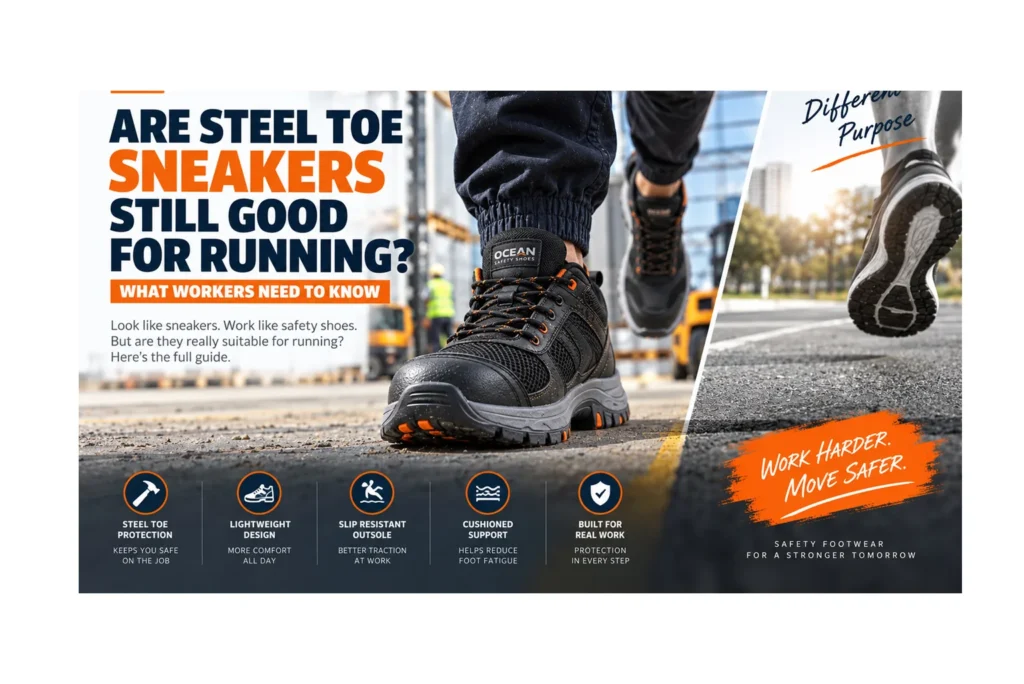
Steel toe sneakers have changed the way many workers think about safety footwear.
Traditional safety shoes were often heavy leather boots designed mainly for construction sites, factories, mining operations and other demanding industrial environments. Today, however, modern steel toe sneakers can look remarkably similar to athletic shoes. They may use mesh uppers, lightweight midsoles, flexible outsoles and cushioned insoles while still providing protective toe caps.
That naturally raises an important question:
Are steel toe sneakers actually good for running?
The short answer is:
They can be suitable for brief running or fast movement at work, but they are generally not designed to replace dedicated running shoes for regular jogging, training or long-distance running.
That distinction matters.
Steel toe sneakers are designed primarily as protective work shoes. Their construction has to balance workplace protection, durability, slip resistance and comfort. Running shoes, by contrast, are engineered primarily around repetitive forward motion, impact management, flexibility and weight.
For workers who frequently walk, climb stairs, move quickly through warehouses or occasionally need to run short distances, athletic-style safety footwear can be an excellent choice. But wearing steel toe sneakers for a 10 km training run is a very different situation.
This guide explains the differences, the potential advantages and limitations, and how workers and safety managers can choose footwear that supports both protection and mobility.
What Are Steel Toe Sneakers?
Steel toe sneakers are a type of safety footwear that combines the appearance and comfort-focused construction of athletic shoes with an impact- and compression-resistant steel toe cap.
Depending on the model, they may also include features such as:
- Slip-resistant outsoles
- Penetration-resistant midsoles
- Shock-absorbing heel or midsole materials
- Breathable mesh uppers
- Removable cushioned insoles
- Oil-resistant outsoles
- Electrical hazard protection
- Antistatic properties
- Reinforced heel and toe areas
The result is footwear that looks significantly less bulky than traditional work boots while still being designed for occupational environments.
Steel toe sneakers are particularly popular among workers who spend much of their shift walking rather than standing in one place.
Typical users include warehouse workers, logistics employees, delivery personnel, technicians, light manufacturing employees, automotive workers and tradespeople.
Are Steel Toe Sneakers Actually Running Shoes?
Not usually.
The visual similarity between a safety sneaker and a running shoe can be misleading.
A dedicated running shoe is designed around thousands of repeated running strides. Manufacturers carefully control factors such as shoe weight, heel-to-toe transition, forefoot flexibility, cushioning geometry and midsole energy absorption.
A steel toe safety sneaker has a different primary objective.
Its most important job is providing protection appropriate to the workplace.
Under U.S. OSHA requirements, for example, employers must ensure workers use protective footwear where hazards include falling or rolling objects, objects that could penetrate the sole, or certain electrical hazards.
That means safety footwear design may need to incorporate protective components that would normally be unnecessary in a conventional running shoe.
These components can affect weight, stiffness and movement.
So although a steel toe sneaker may look like a running shoe, the two products are engineered for different purposes.
Can You Run in Steel Toe Sneakers?
Yes, physically you usually can.
A worker may run several metres to reach equipment, move quickly across a warehouse or jog briefly during normal work activity without necessarily experiencing a problem.
Modern lightweight steel toe safety shoes can be considerably more flexible and comfortable than older industrial boots.
But that does not mean they are ideal for sustained running.
Think of the difference this way:
Occasional running at work: often reasonable.
Repeated jogging throughout a shift: depends heavily on footwear design and job requirements.
Regular fitness running: generally better performed in dedicated running shoes when safety footwear is not required.
Long-distance running: steel toe footwear is usually not the preferred choice.
The longer and more frequently you run, the more important specialised running-shoe characteristics become.
Why Steel Toe Sneakers May Feel Different When Running
Several design differences become more noticeable once walking turns into running.
1. Steel Toe Caps Add Weight
A steel protective toe cap adds mass to footwear.
In everyday walking, the additional weight may seem relatively minor, particularly with a lightweight upper and midsole.
During running, however, your feet accelerate and decelerate repeatedly.
Even a modest difference in shoe weight becomes more noticeable across thousands of strides.
This is one reason manufacturers increasingly use lightweight materials throughout safety sneaker construction.
A modern design may combine a steel toe cap with:
- Engineered mesh
- Lightweight EVA
- PU midsoles
- Reduced-weight rubber outsoles
- Lightweight penetration-resistant materials
The aim is not necessarily to create a running shoe. It is to reduce unnecessary weight while preserving required workplace protection.
2. Toe Protection Can Reduce Forefoot Flexibility
A running shoe normally allows considerable movement through the forefoot.
A protective toe cap creates a rigid protective zone around the toes.
That rigidity is intentional.
The cap needs sufficient strength and space to protect the front of the foot against specified impact and compression hazards.
However, if the shoe is poorly designed, the transition between the rigid toe area and flexible forefoot can feel uncomfortable during faster movement.
Good safety footwear design therefore pays considerable attention to the location of the flex point.
The shoe should flex with the natural movement of the foot rather than directly underneath the rigid toe-cap edge.
3. Safety Outsoles May Be More Substantial
Running shoes generally prioritise low weight, cushioning and movement efficiency.
Industrial footwear must frequently deal with other conditions, such as:
- Smooth warehouse floors
- Oil contamination
- Wet surfaces
- Concrete
- Metal debris
- Rough outdoor surfaces
- Abrasion
- Workplace chemicals
Safety sneaker outsoles may therefore use tougher rubber, PU or TPU compounds with deeper or more specialised tread designs.
These can improve workplace durability or traction but may also make the footwear feel less responsive than a performance running shoe.
4. Protective Midsoles Can Affect Flexibility
Some safety shoes incorporate penetration-resistant components designed to help prevent sharp objects from penetrating through the sole.
Depending on the material and construction, this additional layer can affect flexibility.
Traditional steel midsoles may feel different from newer textile penetration-resistant systems.
Again, neither is automatically superior. The correct choice depends on the hazards and required safety specification.
Steel Toe Sneakers vs Running Shoes
Although they may appear similar, their design priorities are very different.
Steel Toe Sneakers Prioritise
- Toe protection
- Workplace durability
- Slip resistance
- Penetration resistance when required
- Industrial outsole performance
- Occupational safety standards
- All-day workplace wear
Running Shoes Prioritise
- Low weight
- Repetitive forward motion
- Running-specific cushioning
- Forefoot flexibility
- Smooth heel-to-toe transition
- Energy efficiency
- Running gait mechanics
This is why asking whether steel toe sneakers are “good for running” is slightly like asking whether hiking shoes are good for running.
You can run in them.
But running is not necessarily what they were primarily designed to do.
What About Lightweight Steel Toe Sneakers?
This is where the answer becomes more interesting.
Modern lightweight safety sneakers have significantly narrowed the comfort gap between safety shoes and ordinary athletic footwear.
For workers in logistics, warehouses and modern manufacturing environments, heavy six-inch leather boots may provide more protection than the job actually requires while creating unnecessary weight.
Athletic-style safety shoes can provide a better balance.
Features may include:
- Lightweight mesh uppers
- EVA cushioning
- Flexible rubber outsoles
- Breathable lining
- Memory foam or high-rebound insoles
- Lightweight steel toe caps
- Textile penetration-resistant midsoles
- Sport-inspired lasts
These characteristics can make short periods of running much more comfortable.
However, buyers should still remember that lighter does not automatically mean suitable for running training.
The footwear’s certification and workplace function remain the primary considerations.
Are Composite Toe Safety Sneakers Better for Running?
Workers interested in extremely lightweight safety footwear often compare steel toe sneakers with composite toe safety shoes.
Composite protective caps may be made from materials such as fibreglass or other engineered non-metallic compounds.
One potential advantage is reduced footwear weight, although the exact difference depends on cap geometry and overall shoe design.
Composite toes can also help manufacturers create metal-free safety footwear.
For workers who walk large distances every day, reducing total footwear weight may improve the overall feel of the shoe.
But again, a composite toe does not automatically turn safety footwear into a running shoe.
Other components matter just as much:
- Midsole weight
- Outsole thickness
- Shoe geometry
- Upper materials
- Cushioning
- Flexibility
A poorly designed composite-toe shoe can feel heavier and less comfortable than a well-designed steel-toe model.
Evaluate the complete shoe rather than one component.
When Steel Toe Sneakers Make Sense
Steel toe sneakers can be particularly useful in workplaces where mobility is important.
Warehouses and Distribution Centres
Consider a warehouse picker working a long shift.
The employee may walk several kilometres across hard concrete, repeatedly turn between aisles, climb steps and move between packing and loading areas.
A traditional heavy work boot may provide excellent durability but could feel unnecessarily restrictive.
A lightweight safety sneaker can combine occupational protection with greater freedom of movement.
This does not mean the worker is technically “running.”
But the athletic-style design becomes valuable because the employee is highly mobile.
Logistics Operations
Logistics employees frequently transition between:
- Warehouses
- Loading docks
- Vehicles
- Outdoor surfaces
- Customer sites
Lightweight protective footwear can be useful for employees who need both safety and mobility.
Light Manufacturing
Not every manufacturing job involves extreme heat, mud or heavy outdoor construction.
Workers in electronics, assembly, automotive components and modern production facilities may operate on relatively clean indoor floors while still facing hazards requiring safety footwear.
Sport-style safety shoes can be well suited to these environments.
Maintenance and Technical Work
Technicians may walk, crouch, kneel and climb stairs frequently.
Flexible safety sneakers can sometimes provide greater comfort than rigid traditional boots where additional ankle protection is not required by the job.
When Steel Toe Sneakers May Not Be the Best Choice
Athletic styling should never become more important than hazard protection.
There are environments where heavier protective boots may be more appropriate.
Examples can include:
- Heavy construction
- Mining
- Foundries
- Welding environments
- Muddy outdoor worksites
- Extremely abrasive terrain
- Jobs requiring substantial ankle coverage
- Work involving intense heat
- Environments requiring specialised chemical protection
Footwear should always be selected according to workplace hazards rather than fashion preferences.
OSHA’s general construction PPE requirements emphasise that PPE must be safe for the work performed and properly fitted to the worker.
A comfortable sneaker-style design provides little benefit if it lacks a required protective feature.
Can Steel Toe Shoes Slow You Down?
Compared with lightweight performance running shoes, they can.
Additional protective components normally mean greater mass and stiffness.
But the practical impact depends heavily on the shoe.
A lightweight modern safety sneaker may feel considerably faster and more responsive than a traditional leather work boot.
For most workplaces, however, maximum running speed is not the objective.
The better question is:
Can the employee move naturally and efficiently throughout the working day while remaining properly protected?
That is a more useful performance criterion for workplace footwear.
Could Running Damage Steel Toe Safety Shoes?
Occasional short running is unlikely to automatically damage a well-constructed safety shoe.
Repeated running, however, can accelerate wear because footwear experiences greater forces during running than normal walking.
Areas to monitor include:
- Forefoot flex points
- Upper-to-sole bonding
- Outsole wear
- Heel compression
- Insole breakdown
- Internal lining wear
Workers who frequently move at high speed should inspect their footwear regularly.
If the outsole becomes excessively worn, the upper separates from the sole or protective components become damaged, the footwear should be evaluated for replacement.
Is Running in Steel Toe Shoes Dangerous?
Not automatically.
The presence of a steel toe itself does not mean that running is inherently dangerous.
However, footwear that is poorly fitted, excessively heavy or unsuitable for the activity can increase discomfort and potentially make movement less natural.
Common problems may include:
- Heel movement
- Toe rubbing
- Pressure around the toe-cap edge
- Excessive shoe weight
- Poor flexibility
- Inadequate cushioning
- Unsuitable outsole traction
Proper fit is therefore extremely important.
Workers should never assume that buying a larger size creates more room for a steel toe.
Oversized footwear can allow excessive foot movement and reduce stability.
How Should Steel Toe Sneakers Fit?
A properly designed safety shoe should provide enough space for the toes without allowing excessive movement inside the shoe.
Pay particular attention to:
Toe Space
Your toes should not constantly press against the protective cap.
Remember that the steel cap itself does not stretch.
Width
Workers with wide feet should look for a suitable last rather than simply purchasing a longer shoe.
Heel Fit
The heel should remain reasonably secure during walking and faster movement.
Forefoot Flex Point
The footwear should bend approximately where the foot naturally bends.
Socks
Try safety shoes with the type of socks normally worn during work.
Sizing decisions made with very thin casual socks may not accurately represent workplace use.
Cushioning Matters for Workers Who Move All Day
When buyers evaluate safety footwear, they naturally focus on protective features.
But workers may spend eight, ten or twelve hours wearing the same shoes.
Midsole construction therefore matters considerably.
Common cushioning materials include EVA and PU.
EVA Midsoles
EVA is widely used in athletic-inspired footwear because it can provide lightweight cushioning.
It is particularly suitable for modern sport safety sneakers.
PU Midsoles
Polyurethane is widely used throughout safety footwear because it can provide cushioning, durability and suitable production characteristics.
Dual-density PU systems are particularly common in industrial footwear.
Neither material guarantees comfort by itself.
Shoe geometry, density, thickness and overall design are equally important.
Slip Resistance Is Especially Important During Fast Movement
Walking quickly or running increases the consequences of losing traction.
This makes outsole selection particularly important for mobile workers.
A warehouse employee may encounter:
- Polished concrete
- Water
- Oil
- Plastic packaging
- Dust
- Loading-dock surfaces
The footwear needs an outsole designed for the actual environment.
The term “slip resistant” should not be treated as a guarantee that a worker cannot slip.
Surface condition, contaminants, tread wear and movement all affect traction.
A shoe performing well on one surface may behave differently on another.
Should Warehouse Workers Choose Steel Toe Sneakers?
Often, they can be an excellent option.
Warehouse footwear should be selected according to the specific hazard assessment, but modern safety sneakers are particularly attractive where workers need:
- Toe protection
- Low footwear weight
- All-day walking comfort
- Slip resistance
- Breathability
- Flexibility
Under OSHA’s foot-protection rules, the requirement for protective footwear is linked to workplace hazards such as falling or rolling objects, penetration hazards and certain electrical hazards rather than simply to a worker’s job title.
This is an important purchasing principle.
Two warehouses may require completely different footwear specifications.
Are Steel Toe Sneakers Good for Gym Workouts?
If the workout involves running or athletic training, conventional athletic footwear will normally be more appropriate when occupational protective footwear is not required.
Steel toe shoes provide workplace protection that does not offer meaningful benefits during ordinary recreational exercise.
That additional protection also adds weight and rigidity.
If you finish a shift and plan to run several kilometres, changing into dedicated running shoes is usually the more practical option.
Are Steel Toe Sneakers Good for Walking?
This is a different question—and the answer can absolutely be yes.
Modern steel toe sneakers are often specifically designed for workers who walk for long periods.
For walking-focused occupations, evaluate:
- Total footwear weight
- Cushioning
- Heel support
- Breathability
- Flexibility
- Toe room
- Outsole traction
- Fit
A well-designed safety sneaker can be considerably more comfortable for high-mileage workplace walking than a heavy traditional safety boot.
This is one reason sport-style industrial safety shoes have become increasingly common.
What Should Employers Consider When Buying Safety Sneakers?
For B2B procurement, choosing safety sneakers solely because they look modern can lead to problems.
Start with the workplace risk assessment.
Then define the necessary footwear specification.
Important purchasing considerations include:
Safety certification: Confirm the required standard for your market and the exact model being supplied.
Toe protection: Determine whether steel or composite protection is more suitable.
Penetration resistance: Decide whether it is required based on workplace hazards.
Slip resistance: Consider actual floor and contaminant conditions.
Weight: Particularly important for workers walking throughout their shifts.
Cushioning: Evaluate the complete midsole and insole system.
Fit: Consider different foot widths and employee preferences.
Durability: Lightweight does not have to mean disposable.
Breathability: Particularly important in hot indoor environments.
Replacement frequency: Evaluate lifecycle cost rather than purchase price alone.
Safety Standards Still Come First
A safety sneaker should not be evaluated only by how comfortable or athletic it feels.
Its protective function must come first.
Depending on the destination market, buyers may encounter standards such as ASTM F2413 in North America, EN ISO 20345 in Europe, or AS/NZS requirements in Australia and New Zealand.
Employers should verify the requirements applicable to their jurisdiction and workplace.
In the United States, OSHA requires protective footwear when employees are exposed to specified foot hazards, and protective footwear must satisfy applicable criteria or provide equivalent protection.
The key takeaway for buyers is straightforward:
A running-shoe appearance does not prove safety performance.
Ask for documentation for the exact safety footwear model.
Steel Toe Sneakers or Traditional Work Boots?
The answer depends on the job.
A lightweight steel toe sneaker may be better suited to a warehouse picker walking all day on a relatively clean indoor floor.
A robust leather boot may be more appropriate for someone working outside around mud, sharp debris and heavy construction materials.
Neither style is universally superior.
The correct footwear is the one that matches the actual hazard environment while allowing the worker to perform the job comfortably.
Frequently Asked Questions About Running in Steel Toe Sneakers
Can you run in steel toe sneakers?
Yes. Short periods of running or quick movement are generally possible in well-fitted athletic-style safety footwear. However, steel toe sneakers are primarily designed for workplace protection rather than dedicated running training.
Are steel toe sneakers good for jogging?
They are usually not the best choice for regular recreational jogging. Dedicated running shoes are lighter and designed specifically around repetitive running movement.
Can steel toe sneakers be worn all day?
Yes, provided they are correctly fitted and appropriately designed for the worker’s job. Lightweight uppers, cushioning, breathable materials and proper sizing can make sport-style safety shoes suitable for long shifts.
Are composite toe sneakers lighter than steel toe sneakers?
Composite protective caps can reduce weight in some footwear designs, but total shoe weight depends on the entire construction. A lightweight steel toe shoe can sometimes weigh less than a heavily constructed composite model.
Do steel toe sneakers hurt your toes?
Properly fitted safety footwear should not continuously press against the toes. If your toes contact the protective cap during normal walking, the shoe may have an unsuitable size, width or last shape.
Are steel toe sneakers suitable for warehouse workers?
They can be very suitable where the risk assessment requires protective footwear and workers spend substantial time walking. Slip resistance, cushioning, weight and fit should be evaluated alongside toe protection.
Can you exercise in steel toe shoes?
You can perform ordinary movement in them, but safety footwear is generally not the ideal choice for running, gym training or sports when protective footwear is unnecessary.
How long do steel toe sneakers last?
There is no universal lifespan. Durability depends on working conditions, walking distance, outsole material, construction, maintenance and frequency of use. Regular inspection is more useful than replacing footwear according to a fixed calendar interval.
Conclusion: Are Steel Toe Sneakers Still Good for Running?
Steel toe sneakers are good for mobility, but they should not automatically be considered running shoes.
Modern designs can be lightweight, flexible and comfortable enough for workers who spend an entire shift walking and occasionally need to move quickly.
For warehouse, logistics, light manufacturing and technical workers, this can make sport-style steel toe safety shoes an excellent alternative to heavier traditional boots.
But sustained running is different.
A dedicated running shoe is designed specifically for repetitive high-impact movement, while a safety sneaker must balance comfort with protective features such as toe protection, workplace traction, durability and sometimes penetration resistance.
So the practical answer is:
Running briefly at work? A good steel toe sneaker should handle normal fast movement.
Walking all day at work? Lightweight safety sneakers can be an excellent choice.
Training for a 5K or running several kilometres? Change into proper running shoes when workplace safety footwear is no longer required.
For employers and procurement professionals, the goal should not be to find safety shoes that imitate running shoes as closely as possible.
The better objective is to find protective footwear that allows workers to move naturally, comfortably and safely throughout their working day.
Lightweight Safety Sneakers for Modern Workplaces
For PPE distributors, wholesalers, importers and companies sourcing modern workplace footwear, Ocean Safety Shoes manufactures athletic-style safety footwear for industrial applications.
Our safety sneaker range can combine protective steel or composite toe caps with lightweight uppers, cushioned midsoles, slip-resistant outsoles and sport-inspired designs suitable for workers who spend long hours on their feet.
As a professional safety footwear manufacturer, Ocean Safety Shoes also supports OEM and ODM development for distributors and private-label brands, including materials, colours, branding, packaging and product specification.
The goal is not to turn a safety shoe into a running shoe.
It is to create lighter, more comfortable protective footwear that helps modern workers stay mobile without compromising the protection required for their workplace.