
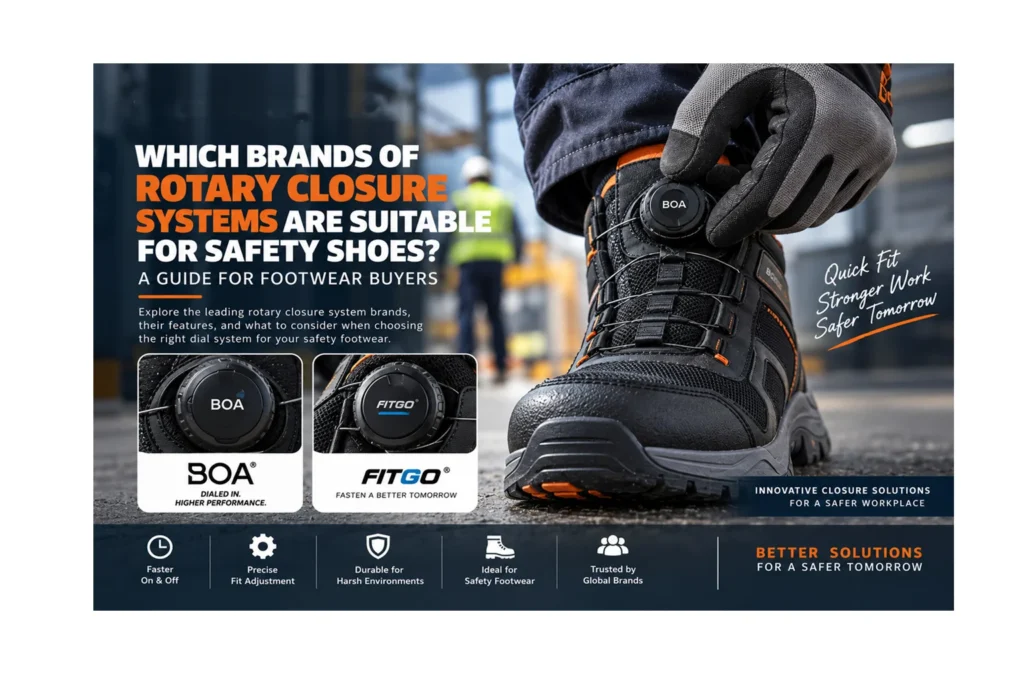
Rotary closure systems for safety shoes offer an alternative to traditional shoelaces, allowing workers to adjust footwear tension through a dial-operated mechanism. For safety footwear buyers, however, choosing the right system involves more than comparing convenience or appearance.
BOA and FITGO are two established rotary closure brands with applications in safety footwear. BOA offers dedicated workwear platforms, including its L-Series and M-Series, while FITGO provides multiple closure configurations for safety shoes and other footwear categories. Both require evaluation at the component and finished-shoe levels.
For PPE importers, wholesalers and private-label brands, the important questions are practical: Which system suits the intended work environment? How should durability be verified? What happens if a dial breaks? Will the closure affect footwear certification? And how does the system influence manufacturing costs?
This guide examines BOA and FITGO, explains the technical factors behind rotary closure selection, and provides an OEM procurement framework for developing reliable safety footwear.
Table of Contents
- What Is a Rotary Closure System?
- BOA Fit System for Safety Footwear
- FITGO Closure Systems for Safety Footwear
- BOA vs FITGO: Technical Comparison
- How to Evaluate Closure Durability
- Integrating Rotary Closures Into Safety Shoes
- Safety Footwear Certification Requirements
- OEM Costs and Supplier Evaluation
- Developing Rotary Closure Safety Shoes
- Frequently Asked Questions
What Is a Rotary Closure System for Safety Shoes?
A rotary closure system is a mechanical fastening system that uses a dial to adjust the tension of a cable or specialised lace.
Unlike conventional shoelaces, which must be tied manually, a rotary system allows the wearer to tighten footwear by turning a dial. The release mechanism varies according to the system and model.
A typical system includes four main components:
| Component | Function |
|---|---|
| Rotary dial | Controls lace tension and release |
| Cable or lace | Transfers tension across the upper |
| Lace guides | Direct the cable through the footwear |
| Mounting base | Secures the dial to the shoe |
The components must work together. A durable dial alone cannot compensate for weak lace guides or poorly designed upper reinforcement.
Why closure design matters in industrial footwear
Safety shoes are exposed to working conditions that differ considerably from those encountered by casual footwear.
A warehouse worker may repeatedly kneel, walk and adjust footwear throughout a shift. A construction worker may expose boots to mud, dust, abrasion and accidental impacts.
A suitable closure must maintain an appropriate fit while remaining functional under the conditions for which the footwear is intended.
Rotary closures may also eliminate loose conventional lace ends and allow adjustments without untying a knot. However, these benefits depend on the specific system and finished-shoe design.
For B2B buyers, the objective is not simply to replace shoelaces with a dial. It is to improve usability without compromising the footwear’s protective performance, durability or commercial viability.
BOA Fit System combines a dial, engineered lace and guides to provide adjustable footwear fastening.
The company offers a dedicated workwear product category, with closure platforms designed for different footwear constructions. Its published workwear information includes component descriptions and performance claims relevant to safety footwear development.
BOA L-Series: Low-cut safety footwear
BOA identifies its L6 and L+1 platforms as lightweight, low-profile closure options.
These platforms are relevant when evaluating low-cut safety sneakers and other footwear where the dial must fit into a relatively compact upper design.
Potential applications include:
- Lightweight warehouse safety shoes
- Athletic-style protective footwear
- Low-cut industrial work shoes
- Safety footwear designed for mobility
The appropriate model should be selected according to the actual upper construction, required tension and intended working environment.
BOA M-Series: Mid-cut and high-cut footwear
BOA describes its M4 platform as engineered for mid- to high-cut footwear, with increased tightening power and rugged construction.
This makes the platform relevant when evaluating work boots that require a more substantial fastening system.
For a mid-cut safety boot, the manufacturer should consider how the closure interacts with ankle support, heel retention and upper flexibility.
A more powerful dial is not automatically the correct choice. The tension distribution must suit the boot’s overall design.
BOA lace construction and published durability data
BOA states that its CS1 and CS3 workwear laces use 49 braided stainless-steel strands wrapped in nylon.
The company also publishes the following workwear performance claims:
| BOA-published information | Reported specification |
|---|---|
| Operating durability | Designed for 5,500 operations without loss of performance |
| Tension capacity | Holds 10 times the tension needed for a tight fit |
| Warranty rate | Reported as below 0.2% |
| CS1/CS3 lace construction | 49 braided stainless-steel strands wrapped in nylon |
Source: BOA Workwear — official technical information
Repairability is particularly important for safety footwear used in demanding environments.
BOA offers a lifetime guarantee for the BOA Fit System during the lifetime of the product on which it is integrated. Its support information identifies dials and laces as covered components.
For damaged sewn or heat-welded components, BOA directs customers to the footwear manufacturer. BOA also states that its system is not intended as an aftermarket retrofit for non-BOA footwear.
his distinction matters for importers developing an after-sales service policy.
A replacement dial may be straightforward to supply, while damage to a mounting base or integrated upper component may require a different repair procedure.
FITGO Closure Systems for Safety Footwear
FITGO is a rotary closure system supplier based in Shenzhen, China. Its product range includes adjustable closure solutions for safety footwear, outdoor shoes and other equipment.
FITGO describes its systems as combinations of a dial, mounting base, lace and low-friction guides. The company also publishes product series recommendations for different applications.
FITGO L7 Series
FITGO identifies its L7 Series as suitable for several footwear categories, including safety shoes.
For manufacturers developing low-cut or general-purpose safety footwear, the L7 Series is a potential starting point for technical evaluation.
However, suitability for a particular safety shoe must still be confirmed through component specifications, upper integration and finished-product testing.
FITGO L8 and M5 Series
FITGO recommends its L8 and M5 Series for high-cut footwear or applications requiring greater locking power and load capacity.
These platforms may therefore be relevant to manufacturers evaluating closure systems for work boots.
The L8 and M5 should not be treated as interchangeable. Their operating mechanisms and specifications need to be reviewed separately.
FitGoTech
FITGO applications in workplace safety
FITGO maintains a dedicated work-safety application category and displays examples of low-cut and mid-cut safety footwear using its systems.
Its work-safety materials describe one-handed adjustment, glove-friendly operation and cable-based fastening.
FitGoTech
These examples establish that FITGO offers systems intended for safety footwear. They do not, by themselves, establish that a particular FITGO-equipped shoe meets a specified safety standard.
Buyers should request the finished footwear’s certification documentation separately.
What OEM buyers should verify with FITGO
Before selecting a FITGO configuration, request:
- The exact dial and lace model numbers
- Technical drawings and mounting instructions
- Applicable operating-cycle and tensile-test reports
- Environmental and impact-resistance information
- Replacement-part availability
- Minimum order quantity and lead time
- Branding and colour customisation options
FITGO’s proximity to Chinese footwear manufacturing may be relevant to sourcing arrangements, but its actual commercial suitability should be established through quotations, sample evaluation and supplier discussions.
BOA vs FITGO: Technical Comparison for Safety Shoes
Comparing rotary closure brands requires separating documented product information from details that depend on the specific project.
The following table provides a starting point for B2B evaluation.
| Evaluation area | BOA | FITGO |
|---|---|---|
| Safety footwear applications | Dedicated workwear range | Dedicated work-safety applications |
| Low-cut options | L-Series, including L6 and L+1 | L7 among available options |
| Higher-cut options | M-Series, including M4 | L8 and M5 among available options |
| Published technical information | Workwear component and performance information | Product series and application information |
| Repair support | Published guarantee and repair-kit programme | Confirm arrangements for selected model |
| OEM integration | Requires coordination with BOA | Requires coordination with FITGO |
| Component pricing | Request project quotation | Request project quotation |
| MOQ and lead time | Confirm with supplier | Confirm with supplier |
Sources: BOA Workwear and FITGO Technology and Product Series .
The table is not a performance ranking. Published information differs between suppliers, and comparable independent test results were not established for the specific models discussed here.
Which factors should determine the final selection?
For a low-cut safety sneaker, the buyer may focus on dial profile, fit adjustment, weight and integration with the upper.
For a high-cut industrial boot, the evaluation may place greater emphasis on tightening capacity, impact exposure, contamination and the ability to maintain an appropriate fit around the ankle.
For a private-label collection, buyers must also examine component availability, development support, commercial terms and replacement-part arrangements.
The correct selection is the configuration that meets the project’s documented requirements and passes the necessary product-level evaluation.
How to Evaluate Rotary Closure Durability
A rotary closure should be assessed as a complete fastening system rather than as an isolated component.
The following tests and inspections provide a useful framework for footwear manufacturers and procurement teams.
1. Repeated tightening and release
Repeated-operation testing helps assess whether the dial continues to function after prolonged use.
Buyers should ask the supplier to identify the test method, number of cycles, applied tension and acceptance criteria.
The test report should also explain whether performance was evaluated after environmental exposure.
A cycle count without test conditions provides limited information.
2. Lace tensile strength and abrasion
The cable transfers tightening force through the footwear upper.
A suitable evaluation should consider tensile strength, abrasion resistance and repeated flexing.
Particular attention should be given to the points where the lace enters and exits guides, because local friction can influence wear.
The selected lace must also be compatible with the dial and guide configuration.
3. Dial impact resistance
A dial mounted on the outside of a work boot may encounter accidental contact with pallets, equipment or other workplace objects.
Impact testing should reflect the intended application.
Buyers should inspect whether the dial remains attached, whether its operating mechanism is damaged and whether the footwear can still be secured correctly.
4. Dust, mud and water exposure
Construction and outdoor footwear may encounter contaminants that affect mechanical components.
Testing should establish whether the system continues to tighten and release after exposure to relevant conditions.
Where contamination is expected, the manufacturer should also provide appropriate cleaning instructions.
5. Glove operation
A closure that is easy to operate with bare hands may be less convenient when the wearer uses thick protective gloves.
Sample evaluations should include the types of gloves expected in the target workplace.
This is particularly relevant for cold-storage, construction and outdoor applications.
6. Repair and replacement
A damaged dial does not necessarily mean that the entire shoe must be discarded.
However, repairability depends on the system’s design and the damaged component.
Buyers should establish whether replacement parts are available, who can perform repairs and whether replacement affects the footwear’s approved configuration.
Technical evaluation checklist
Use this checklist when reviewing samples and supplier documentation.
Documentation reviewed
0 of 8Exact component model and technical drawingsOperating-cycle test reportLace tensile and abrasion dataDial impact-resistance evidenceDust, mud and water exposure assessmentGlove-operation sample evaluationReplacement-part and repair procedureFinished-shoe testing and certification review
These checks are a procurement framework, not a substitute for applicable certification testing.
Integrating Rotary Closures Into Safety Shoes
Selecting a closure brand is only one part of footwear development. The system must also be integrated into the upper in a way that provides appropriate fit, durability and usability.
For OEM and ODM projects, closure integration should begin during product design rather than after the upper pattern has been finalised.
Dial placement: Tongue-mounted vs side-mounted
The position of the dial influences accessibility, cable routing and exposure to workplace hazards.
Tongue-mounted closure
A centrally positioned dial can provide convenient access and a symmetrical appearance. The manufacturer must evaluate tongue reinforcement, pressure distribution and cable routing.
Side-mounted closure
A side-mounted dial allows alternative routing arrangements. Its position should be assessed for accidental impacts, ease of operation and interference with other footwear components.
Neither mounting position is universally suitable for every shoe.
The design should reflect the footwear’s height, upper materials, intended work environment and the closure supplier’s integration requirements.
Single-dial vs dual-dial configurations
A single-dial system uses one adjustment mechanism to control the designated closure zone.
It can simplify the upper construction and may be appropriate for low-cut safety shoes.
A dual-dial configuration allows separate adjustment of two zones, such as the forefoot and upper section of a boot.
This may be useful when independent tension control is a specific design requirement.
However, a second dial also introduces additional components and integration considerations.
Buyers should evaluate whether the proposed configuration provides a measurable improvement in fit or usability rather than choosing it solely for appearance.
Upper reinforcement and lace routing
The upper must withstand the forces introduced by the closure system.
Depending on the construction, reinforcement may be required around mounting points and lace guides.
The manufacturer should evaluate:
- Whether tightening creates excessive local pressure
- Whether the guides remain securely attached during flexing
- Whether the lace rubs against vulnerable upper materials
- Whether the tongue remains correctly positioned
- Whether the closure maintains suitable heel retention
A closure system that performs well as a standalone component may still produce an unsatisfactory result if the upper is poorly engineered.
Can rotary closures be used on waterproof safety shoes?
Yes, rotary closure systems can be incorporated into waterproof footwear designs.
However, the mounting base, stitching, guide attachment and upper construction must be considered together.
The presence of a waterproof membrane does not automatically guarantee that the finished shoe will remain waterproof after modifications.
Water-resistance or waterproof performance should be verified using the applicable requirements for the intended product and market.
Does Changing the Closure System Affect Safety Footwear Certification?
Changing a safety shoe from conventional laces to a rotary closure should be treated as a product modification requiring technical review.
The closure system is not the same as the protective toe cap or outsole, but it forms part of the footwear’s construction and may affect fit, upper integrity and other tested characteristics.
For European-market safety footwear, EN ISO 20345:2022 is an important reference. The underlying ISO 20345:2021 standard specifies basic and additional requirements for general-purpose safety footwear, including mechanical risks, slip resistance, thermal risks and ergonomic behaviour.
Personal protective equipment — Safety footwear
What should importers verify?
Before placing a bulk order, buyers should confirm that the certification documentation corresponds to the actual finished footwear configuration.
The review should include the following questions.
| Certification question | Why it matters |
|---|---|
| Is the rotary closure included in the certified construction? | Confirms that the documented product matches the supplied footwear |
| Has the upper construction changed? | Changes may affect previously assessed characteristics |
| Does the certificate cover the exact model? | Avoids relying on documentation for a different shoe |
| Are the applicable protective markings supported? | Ensures that the claimed protection matches the tested product |
| Has the certification body reviewed relevant changes? | Establishes whether additional assessment or testing is necessary |
For an existing certified model, the manufacturer should consult the relevant certification body to determine whether the proposed modification requires further evaluation.
A change does not automatically mean that every test must be repeated. Equally, it should not be assumed that the original certification remains applicable without review.
Does a BOA or FITGO dial make a shoe EN ISO 20345 compliant?
No.
The use of a particular closure brand does not establish compliance with a safety footwear standard.
Compliance must be demonstrated for the finished footwear against the applicable requirements.
A buyer should therefore request the appropriate product certification and supporting documentation rather than relying on the reputation of the closure supplier.
For more information about the European standard, see the official ISO 20345:2021 standard information .
OEM Procurement: Cost, MOQ and Supplier Evaluation
For B2B footwear buyers, the closure system affects more than the component purchase price.
It can influence product development, manufacturing, quality control, inventory management and after-sales service.
Understanding the total cost of a rotary closure system
A meaningful cost comparison should include the complete integration process.
| Cost element | What buyers should evaluate |
|---|---|
| Closure components | Dial, lace, guides and mounting base |
| Upper development | Pattern adjustments and reinforcement |
| Manufacturing | Installation and assembly requirements |
| Testing | Component and finished-footwear evaluation |
| Replacement parts | Spare-component availability and cost |
| Warranty | Responsibility for component failures |
| Inventory | MOQ, lead time and spare-parts stock |
A lower component quotation does not necessarily result in a lower total project cost.
For example, a system requiring extensive upper modifications or difficult-to-source replacement parts may create additional expenses.
Conversely, a higher component price may be commercially acceptable if it supports the intended product specification and customer requirements.
The final decision should be based on comparable quotations and documented performance.
What MOQ should buyers expect?
There is no universal MOQ for rotary closure safety shoes.
The required quantity can depend on the closure supplier, component model, colour, customisation, upper materials and manufacturing arrangements.
Buyers should distinguish between three separate quantities:
- The closure supplier’s minimum component order.
- The footwear factory’s minimum production order.
- The minimum quantity required for customised components or branding.
These quantities may differ.
Before confirming an order, request written clarification of the MOQ for each component and the complete footwear model.
Questions to ask a rotary closure supplier
A professional procurement enquiry should request the following information:
| Category | Information to request |
|---|---|
| Product identification | Exact model number and component specification |
| Technical performance | Relevant test reports and test conditions |
| Integration | Drawings, installation instructions and engineering support |
| Commercial terms | Quotation, MOQ, lead time and payment terms |
| Customisation | Available colours, branding and tooling requirements |
| Quality control | Inspection procedures and batch traceability |
| After-sales service | Warranty, spare parts and replacement instructions |
For large-volume orders, the buyer should also clarify how component changes will be communicated.
A change in dial construction, lace material or mounting design may require the footwear manufacturer to reassess the finished product.
Should buyers consider other rotary closure suppliers?
Other suppliers may offer systems suitable for specific footwear projects.
However, buyers should not assume that a closure designed for casual sneakers is appropriate for industrial safety footwear.
Before selecting an alternative supplier, request evidence of relevant application experience, component performance and quality consistency.
The evaluation criteria should remain the same regardless of brand.
Developing Rotary Closure Safety Shoes With Ocean Safety Shoes
For importers, wholesalers and private-label footwear brands, the rotary closure should be considered as part of the complete safety shoe design.
At Ocean Safety Shoes , our OEM and ODM safety footwear offering provides a starting point for discussing rotary closure designs alongside the other specifications required for a B2B footwear project.
A typical development discussion should address the intended market, working environment, protective requirements, upper construction and closure configuration.
Step 1: Define the target application
The first step is to establish where the footwear will be used.
A lightweight warehouse safety shoe may have different requirements from a waterproof construction boot.
The buyer should identify the relevant workplace hazards, required protective features, expected wearing conditions and target market.
Step 2: Select the proposed closure configuration
The closure should be selected according to the footwear design and the component supplier’s recommendations.
The discussion may include BOA, FITGO or another system that meets the project’s requirements.
At this stage, buyers should confirm the exact component model rather than specifying only a brand name.
Step 3: Develop the upper and closure layout
The upper pattern, dial mounting position, guide placement and reinforcement should be considered together.
The aim is to achieve an appropriate fit while avoiding unnecessary pressure points or vulnerable attachment areas.
Step 4: Evaluate the sample
Before bulk production, the sample should be reviewed for fit, operation, durability and the relevant protective requirements.
The evaluation should reflect the intended workplace.
Any issues identified during sample review should be resolved before the production specification is finalised.
Step 5: Confirm specifications and documentation
The approved product specification should identify the closure components, materials, construction and applicable compliance requirements.
Buyers should also agree on component substitution rules, quality-control expectations and replacement-part arrangements.
These steps provide a development framework. The exact process, available closure options, testing arrangements and production terms should be confirmed for each project.
Request an OEM rotary closure safety shoe quotation
Are you developing a new safety footwear collection for your market?
Ocean Safety Shoes welcomes enquiries from PPE distributors, safety footwear importers, wholesalers and private-label brands.
To help us understand your project, please provide your preferred shoe style, target market, required protection, estimated order quantity and any closure-system preferences.
Develop Your Rotary Closure Safety Shoes
Discuss your OEM or ODM project with Ocean Safety Shoes, including product specifications, closure options and sourcing requirements.Visit Ocean Safety Shoes
Share your project requirements through the website’s contact options.
Frequently Asked Questions
What is the difference between BOA and FITGO?
BOA and FITGO are separate rotary closure brands offering dial-operated fastening systems. Both have applications in safety footwear, but their product platforms, component specifications, integration arrangements and after-sales programmes differ.
Buyers should compare specific models rather than assuming that every product from either brand has identical performance.
Which BOA system is suitable for safety shoes?
BOA’s L-Series includes low-profile platforms such as L6 and L+1, while its M4 platform is designed for mid- to high-cut footwear.
The appropriate selection depends on the shoe construction, required tightening performance and intended application.
Can FITGO be used on industrial safety shoes?
Yes. FITGO offers closure systems intended for workplace safety applications, including low-cut and mid-cut safety footwear.
The exact component should be selected according to the footwear design and verified through the appropriate technical evaluation.
Are rotary closure safety shoes suitable for construction work?
They can be suitable when the complete footwear design meets the relevant workplace requirements.
For construction applications, buyers should pay particular attention to dust exposure, impact resistance, abrasion, contamination and repairability.
A closure intended for casual footwear should not automatically be assumed suitable for demanding construction environments.
Can a rotary closure system be installed on existing safety shoes?
Changing an existing shoe’s closure may require modifications to the upper, mounting points and lace routing.
BOA specifically states that its Fit System is not an aftermarket solution for non-BOA footwear.
For certified safety footwear, manufacturers should review whether the modification affects the approved construction before proceeding.
What happens if a rotary closure dial breaks?
The repair procedure depends on the system and the damaged component.
Some systems provide replaceable dials and laces. Damage to integrated mounting components may require attention from the footwear manufacturer.
Buyers should confirm replacement-part availability and repair instructions before placing a bulk order.
Does a rotary closure system affect safety shoe certification?
It may. Changes to the upper or fastening construction should be reviewed against the footwear’s existing certification documentation.
The need for additional assessment or testing depends on the nature of the modification and the applicable certification requirements.
How should importers choose a rotary closure supplier?
Importers should evaluate the supplier’s component specifications, test evidence, application experience, technical support, commercial terms and replacement-part arrangements.
The selected system should then be evaluated as part of the finished footwear.
Conclusion
BOA and FITGO provide rotary closure options for safety footwear manufacturers and B2B buyers, but selecting a suitable system requires more than comparing brand recognition or component prices.
BOA offers dedicated workwear platforms and a published repair programme. FITGO provides multiple closure series and documented safety footwear applications. Both require model-specific evaluation and appropriate integration into the finished shoe.
For PPE importers, distributors and private-label brands, the purchasing process should focus on technical compatibility, durability, repairability, certification requirements and total project cost.
A well-selected rotary closure can improve the usability of safety footwear. Its long-term value, however, depends on how effectively the complete shoe is designed, tested and manufactured.