
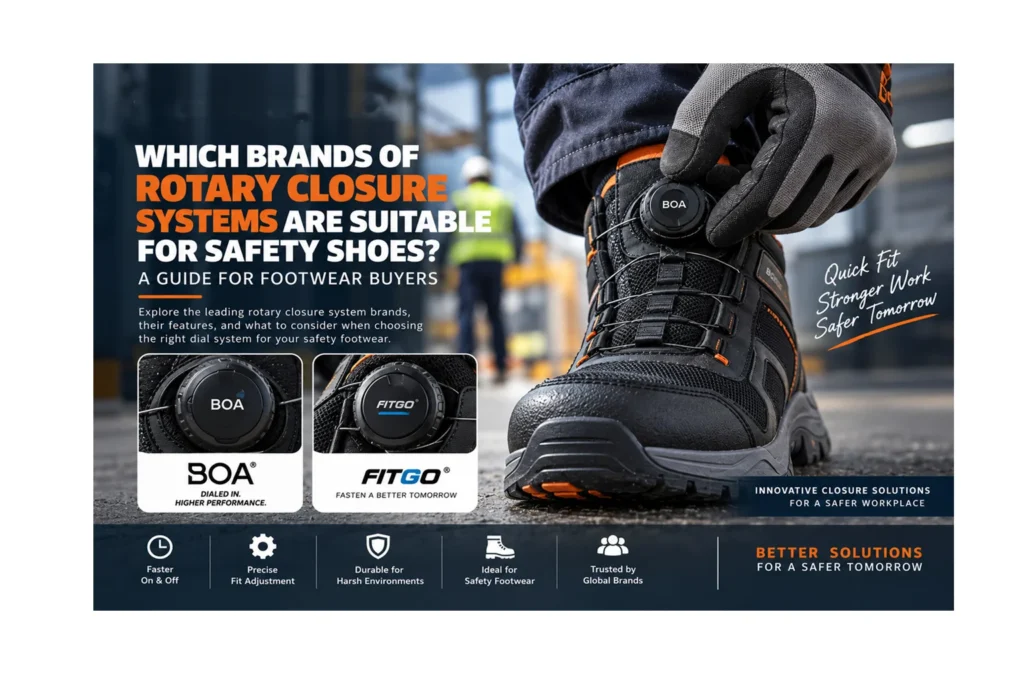
Traditional shoelaces have worked for generations, but industrial safety footwear is changing.
Walk through a modern warehouse, automotive plant or logistics centre and you are increasingly likely to see workers wearing safety shoes with rotary dial closure systems instead of conventional laces.
The idea is simple: rather than tying a knot, the worker turns a dial to tension a cable or specialised lace through a series of guides. Depending on the system, releasing the dial allows the shoe to be loosened quickly.
For workers, this can mean faster on-and-off, easier adjustment and fewer loose laces.
For safety footwear manufacturers and B2B buyers, however, choosing a rotary closure system is more complicated.
One of the most recognised options is BOA® Fit System, but it is not the only rotary closure solution available. Other systems, including FITGO, are increasingly relevant to footwear manufacturers developing safety shoes, work boots and other occupational footwear.
So, which rotary closure system brands are suitable for safety shoes?
This guide looks at the main options, explains what matters when selecting a dial closure system and discusses how manufacturers should evaluate durability, fit, cost, product positioning and after-sales support before integrating one into a safety footwear collection.
What Is a Rotary Closure System for Safety Shoes?
A rotary closure system—also called a dial closure system, rotary lacing system, quick lacing system or dial lacing system—replaces or supplements traditional shoelaces with a mechanical tightening system.
Most designs use three basic elements:
- A rotary dial
- A specialised cable or lace
- Lace guides or routing components
The worker engages the system and turns the dial to increase tension.
The lace moves through the guides and gradually draws the upper around the foot. Depending on the design, the dial can provide relatively fine adjustment rather than the worker having to untie and retie conventional laces.
To remove the footwear, the system provides a release mechanism that removes or reduces tension.
The concept sounds simple, but engineering it for industrial safety shoes is considerably more demanding than putting a dial on casual footwear.
A closure used on safety footwear may be exposed to:
- Dust
- Mud
- Water
- Concrete particles
- Oil
- Repeated flexing
- Abrasion
- Impacts
- Gloves
- Cold conditions
- Thousands of tightening and releasing cycles
That is why the closure should be evaluated as a functional footwear component rather than a cosmetic accessory.
As a professional safety shoes factory ocean safety shoes has many rotary closure systems safety shoes:
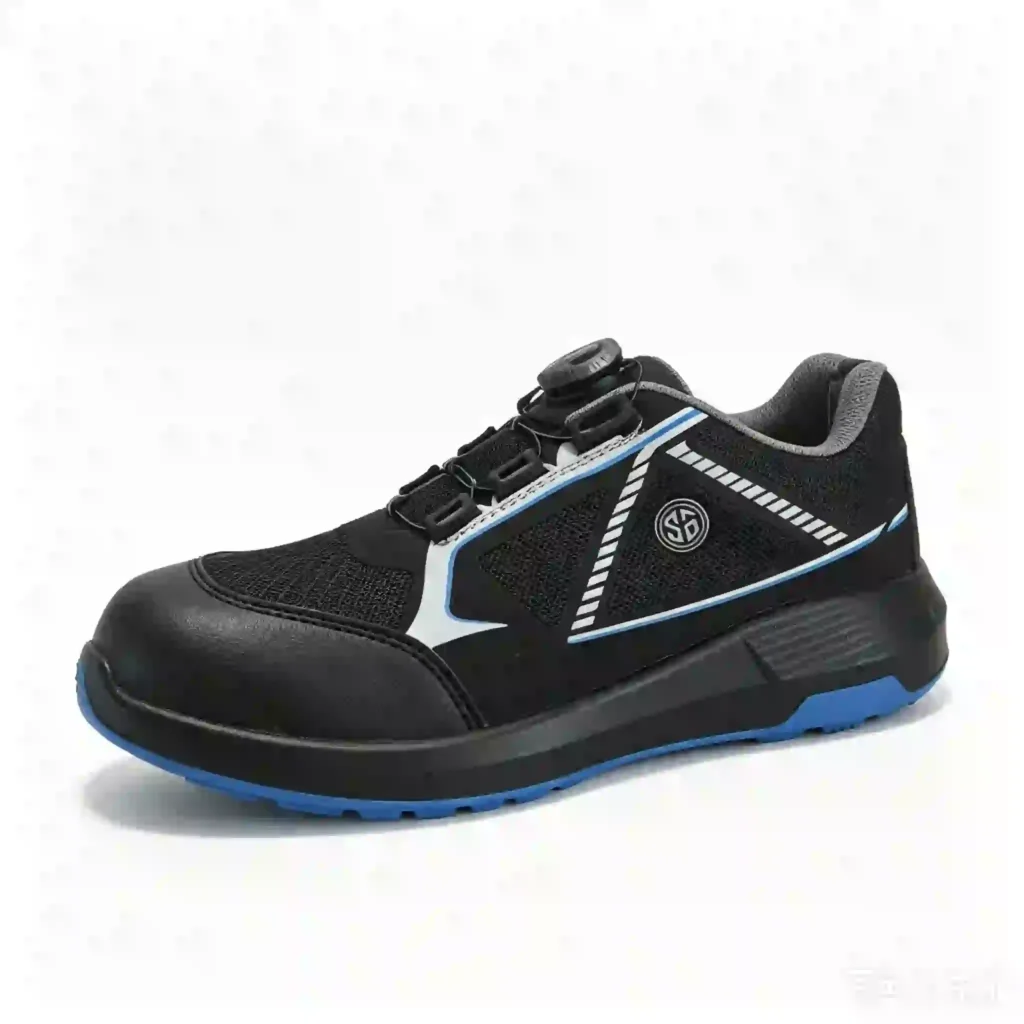
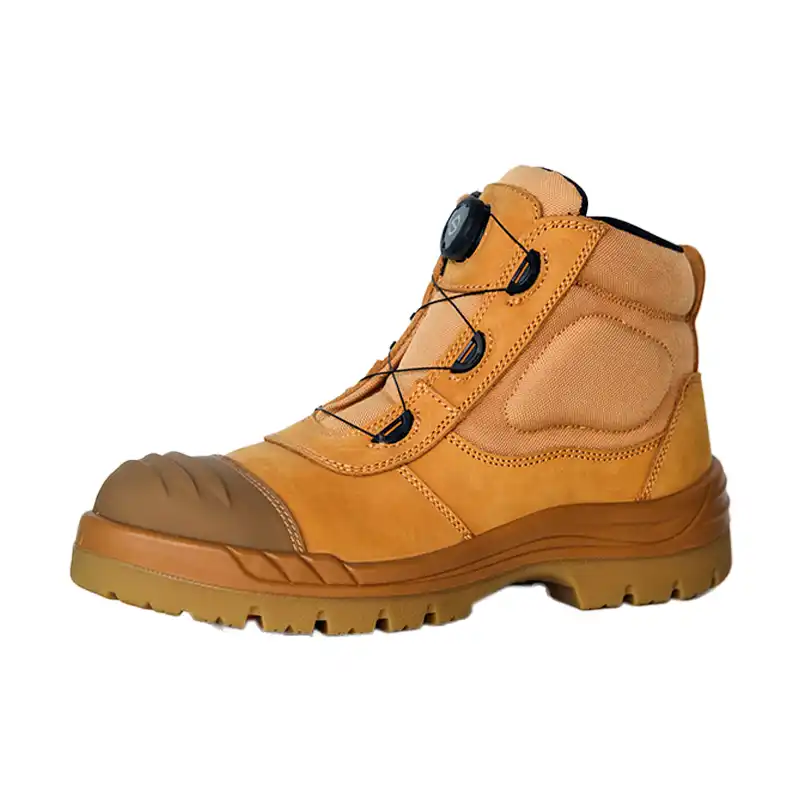
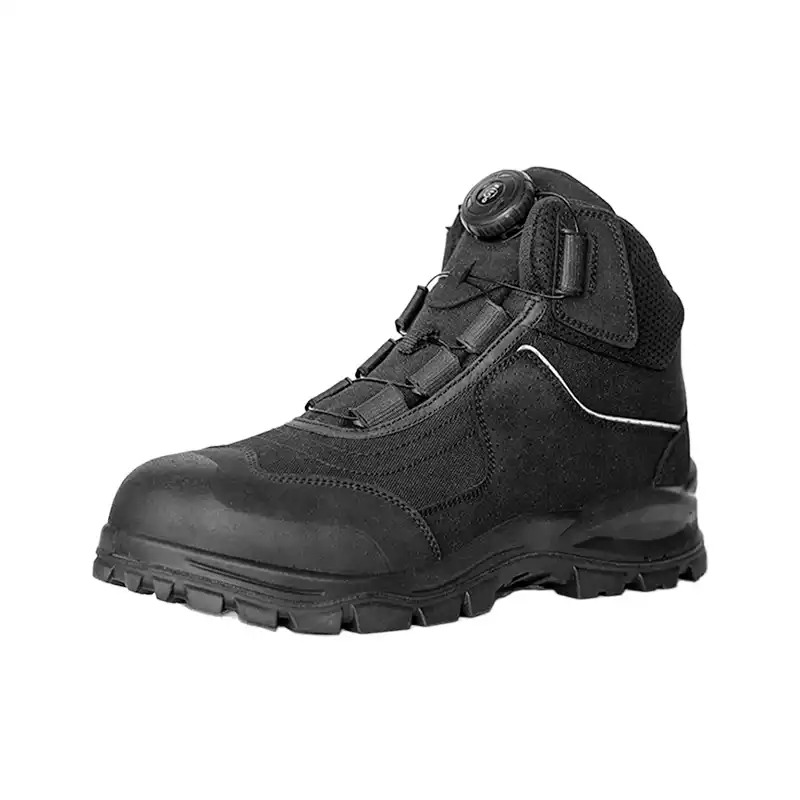
Why Are Rotary Closure Systems Becoming Popular in Safety Footwear?
Workers may put on and remove their safety shoes several times during a working day.
Traditional laces can also loosen, become contaminated or create dangling ends.
A well-designed rotary closure system offers several potential advantages.
Faster On and Off
A worker can normally tighten a dial closure in seconds.
This is particularly convenient in workplaces where employees frequently change footwear before entering clean areas, production facilities or different work zones.
Micro-Adjustable Fit
One of the biggest advantages of a dial system is the ability to make relatively small tension adjustments.
If a worker’s feet swell slightly during a long shift, the fit can be adjusted without completely unlacing the shoe.
BOA, for example, describes its workwear system as providing micro-adjustable fit and uniform pressure distribution.
No Traditional Loose Lace Ends
Traditional shoelaces can come undone.
A rotary system removes the conventional bow and dangling lace ends, although this does not eliminate every possible trip or footwear hazard.
Bata Industrials specifically identifies the absence of untied and loose conventional laces as one benefit of BOA-equipped safety footwear.
Easier Operation With Work Gloves
Depending on dial size and design, a rotary closure may be easier to adjust while wearing gloves than conventional laces.
This can be useful for construction, logistics, cold-storage and outdoor workers.
Modern Product Positioning
There is also a commercial reason for their popularity.
Safety footwear increasingly competes on:
- Comfort
- Weight
- Styling
- Convenience
- Fit
- Technology
A visible dial closure immediately differentiates a product from a basic lace-up safety shoe.
For PPE distributors and private-label brands, this can help create a higher-value product category.
1. BOA® Fit System
BOA® Fit System is probably the best-known premium dial-based fit system used in occupational footwear.
BOA is not simply a replacement shoelace.
The complete system combines a dial platform, engineered lace and low-friction guides. BOA says these components are configured together to deliver a precise and secure fit.
BOA in Safety Footwear
BOA has a dedicated workwear category and is already integrated into products from numerous established footwear companies.
Current BOA workwear listings include safety footwear from brands such as:
- Red Wing
- Timberland PRO
- Danner
- Helly Hansen
- Diadora Utility
- Jalas
- DeWalt
- Georgia Boot
- Ariat
- Rocky
- Strauss
This demonstrates that BOA is not merely an outdoor or cycling technology adapted experimentally to work shoes; it has an established presence in professional workwear.
BOA L-Series
BOA’s L-Series is designed around lower-profile, lightweight applications.
The L6 is widely used, while the L+1 provides greater size, power and lace capacity for certain footwear configurations.
For manufacturers developing low-cut safety sneakers, lightweight work shoes or athletic-style occupational footwear, this type of platform can be particularly relevant.
BOA M-Series
The M-Series is designed for more substantial footwear applications.
BOA describes the M4 as engineered for mid- to high-cut footwear, combining rugged durability with increased tightening power.
That makes this category more relevant to:
- Mid-cut safety shoes
- Work boots
- Heavy-duty occupational footwear
- Outdoor work footwear
Bata Industrials similarly explains that it uses M-Series closures on mid-cut shoes and boots, while L-Series closures are used on lower sneaker-style models.
BOA Lace Construction
For workwear, the lace itself is important.
BOA states that its CS1 and CS3 laces use 49 braided stainless-steel strands wrapped in nylon, creating a structure designed to withstand demanding environments.
This illustrates why buyers should evaluate the entire closure rather than looking only at the dial.
Durability
According to BOA’s workwear information, its systems are tested for thousands of operating cycles, and the company publishes performance claims relating to tension capacity and warranty rates.
BOA also offers a lifetime guarantee covering the BOA Fit System for the lifetime of the product on which it is integrated, with repair kits available through its support program.
For established safety footwear brands, this after-sales ecosystem can be an important advantage.
Best Suited For
BOA is particularly attractive for:
- Premium safety footwear
- International safety shoe brands
- High-end private-label collections
- Professional work boots
- Lightweight premium safety sneakers
- Products where brand recognition matters
- Footwear requiring an established replacement-parts ecosystem
The main consideration for manufacturers is usually commercial positioning.
A premium branded closure can add product value, but buyers should consider component cost, integration requirements, target retail price and supplier arrangements before deciding whether it makes sense for every product line.
2. FITGO Lacing System
FITGO is another rotary closure system increasingly relevant to the footwear industry.
FITGO Innovation is based in Shenzhen, China and specialises in dial-based closure technology for footwear and related applications.
The company promotes its micro-adjustable dial closure systems for categories including:
- Safety footwear
- Outdoor footwear
- Tactical boots
- Sports footwear
- Casual footwear
Its recent industry activity has included dedicated promotion of FITGO solutions for safety footwear and participation in international footwear and occupational-safety exhibitions.
FITGO in Safety Shoes
FITGO has already moved beyond being simply a component concept.
Safety footwear using the system is commercially available.
For example, Nine Worths describes using FITGO on its Nurmi safety shoes and highlights quick adjustment, controlled tension and ease of use as key advantages.
FITGO has also been used in more demanding occupational footwear. An EWS fire brigade boot specification lists a FITGO high-power reel lacing system alongside steel toe protection and other features in footwear tested to EN 15090:2012.
This is significant because it demonstrates applications beyond lightweight casual-style shoes.
Why FITGO May Interest Safety Shoe Manufacturers
For OEM and ODM manufacturers, FITGO can be particularly interesting when developing:
- Mid-range dial closure safety shoes
- Private-label products
- Athletic-style safety footwear
- Work boots
- Tactical-style occupational footwear
- Projects requiring alternatives to premium closure systems
Because FITGO is a Chinese closure-system supplier, it can also be commercially relevant to Chinese safety footwear factories seeking closer supply-chain integration.
However, buyers should evaluate the exact FITGO component series proposed for their footwear rather than assuming every dial is appropriate for every industrial application.
BOA vs FITGO for Safety Shoes
This is likely to be one of the first comparisons made by a safety footwear buyer.
But the question should not simply be:
“Which one is better?”
A more useful question is:
“Which system is better suited to this particular footwear project?”
BOA May Have an Advantage When:
- Premium brand positioning is important
- End customers already recognise the BOA name
- The product has a higher retail price
- An established global workwear track record is valuable
- Replacement-part support is a priority
- The footwear brand wants a proven premium technology story
FITGO May Be Attractive When:
- The buyer is developing OEM/private-label footwear
- Cost control is particularly important
- The factory wants more sourcing flexibility
- The product is positioned in a competitive mid-market segment
- The manufacturer needs multiple design possibilities
- Supply-chain integration in Asia is valuable
Neither decision should be based on logo recognition alone.
The final system should be tested as part of the complete shoe.
What About Other Rotary Closure System Brands?
The footwear-component market contains numerous dial and quick-lacing suppliers, particularly across China and other Asian manufacturing regions.
Some provide their own branded systems, while others manufacture OEM rotary closure components.
These can be commercially attractive because they may offer:
- Lower component costs
- Lower MOQs
- Custom dial designs
- Custom colours
- Private-label opportunities
- Greater sourcing flexibility
However, safety footwear is not the ideal category for selecting a closure solely because it is inexpensive.
A dial system that performs adequately on casual sneakers may not withstand an industrial environment.
Before using a less-established rotary closure supplier, a safety shoe manufacturer should request detailed information about:
- Cycle testing
- Tensile performance
- Cable abrasion
- Dial impact resistance
- Contamination testing
- Temperature performance
- Replacement procedures
- Component consistency
- Warranty policy
- Field-use experience
For large-volume orders, component validation should be part of product development.
How Should B2B Buyers Compare Rotary Closure Systems?
The dial itself is only one part of the decision.
A professional comparison should examine the complete closure system.
1. Dial Durability
The dial is exposed on the outside of the shoe.
On a worksite, it may hit:
- Pallets
- Equipment
- Concrete
- Steel structures
- Ladders
- Machinery
- Debris
Ask the closure supplier how the dial has been tested for impact and repeated operation.
A dial that feels smooth in a showroom is not necessarily durable enough for industrial footwear.
2. Lace or Cable Strength
The lace transfers tension across the upper.
Depending on the system, it may be made from metal strands, textile fibres or engineered combinations.
Consider:
- Tensile strength
- Abrasion resistance
- Flex fatigue
- Water resistance
- Contamination
- Resistance to repeated tension
A broken cable can make otherwise undamaged footwear difficult or impossible to secure correctly.
3. Guide Design
The cable does not operate independently.
Guides influence:
- Friction
- Tension distribution
- Tightening speed
- Pressure across the foot
- Cable wear
Poor guide placement can create pressure points even when a high-quality dial is used.
This is one reason rotary closure integration should begin during footwear development rather than being added at the last moment.
4. Release Mechanism
Workers need to remove footwear efficiently.
Test the system:
- With bare hands
- With work gloves
- After exposure to dust
- After exposure to water
- After repeated use
A mechanism that works perfectly on a new sample should continue to operate reliably after prolonged use.
5. Fine Adjustment
One major reason to choose a rotary system is fit control.
The worker should be able to adjust tension without creating uncomfortable concentrated pressure across the instep.
BOA specifically promotes uniform pressure distribution and micro-adjustability as workwear benefits.
Manufacturers should evaluate whether alternative systems provide comparable practical adjustment for their particular upper design.
Rotary Closure Placement Matters
Where the dial is positioned can significantly affect the performance and durability of the shoe.
Common positions include:
Tongue-Mounted Dial
The dial sits approximately in the centre of the tongue.
Advantages can include:
- Intuitive operation
- Balanced appearance
- Easy access
- Symmetrical tightening
It is particularly common on low-cut sport safety shoes.
Side-Mounted Dial
The dial is positioned on the side of the footwear.
Potential advantages include easier cable routing for certain boot constructions and keeping the centre of the tongue relatively clean.
However, the manufacturer needs to consider whether the dial is more exposed to workplace impacts.
Rear or Heel-Mounted Systems
Some footwear concepts place adjustment mechanisms closer to the heel.
These can produce distinctive designs but require careful engineering.
For most conventional industrial safety shoes, tongue and side-mounted configurations remain easier for buyers and workers to understand.
Single Dial vs Dual Dial Safety Shoes
A single dial is usually sufficient for many low-cut safety shoes.
It is:
- Simple
- Lightweight
- Easy to operate
- Relatively economical
- Visually clean
Higher work boots can benefit from two adjustment zones.
A dual-dial system may allow the wearer to control lower-foot and upper-ankle tension separately.
This can be useful when the worker wants:
- Firm heel retention
- Comfortable forefoot space
- Independent ankle adjustment
BOA’s workwear solutions include both single- and dual-dial configurations for mid-cut footwear.
Dual-dial designs, however, add components, cost and product complexity.
They should solve a genuine fit problem rather than simply being added to make a shoe look more technical.
Are Rotary Closure Systems Suitable for Heavy-Duty Work Boots?
They can be, but component selection becomes especially important.
A warehouse safety sneaker and a mining boot do not experience the same environment.
Heavy-duty footwear may encounter:
- Mud
- Sand
- Concrete dust
- High abrasion
- Repeated impacts
- Greater upper tension
- Outdoor weather
- Thick gloves
The closure system needs to be designed accordingly.
BOA’s M-Series, for example, is specifically positioned toward mid- and high-cut footwear and demanding applications.
FITGO has also appeared on professional boots, including specialist fire-brigade footwear.
The key is not whether rotary systems can be used on boots.
It is whether the specific closure configuration has been engineered and validated for that boot.
Are Rotary Closure Safety Shoes Better Than Lace-Up Safety Shoes?
Not always.
Rotary closure systems provide clear convenience advantages, but conventional laces still have strengths.
Rotary Closure Advantages
They can offer:
- Faster adjustment
- No traditional knots
- Precise tension control
- Modern styling
- Easy operation
- Consistent tightening
- Premium product positioning
Traditional Lace Advantages
Traditional laces offer:
- Very low cost
- Easy field replacement
- Global availability
- Simple construction
- Familiar operation
- Minimal hardware
For an entry-level industrial boot, conventional laces may still be the most logical solution.
For a premium warehouse safety sneaker, a rotary system may create meaningful additional value.
Product positioning matters.
Can a Factory Simply Add a Rotary Dial to an Existing Safety Shoe?
Technically, modifications are possible.
Professionally, it should be treated as a footwear development project.
Changing from traditional laces to a rotary closure may affect:
- Upper pattern
- Reinforcement
- Tongue design
- Guide positions
- Pressure distribution
- Flexibility
- Fit
- User interaction
- Manufacturing process
The cable may concentrate force differently from textile shoelaces.
Areas around the guides may therefore require reinforcement.
For certified safety footwear, manufacturers should also determine whether a construction change affects existing certification or requires additional assessment or testing.
Never assume that changing the closure has no compliance implications.
What Should Safety Shoe Manufacturers Ask a Closure Supplier?
Before committing to production, ask technical questions rather than focusing only on quotation price.
A useful supplier evaluation should cover:
Which dial model do you recommend for low-cut safety shoes?
Which model is appropriate for mid-cut or high-cut work boots?
What is the recommended lace routing?
What testing has been completed?
How many operating cycles has the system been evaluated for?
What is the lace tensile strength?
How does the system perform when contaminated with dust or mud?
Can workers replace damaged components?
Are repair kits available?
What warranty is offered?
What is the MOQ?
Can dial colours or branding be customised?
What support is available during upper development?
These questions help distinguish a genuine closure-system engineering partner from a basic component supplier.
How Rotary Closures Affect the Cost of Safety Shoes
A rotary closure will generally cost more than ordinary shoelaces.
But B2B buyers should evaluate product value, not simply component cost.
Suppose two safety shoes use similar uppers, toe caps and outsoles.
One uses conventional laces.
The other uses a recognised dial closure system.
The second model may support a higher wholesale or retail position because customers perceive benefits in:
- Convenience
- Technology
- Fit
- Appearance
- Brand differentiation
The relevant question becomes:
Does the additional closure cost create enough value for the target customer?
For premium professional footwear, often it can.
For highly price-sensitive tender footwear, perhaps not.
Which Industries Can Benefit Most From Rotary Closure Safety Shoes?
Rotary systems are especially attractive where workers value frequent adjustment and mobility.
Warehousing and Logistics
Workers may walk many kilometres per shift.
Lightweight safety sneakers with quick adjustment can be particularly suitable.
Automotive Manufacturing
Modern factories often favour low-cut safety shoes with athletic styling and precise fit.
Construction
Rotary systems can simplify adjustment when workers are wearing gloves, although the system should be robust enough for dust, mud and impact exposure.
Maintenance and Engineering
Technicians who frequently kneel, climb or move between work areas may appreciate quick fit adjustment.
Airports and Transportation
Workers often need safety footwear that combines protection, mobility and a professional appearance.
Light Manufacturing
Modern dial closure safety sneakers can work particularly well in relatively clean industrial environments where comfort and mobility are important.
What Is the Best Rotary Closure System for Safety Shoes?
There is no single answer for every product.
For premium international safety footwear, BOA is one of the strongest options because of its established workwear presence, recognised brand, specialised component platforms and after-sales ecosystem.
For OEM, ODM and private-label safety footwear, FITGO can be a compelling alternative, particularly for manufacturers seeking additional design and sourcing flexibility.
Other rotary closure suppliers may also be appropriate, provided their systems can demonstrate sufficient durability, reliability and technical support for the intended workplace.
A useful purchasing hierarchy is:
Work environment → Footwear design → Required durability → Fit performance → Closure platform → Testing → After-sales support → Cost
Not:
Lowest dial price → everything else.
Frequently Asked Questions About Rotary Closure Safety Shoes
What is the dial on safety shoes called?
It is commonly described as a rotary closure system, dial closure system, dial lacing system or quick-lacing system. BOA is a specific brand of fit system rather than the generic name for every rotary dial closure.
Is BOA suitable for safety shoes?
Yes. BOA has a dedicated workwear category and is used by numerous established safety footwear brands, including Red Wing, Timberland PRO, Danner, Helly Hansen and others.
Is FITGO suitable for safety shoes?
Yes. FITGO markets closure solutions specifically for safety footwear, and the system is already used on commercial safety shoes and specialist occupational boots.
Is BOA better than normal shoelaces?
It depends on the product. BOA offers quick adjustment, micro-adjustability and a specialised fit system, while traditional laces are inexpensive, simple and easy to replace. Premium safety footwear may benefit more from BOA than highly price-sensitive basic work shoes.
Can a rotary closure break?
Any mechanical component can potentially be damaged. This is why dial durability, lace strength and replacement support should be considered during purchasing. BOA, for example, provides repair kits and backs its system with its BOA Guarantee.
Can rotary closure systems be used on steel toe shoes?
Yes. The closure system and toe protection perform different functions. Rotary systems can be incorporated into steel toe, composite toe and other safety footwear designs when properly engineered.
Are dial safety shoes suitable for construction?
They can be. For construction applications, manufacturers should select systems designed for demanding work environments and evaluate resistance to dust, mud, impact and abrasion.
Can rotary closures be used on waterproof safety shoes?
Yes, but the entire footwear construction must be engineered correctly. Cable guides, reinforcement and upper construction should not compromise the intended waterproof design.
Conclusion: Choosing the Right Rotary Closure System for Safety Shoes
Rotary closure systems are becoming an important part of modern safety footwear design.
They address a genuine workplace need: workers want protective footwear that is easier to put on, easier to adjust and more comfortable during long shifts.
But the dial itself is only the visible part of the technology.
For manufacturers, distributors and private-label brands, the real evaluation should include:
- Dial durability
- Lace or cable strength
- Guide design
- Fit distribution
- Industrial-environment performance
- Repairability
- Supplier technical support
- Cost
- Target market
- Footwear certification
BOA® Fit System remains one of the most established premium choices for professional workwear, with dedicated platforms for different footwear constructions and adoption across numerous global workwear brands.
FITGO provides another relevant option for safety footwear development and may be particularly interesting to OEM and ODM manufacturers looking for greater sourcing flexibility. Its use in existing safety footwear demonstrates that rotary closure alternatives are becoming increasingly established.
Ultimately, the best rotary closure is not necessarily the most famous or the least expensive.
It is the system that matches the shoe design, working environment, target customer and commercial positioning.
Developing Rotary Closure Safety Shoes With Ocean Safety Shoes
For PPE distributors, wholesalers and private-label brands interested in developing dial closure safety footwear, Ocean Safety Shoes can support OEM and ODM product development for international markets.
Rotary closure systems can be considered alongside other product specifications such as:
- Steel or composite toe protection
- Lightweight athletic uppers
- Waterproof constructions
- Penetration-resistant midsoles
- Slip-resistant outsoles
- EVA/rubber or PU-based sole systems
- Custom colours
- Private-label branding
- Packaging
For a B2B project, the closure should be selected during the product-development stage rather than added after the shoe has already been designed.
This allows the upper pattern, reinforcement, lace routing, fit and overall appearance to be developed as one complete system.
The objective is not simply to put a dial on a safety shoe.
It is to create workplace safety footwear in which protection, fit, convenience and durability work together as a complete product.