
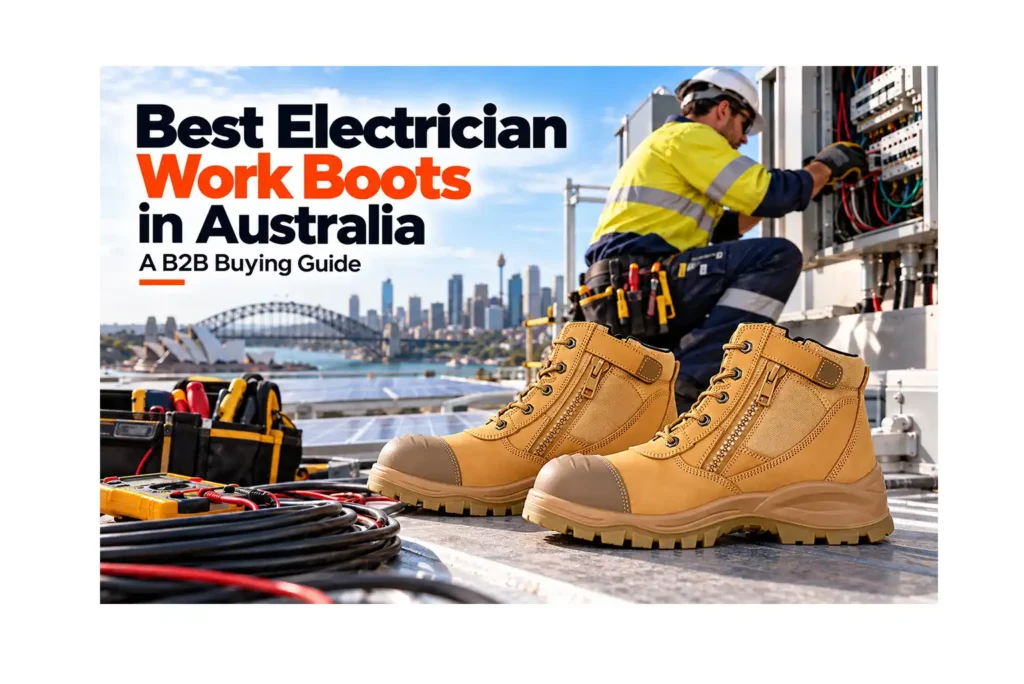
Choosing the best electrician work boots in Australia involves more than selecting comfortable safety footwear. Electricians work across residential construction sites, commercial buildings, solar installations, industrial facilities, and infrastructure projects, where footwear requirements can vary considerably.
For Australian electrical contractors, PPE distributors, and industrial footwear importers, the challenge is identifying suitable work boots while balancing protection, mobility, comfort, price, and reliable supply.
Should electricians choose lace-up boots or side-zip designs? Are lightweight safety shoes practical for electrical installations? What should businesses look for when purchasing electrician work boots in bulk?
This guide compares common footwear options, explains job-specific buying considerations, and provides a practical framework for evaluating wholesale suppliers and manufacturers.
1. Best Electrician Work Boots in Australia: Quick Buying Comparison
The best electrician work boots depend on the intended work environment, required protective properties, and individual fit.
Rather than recommending one boot for every electrician, buyers should compare footwear designs against specific applications.
| Work Boot Type | Potential Applications | Main Advantages | Key Considerations |
|---|---|---|---|
| Lace-up safety boots | Construction and industrial electrical work | Adjustable fit and secure fastening | Weight, flexibility, protection requirements |
| Side-zip safety boots | Commercial and general construction work | Convenient removal and adjustable lacing | Zip durability and fit |
| Lightweight safety shoes | Some indoor electrical installation tasks | Reduced bulk and ease of movement | Site approval and protective classification |
| Waterproof safety boots | Outdoor electrical and infrastructure work | Protection against water ingress when appropriately designed | Heat, breathability, and documented performance |
| Specialist electrically insulating footwear | Defined electrical hazards | Tested electrical protective performance | Specific ratings, limitations, maintenance, and safety procedures |
Important: Ordinary safety footwear, including composite-toe or metal-free designs, must not be assumed to provide electrical insulation.
Where electrical protection is required, the footwear must be assessed against the actual electrical hazards and relevant performance requirements.
For most business buyers, the starting point is a workplace-approved specification followed by a comparison of suitable models.
2. Which Work Boots Suit Different Australian Electrical Trades?
Electrical contractors may employ workers who perform very different activities during the same working day.
A practical buying strategy is to match footwear characteristics to the tasks and surfaces employees regularly encounter.
Residential Electricians
Residential electricians frequently work on unfinished floors, stairs, ladders, and confined installation areas.
They may need to walk between buildings, crouch under fixtures, or kneel while installing wiring.
Useful footwear characteristics include:
- Secure fastening
- Comfortable forefoot movement
- Suitable traction
- Appropriate protective toe construction
- Fit that remains comfortable during repeated changes of posture
A mid-cut lace-up boot may be a practical starting point where it satisfies the workplace’s protection requirements.
Commercial Construction Electricians
Commercial electricians often move between concrete floors, steel structures, temporary access equipment, and finished interior areas.
They may prefer boots that combine secure fit with convenient removal.
Side-zip safety boots can be considered, provided the complete footwear design satisfies the intended workplace requirements.
Industrial Maintenance Electricians
Industrial environments may include machinery, workshop floors, oils, moisture, and other hazards.
Footwear should be selected using the site’s actual risk assessment.
Where specialist electrical protection is required, buyers must verify that the exact model is appropriate for the defined electrical task.
Solar Installation Electricians
Solar installers may encounter sloped roofs, metal roofing, outdoor heat, and changing surface conditions.
Suitable traction and fit are essential considerations, but footwear alone cannot control fall risks.
Electrical contractors must also apply appropriate access and fall-prevention procedures.
3. What Should Electricians Look for in a Work Boot?
When comparing shortlisted electrician work boots, buyers should evaluate the characteristics that affect daily usability.
Fit and Foot Retention
Boots should hold the heel securely without excessive pressure on the toes or instep.
Workers who frequently climb, crouch, or change direction may notice poor fit more quickly than workers performing mostly stationary tasks.
Forefoot Flexibility
Electrical installation work often involves kneeling and crouching.
Excessive stiffness can reduce comfort, although flexibility must not compromise the footwear’s required protection or stability.
Outsole Traction
Electricians may work on concrete, metal surfaces, workshop floors, or outdoor construction sites.
Buyers should review relevant slip-performance information and consider the actual conditions in which the footwear will be used.
No outsole provides reliable traction on every surface.
Weight and Heat Management
Footwear weight and ventilation can affect comfort during long working days.
For indoor work, a lighter design may be attractive where protection requirements permit it.
For outdoor work, buyers may prioritise more durable upper construction or verified water resistance.
Verified Protective Properties
In Australia, safety footwear is commonly assessed against relevant AS/NZS 2210 requirements.
Electrical protection must be considered separately. Antistatic footwear, ESD footwear, electrical-hazard footwear, and specialist insulating footwear serve different purposes.
Buyers should request documentation for the exact model and should not infer electrical protection from a composite toe cap or non-metallic construction.
For further information, see our guide to Australian safety footwear standards.
4. Lace-Up vs Side-Zip vs Lightweight Electrician Work Boots
Different footwear designs offer practical advantages, but none is automatically the best choice for all electrical trades.
Lace-Up Electrician Work Boots
Lace-up boots offer adjustable fastening and are commonly considered for construction and industrial work.
They may suit workers who value a secure fit across the instep and ankle area.
However, buyers should compare boot weight, outsole flexibility, and the required protective properties.
Side-Zip Electrician Work Boots
Side-zip boots may be convenient for electricians who frequently enter clean indoor areas or need to remove footwear during normal work routines.
The zip should not replace appropriate lacing and fit adjustment.
Buyers should also assess fastening durability and whether the design remains comfortable during kneeling.
Lightweight Electrician Safety Shoes
Lightweight safety shoes may appeal to employees who spend much of their day walking through indoor commercial installations.
However, lower-cut footwear is not suitable for every construction site.
The decision must reflect the approved protective specification and the hazards present.
Which Design Should Businesses Choose?
| Buying Priority | Design Worth Evaluating |
|---|---|
| Adjustable fastening | Lace-up boots |
| Convenient removal | Side-zip boots |
| Reduced footwear bulk | Lightweight safety shoes |
| Frequent wet outdoor work | Appropriately rated water-resistant or waterproof boots |
| Defined electrical insulation requirement | Verified specialist electrically insulating footwear |
The final choice should be based on tested product performance, workplace approval, and worker fit—not footwear style alone.
5. Evaluating Work Boots for Ladders, Rooftops and Indoor Installations
Electricians perform movements that differ from those of many other industrial workers.
A practical product comparison should reflect these activities.
Ladder-Related Tasks
When workers use ladders, assess whether shortlisted footwear provides suitable fit and traction for the permitted work.
Useful evaluation questions include:
- Does the heel remain secure?
- Is the boot comfortable during repeated climbing?
- Does the outsole provide appropriate contact with the ladder surface?
- Does the footwear interfere with safe use of the ladder?
Boots must be used alongside proper ladder selection, positioning, and safe working procedures.
Rooftop Installations
For solar and rooftop electrical projects, evaluate footwear on representative surfaces where this can be done safely.
Dry concrete, smooth metal roofing, and wet surfaces can have very different traction characteristics.
A specialist footwear selection must form part of the broader rooftop safety system.
Indoor Electrical Fit-Outs
Commercial electricians may spend significant time kneeling, walking on hard floors, and entering restricted areas.
During product trials, buyers can record fit, comfort, and movement restrictions during representative tasks.
The objective is to compare approved footwear options, not to replace formal safety assessment.
6. Comparing Electrician Work Boot Options for Business Buyers
Australian contractors and PPE distributors can use a structured comparison rather than relying on brand reputation or initial impressions.
The following scorecard illustrates how two technically approved footwear models could be compared.
Illustrative example only
| Commercial Evaluation | Weight | Boot A: Lace-Up | Boot B: Side-Zip |
|---|---|---|---|
| Worker fit and acceptance | 30% | 4/5 | 5/5 |
| Comfort during job tasks | 25% | 4/5 | 4/5 |
| Size availability | 20% | 5/5 | 3/5 |
| Replacement availability | 15% | 4/5 | 4/5 |
| Delivered procurement cost | 10% | 4/5 | 3/5 |
| Weighted score | 100% | 84/100 | 79/100 |
The ratings are hypothetical and do not describe actual commercial products.
Importantly, all mandatory protective requirements must be satisfied before commercial scoring begins.
A lower-cost model cannot compensate for inadequate protection.
This method can help procurement teams identify the most suitable approved option for a specific electrical workforce.
7. How Australian Electrical Contractors Can Plan Bulk Orders
Electrical contractors managing multiple construction projects may need to purchase work boots for dozens or hundreds of employees.
Without coordinated purchasing, the company may experience size shortages, unnecessary stock, and expensive urgent orders.
Example: A Multi-Project Electrical Contractor
Consider a hypothetical Australian contractor preparing footwear allocations for three upcoming projects.
| Project | Electricians | Planned Allocation |
|---|---|---|
| Sydney commercial development | 65 | 65 pairs |
| Melbourne industrial project | 45 | 45 pairs |
| Brisbane residential projects | 40 | 40 pairs |
| Total | 150 | 150 pairs |
The company could consolidate its procurement requirements while arranging deliveries according to project start dates.
Actual purchasing quantities should account for employees who already have suitable approved footwear.
Three Practical Purchasing Priorities
First, confirm the footwear specification. Do not consolidate orders for workers who require different forms of protection.
Second, collect actual sizing information. Size distribution should reflect the workforce rather than an assumed national average.
Third, confirm replenishment arrangements. An approved model that cannot be supplied consistently may create operational difficulties.
For larger contractors, a shared footwear issuance record can help purchasing teams track sizes, replacements, and stock transfers between projects.
8. Wholesale Electrician Safety Boots: Pricing, MOQ and Lead Times
Businesses comparing wholesale electrician safety boots should consider more than the manufacturer’s quoted unit price.
What Affects Wholesale Pricing?
Common pricing factors include:
- Upper materials
- Outsole construction
- Protective components
- Product design complexity
- Testing and documentation requirements
- Order quantity
- Branding and packaging
- Freight and delivery arrangements
Products requiring specialist electrical performance verification may involve additional development and testing considerations.
Minimum Order Quantity
Minimum order quantity (MOQ) varies by manufacturer and product.
Standard models, customised existing designs, and fully developed private-label products may have different commercial requirements.
Before requesting a quotation, buyers should prepare an approximate size distribution and annual purchasing forecast.
Production and Delivery Lead Times
Lead times depend on material availability, manufacturing capacity, customisation, testing needs, and transport.
Australian importers should also consider customs processing, domestic distribution, and stock required between shipments.
Comparing Total Delivered Cost
Consider two hypothetical approved boot options:
| Cost Component | Option A | Option B |
|---|---|---|
| Unit footwear cost | A$85 | A$95 |
| Freight and handling per pair | A$15 | A$10 |
| Estimated delivered cost | A$100 | A$105 |
| Cost for 500 pairs | A$50,000 | A$52,500 |
These are illustrative calculations, not supplier quotations or current Australian market prices.
The A$2,500 difference should be considered alongside fit acceptance, delivery reliability, and the cost of maintaining replacement stock.
9. OEM Electrician Work Boots for Australian PPE Distributors
Australian PPE distributors may want to develop a dedicated range of electrician work boots for construction and industrial customers.
OEM development can support a consistent product range, private-label branding, and repeat wholesale orders.
Start With a Defined Customer Group
Rather than developing one model for every electrician, distributors can segment their intended customers:
| Target Customer | Product Development Focus |
|---|---|
| Residential electrical contractors | Secure fit and practical mobility |
| Commercial installation companies | Comfort and convenient fastening |
| Industrial maintenance contractors | Defined workplace protection requirements |
| Solar installation businesses | Outdoor usability and suitable traction |
These are commercial development priorities, not substitutes for workplace safety specifications.
Prepare a Product Development Brief
Provide the manufacturer with:
- Target Australian customer segment
- Intended working environment
- Required protective performance
- Preferred footwear design
- Size range and fitting requirements
- Estimated wholesale volume
- Branding and packaging needs
- Sample approval process
- Expected repeat-order schedule
For footwear marketed with specialist electrical protective properties, supporting evidence must relate to the completed product and the specific claims.
Choose a Manufacturer That Can Support Repeat Orders
An electrical safety boots manufacturer should be assessed on product consistency, documentation, manufacturing capability, and communication.
Distributors should also establish procedures for approving material changes, confirming samples, and managing repeat production.
10. Electrician Work Boots Procurement Checklist
Before approving a supplier or placing a bulk order, Australian electrical contractors and PPE buyers can use the following checklist.
| Procurement Question | Check |
|---|---|
| Has the footwear been approved for its intended tasks? | ☐ |
| Are all mandatory protective properties verified? | ☐ |
| Has the exact model been identified? | ☐ |
| Does the footwear fit representative workers? | ☐ |
| Is the required size range available? | ☐ |
| Are product samples consistent with specifications? | ☐ |
| Have bulk prices and additional costs been reviewed? | ☐ |
| Are MOQ requirements acceptable? | ☐ |
| Are production and delivery lead times confirmed? | ☐ |
| Is a size exchange or replacement process available? | ☐ |
| Are repeat-order specifications controlled? | ☐ |
| Is relevant documentation available to the buyer? | ☐ |
Technical suitability should always be confirmed before price and commercial convenience are evaluated.
For electrical safety matters, buyers should follow applicable Australian requirements and workplace procedures. Safe Work Australia provides guidance on managing electrical risks and selecting appropriate protective equipment.
Frequently Asked Questions About Electrician Work Boots in Australia
What Are the Best Work Boots for Electricians in Australia?
The best electrician work boots are those that meet the protective requirements of the intended electrical work and provide appropriate fit, comfort, and traction. Lace-up, side-zip, and lightweight designs may all be considered where permitted by the workplace risk assessment.
Are Composite Toe Work Boots Suitable for Electricians?
Composite-toe footwear can provide appropriate impact protection when the finished product meets the relevant requirements. However, composite toe construction does not establish electrical insulation or protection against electric shock.
Are Side-Zip Work Boots Good for Electricians?
Side-zip boots can be convenient for electricians who frequently remove their footwear. Buyers should assess fastening security, comfort, durability, and whether the exact model meets all required protective specifications.
What Is the Difference Between Electrical Safety Boots and Ordinary Safety Boots?
Ordinary safety boots may protect against workplace hazards such as impact or compression. Footwear intended to provide protection against particular electrical hazards requires specific performance verification. Marketing terminology alone is insufficient to establish suitability.
Where Can Businesses Buy Electrician Work Boots in Bulk?
Australian electrical contractors and PPE distributors can source approved footwear from local suppliers or overseas manufacturers. The best purchasing arrangement depends on product specifications, order volume, size availability, lead time, and replacement requirements.
Can Australian Distributors Order OEM Electrician Work Boots?
Yes. OEM manufacturers can support private-label product development, custom branding, and wholesale production. Buyers should verify the final product’s suitability and documentation before making protective performance claims.
How Much Do Wholesale Electrician Work Boots Cost?
Wholesale pricing depends on construction, materials, protective requirements, customisation, order volume, and shipping arrangements. Buyers should request itemised quotations and compare total delivered costs rather than unit prices alone.
Do Electricians Need Electrically Insulating Footwear?
Not every electrical task requires the same footwear. Where specialist electrical protective footwear is necessary, the selection must follow the relevant electrical risk assessment, applicable requirements, and safe work procedures.
Conclusion
Choosing the best electrician work boots in Australia requires an informed comparison of protective suitability, footwear design, worker comfort, and long-term purchasing requirements.
For electrical contractors, the priority is selecting approved footwear that meets the demands of daily work, including construction, maintenance, and installation activities.
For PPE distributors and importers, successful purchasing also depends on consistent manufacturing, practical pricing, size availability, and dependable repeat orders.
By comparing suitable footwear designs and working with reliable suppliers, Australian businesses can make more effective purchasing decisions while maintaining appropriate workplace protection.
Source Wholesale Electrician Work Boots With Ocean Safety Shoes
Ocean Safety Shoes is a professional safety footwear manufacturer serving international PPE distributors, industrial footwear importers, wholesalers, and private-label brands.
We provide OEM/ODM development, custom branding, and bulk manufacturing services for different industrial footwear applications.
For Australian businesses sourcing wholesale electrician safety boots, our team can discuss your intended applications, required footwear specifications, size ranges, customisation needs, and estimated order quantities.
Whether you are developing a private-label safety footwear range or sourcing work boots for electrical contractors, Ocean Safety Shoes can help you explore suitable manufacturing options.
Looking for a reliable safety footwear manufacturing partner?
Contact Ocean Safety Shoes to discuss wholesale supply and OEM electrician work boot development for the Australian market. Any specialist electrical protective requirements must be specified and verified before product approval.